JENKS "TEX" CARMAN Ole Indian LP Rare'62 RED WAX hillbilly steel guitar cow punk
$
25


Favourite Auctions
To save auctions to your favourites, please login
If you don't have an account, please register
Description
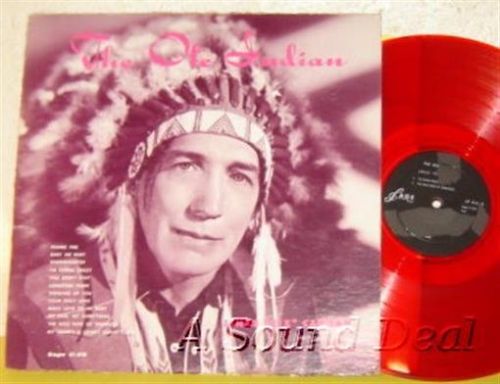
Record: Poor (P) plays near VG+ but has a few skips. Sold As Is in this regard Cover: Good (G) sleeve completely split at spine and bottom. Otherwise no marks or stickers Labels: Clean! Jenks "Tex" Carman The Ole Indian 1962 United States Sage C-26 12" [[M/S/Q]] LP texcarmanlp
Jenks "Tex" Carman
The Ole Indian
1962 Sage LP
Original '62 press with black labels and dark red wax RARE!
Condition
Vinyl: Poor (P) plays near VG+ but has a few skips. Sold As Is in this regard
Sleeve: Good (G) sleeve completely split at spine and bottom. Otherwise no marks or stickers
See Item Specifics section above for additional details
(clickable images enlarge)
Tracks:
by request
JENKS "TEX" CARMAN Ole Indian LP Rare'62 RED WAX hillbilly steel guitar cow punk Jenks Tex Carman was one of the more dubious but interesting talents ever to achieve stardom, however fleeting, in country music. A player of great dexterity but severely lacking in any sense of rhythm, and even more lacking in a voice, Carman succeeded on the basis of the sheer enthusiasm of his performances, achieving some respectable record sales and a national following based on his television appearances. Jenkins Carman was the seventh of eight children born to Alford Carman and his wife. They were a farm family with a great love of music -- throughout his career, Carman also claimed part Cherokee ancestry, and tried to emphasize this by wearing Native American regalia in some of his public appearances and later album cover art. By age 12 he was on his way to becoming an accomplished guitarist, and he left home in his teens to pursue a career in music. He started out in vaudeville and playing Chautauqua shows, and by the end of the 1920s had emerged as a solo-guitar novelty act. He cut a pair of songs in late 1929 for the Gennett label in Indiana, but neither was ever issued. In the early '30s, he hooked up with Hawaiian guitar virtuoso Frank Plada, who taught Carman the basics of Hawaiian guitar technique. This instrument became the core of Carman's music from the early '30s onward, and it was using the unamplified acoustic Hawaiian guitar, hung from his neck and fretted with a steel bar, that he began making a name for himself in country music. By the late '40s, he had signed to the Four Star label and begun recording under the name Jenks Tex Carman, "the Dixie Cowboy," as well as appearing on local radio. Soon after, he started to perform regularly on television on the country music showcase Town Hall Party, hosted by Tex Ritter and Johnny Bond, and later still became a regular on Cliffie Stone's Hometown Jamboree. His contract with Four Star ended, and Stone brought Carman to Capitol Records and producer Ken Nelson in 1951. Carman's Capitol recording career lasted from April of 1951 until December of 1953, and despite some very uncomfortable moments in the studio, he generated some choice sides -- "Hillbilly Hula" was his most famous and requested song, a number he featured on his television appearances, but other highlights included "The Caissons Go Rolling Along" and "Locust Hill Rag." The backing personnel on these cuts is not known, although essayist Cary Ginell believes that Joe Maphis was probably one of the participants on electric guitar or banjo. Carman never acquired much more than a cult following through his records, but on stage or television he was a major attraction. The sheer wildness of his appearances and the unbridled enthusiasm of his work made him a continuous showstopper, despite his inability to hold a beat or hit a cue. The sales of Carman's singles were too low to justify the renewal of his Capitol contract, and after a lapse of several years, he signed to the small Sage & Sand label, even as he continued to work on television as a regular on locally produced variety series. His later albums tended to emphasize his unverified claims to Cherokee ancestry, which were reinforced by his unusual physiognomy -- as one onlooker recalled, Carman dressed like a cowboy and looked like an Indian; occasionally, he even donned a feathered headdress. Carman's last album was called The Ole Indian, released by Sage & Sand in 1962. By the mid- to late '60s, he had retired after a 40-year career in music. Jenks Tex Carman was not in a league with the best steel or Hawaiian guitarists, and his vocal skills were even more limited. He was a master showman, however, and accomplished with sheer enthusiasm and reckless abandon what he couldn't do with technical skills or musical instincts. He was known as the "Dixie Cowboy" and was a native of Hardinsburg, Kentucky. He showed his musical talents at a very early age while in school and at church and became quite a bit of an expert at 'strumming the old family guitar'. His very first professional musical engagement was with the Continental Lyceum Chautauqua Bureau of Louisville, KY as the leader of the International Glee Club Quartette. He stayed with them for a couple of years before doing a vaudeville tour with the likes of the Loew's Time, Bently Theatrical Agency Time of St. Louis, MO. and other circuits. Jenks did his vaudeville act as a single for several years, while later teaming with his sister when they billed themselves as the "Royal Castillians". When his sister got married, the act broke up. And Jenks went back to doing the vaudeville tours by himself. Then he began to do radio work on stations such as KMOX out of St. Louis, WHAS out of Louisville. Later, he was signed to record with the Four Star Records, Inc. label. On Four Star, some of his more notable recordings were: End of the World Sunny Tennessee I Don't Know Why But I Do Wreck of the Old 97 New Waikiki Beach Hillbilly Hula What was the key to his success? He was a showman. And he had a unique style of playing the steel guitar that "...placed him in a class by himself." Jenks learned his steel guitar from Frank Plada, one of the first of the Hawaiian musicians that came to this country. The showman he is, he learned the traditional Hawaiian stylings, but let his showmanship creativity turn it into something unique that entertained the audiences everywhere he went. Those talents led to a later recording contract with Capitol Records where it saw him record such tunes as: End of the World Don't Feel Sorry For Me Poor Lonesome Fellow My Loney Heart and I Samoa Stomp Hillbily Hula Indian Polka I Could Love You, Darlin' Dixie Cannon Ball The Caisons Go Rolling Along Locust Hill Rag Jenks in the mid-1950s was performing on the west coast show "Town Hall Party", that was one of the top TV shows out of Compton, California on KTTV. Country Early Country,Honky-Tonk 1st Edition,Colored Vinyl 33 RPM Jenks "Tex" Carman The Ole Indian 1962 United States Sage C-26 12" LP Cover: Good (G) sleeve completely split at spine and bottom. Otherwise no marks or stickers Record: Poor (P) plays near VG+ but has a few skips. Sold As Is in this regard Labels: Clean! texcarmanlp
This exquisite slice of retro music history is a vinyl sound recording (not a CD). Please reference Item Specifics above for additional detail. Strict Goldmine grading -- Over 16 years on Ebay! Combine Items to Save $$$!
©A Sound Deal
price rating