JERRY LEE LEWIS - Original 1958 PROMO DEMO ACETATE
$
292


Favourite Auctions
To save auctions to your favourites, please login
If you don't have an account, please register
Description
NB : We are still figuring out where this acetate really comes from. We have had info that the last three songs are from the 3rd Memphis show of Jerry, taped late February 1961. The first song (milkshake mademoiselle) is the only studio track on this record. So the 1958 on the label is strange. This can be one of the first issues of www.collectorrecords.nl , somewhere in the late sixties. Have a look at http://www.topfreeforum.com/jerryleelewis/index.php?mforum=jerryleelewis to follow the discussion.
- The record is a so called lacquer. It has a metal base with vinyl on both sides. It is direct cut by the cutting machine. The first step in record production. The record is great, like new condition. We've played it once and enjoyed the genuine rock 'n roll sound. Heavy record.
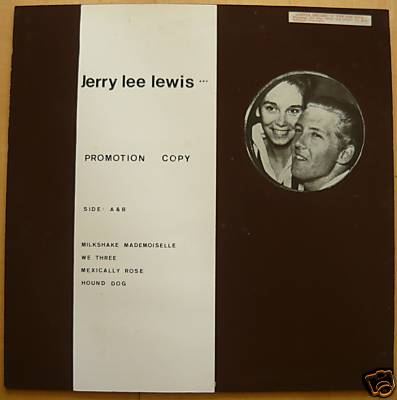
- The cover is a brown fold-out cover with text and picture on the front side. Back side is neutral brown.
- The record plays on 45rpm (altough it is 12 inch) and contains the same four songs on both sides : 1. Milkshake Mademoiselle 2. We Three 3. Mexically Rose 4. Hound Dog. First song is the only studio take. These are full songs in a reasonable sound quality.
- Please have a close look at the pictures. Record has been manufactured in the Netherlands and we are very confident this is original stuff. If you see and feel the record, you would agree.
- We think this had record has been made once for test and promo activities.
So, a treasure for Rock 'n Roll heaven !
-
THIS IMPOSSIBLE TO FIND RECORD is a treasure for every record collector especially in this superb condition. A collectors keepers copy ! 9.9 out 10 !
Have a look at www.recordfriend.com for more info about us. We sell only superb collector records via E-bay
- Shipping all over the world via registered airmail is $ 15.00. We take care of very good packing and shipment.
- We do guarantee all our records. If not conform description, you can return the record within 7 days for full money back.
WHAT IS AN "ACETATE"??
Special thanks to Michael Papas for helping me with this page.
An acetate disc is cut prior to the cutting of the master disc which is used for mass production of records. Even though referred to as an "acetate", it is essentially an aluminium disc coated with a fine film of nitro-celluolose lacquer with no acetate in it at all! I can tell you right off the bat that they're nothing special to look at. They do not come in a frame. There is NO picture sleeve, and no special artwork on the record labels. Most acetates are 10" round, but the actual music record grooves are usually 7" in diameter. A 7" single is usually cut on a 10" disc, a 12" single or LP is cut onto a 12" disc. They're almost always single-sided (the other side is totally blank and shiny, with no grooves and no label).
This is used as a reference disc allowing the producer, engineer, artist and other interested parties to see how well the recording transfers to disc. Trying to tranfser some recordings to disc is like trying to fit a square peg into a round hole, and so the cutting engineer must make some adjustments to the sound so that song on the tape fits within the confines of a record groove. This may include adjusting the overall level (volume), adjusting bass/treble, compressing the overall signal, etc so that the record sounds as good as possible when played on a variety of hi-fi systems. For example, if a song is excessively long, the cutting engineer will have to reduce the overall level of the disc. When such changes are necessary, the reference disc (or "acetate") allows the producer to check and approve these changes before the master disc is cut and sent off to the pressing plant where thousands of copies are pressed.
Once everyone is happy with the reference cut, the engineer will cut the MASTER LACQUER disc with the same changes and send it off to the pressing plant for mass production.
The lacquer coating on the disc is very soft and so the sound quality will deteriorate the more you play it. At first, the high frequencies will diminish and an increase of surface noise will be evident. If you thought records scratch and wear out easily, a lacquer disc is worse!
Reference cuts will usually appear as 10" discs with a 7"single cut onto them, or a 12" disc with either a 7" or a 12" cut. Reference discs will often have a second hole near the centre hole. This is to identify them as reference cuts and not master lacquers for production use.
So if you have an "acetate", you have a disc that was theoretically cut for the producer, engineer and artist to listen to. On the other hand, anyone with a disc cutting lathe can cut such a disc and pass it off as a real one".
To make sure that the disc-masterer will make a disc-transfer acceptable to you and you engineer and/or producer, you should request that reference lacquers, or "acetates", be cut before your master lacquers are cut, which would be used for pressing your records. Listen to your reference lacquers with your recording engineer or producer, who can best judge how they compare with your master tape. The lacquers should not be overplayed as they are very fragile and are only good for five or six listenings before noticeable sound deterioration. You will need to save a few plays for the pressing stage, in order to verify the quality of your test pressings. Lacquers should be checked for the following problems before you go to the trouble of making the final cut:
1. Low overall volume compared to other records 2. variations in volume levels within the songs or from cut to cut 3. variations of tempo within each song 4. breaking up or distortion in the treble or high registers at peak loudness levels or towards the end of a side 5. excessive boominess or airiness in the bass or low registers 6. dullness or lack of presence in the mid-range 7. skips, buzzes, crackling noises, or dull thuds at the beginnings of notes.Your engineer and/or producer will probably listen to the reference lacquers on both large and small speakers (like those used in car stereos) to be sure that there is adequate treble and bass response.
Once you've approved the reference lacquers (you don't send them back), the disc-masterer will then cut the master lacquers using settings identical to those used when cutting the reference lacquers. If the engineer has only minor changes to request, he or she probably won't ask for additional reference lacquers."
On many acetates, such as the one in this photo, You'll usually notice yellow (or red) "cue marks" on the record, which basically just look like a crayon line (or arrow) hand-drawn on the acetate, to indicate the beginning and end of the music. There are sometimes two holes in the center of the record (one is perfectly centered, and the other is off-center); the second hole is to let you know that these discs are not designed for use as master lacquers for record manufacturing.
When you physically handle an acetate, you'll notice that it's extremely stiff. Depending on whether the acetate is a "metal" plate or made from some other material, you'll notice that it is not nearly as "flexible" as a standard record. Acetates are not made from a variety of material. They are only made of: aluminum disc with a thin coating of nitro-cellulose lacquer. Most times, you'll even notice that the acetate smells kinda funny, almost like that "moldey, library kinda smell" - this is because they've usually been sitting around for years in storage, or in the record company's archives. The origial mustard-colored paper sleeves are usually what gives the acetates their funny smell.
I guess the best way to explain it would be like this: having an acetate for a song is almost like having the "negatives" for a photo. You can actually play an acetate if you really want to, but they weren't designed to be played on a standard record player, so sometimes they may not sound that great. The reason you cut an acetate refence disc is so that you CAN play it on a standard record player! That's why they were used for reference purposes. If it doesn't sound great it's because it has been played to death and the soft lacquer wears very fast. They sound GREAT when you are the first person to play it. Acetates are extremely rare, and in some cases, are one-of-a-kind.
price rating















![Rush Moving Pictures (40th Anniversary)[Super Deluxe Edition 3CD/5LP/Blu-Ray]](https://www.popsike.mobi/php/thumbnail.php?url=https://www.popsike.pics/pix/20241118/126782751326.jpg)