JO KONDO sen no ongaku LP 1974 alm avant kosugi fluxus
$
66


Favourite Auctions
To save auctions to your favourites, please login
If you don't have an account, please register
Description
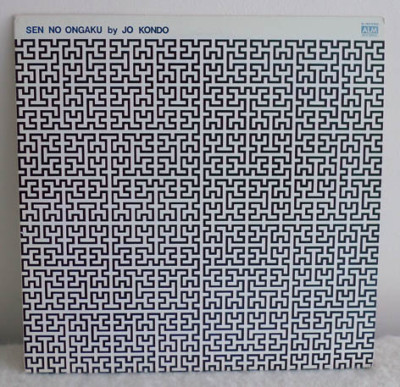
Jo Kondo "Sen No Ongaku" LP issued by ALM Records (AL-10) in Japan, 1974. ****** Rec.ex / Cov:ex ****** Rare debut album from japanese composer Jo Kondo including "Click Crack" (8:04); "Orient Orientation" (8:58); "Standing" (7:56); "Pass" (10:28); "Falling" (13:47). A beautiful example of his "linear music". Released on the highly collectable ALM Records label (East Bionic Symphonia, Takehisa Kosugi, Somei Satoh, Norio Sato, Yuji Takahashi, John Cage, Akio Suzuki, Sano Kiyohiko… see other ALM items currently on auction). Since the early 1970s, Jo Kondo's compositions have stood on a concept he has named "Sen no Ongaku" (i.e. "Linear Music"), music consisting of a "line" of single notes, hocketted over different instruments. Over the years, the "line" of notes has gradually evolved a much thicker texture, as if the "line" had been "harmonized". However, unlike conventional harmony, Kondo's "harmonizations" do not provide architectonic musical underpinnings; the sole role of these "harmonizations" (which provide a chord for each note of the "line") is to imbue every attack with a specific "color" or "quality". Given that there are only three possible chordal arrangements: (a) the chord "hangs down" from a "melody" note when that note is at the top of the chord; (b) the chord "stands" on the "melody" note when that note is the lowest note; (c) the chord wraps around the note; and further given that these three possible chord formations are freely ordered, the originally "thin" single line becomes embedded and integral within a chordal succession, which by definition is a "thick" single line. In the listening tradition of Western music, in a succession of chords (that are not exceedingly dense, complex, and/or cluster-like), one becomes accustomed to finding "part writing" (SATB as an example), even if that "part writing" was not of original intent. Kondo's music has no such part writing in mind; but one can nevertheless imagine, or pretend to discover, a transient, fragile, and nonstructural, "pseudo-polyphony". This psychological, accidental byproduct allows the composer ample room to create musical situations whose meaning and implications are far more deliberately ambiguous than those we are normally accustomed to; but this deliberate ambiguity mandates that the composite rhythm (i.e. the rhythm of all the parts taken together) assume a crucial personage, for unlike Western music, the overall "flow" of the performance is now the sole purview of the composite rhythm, as the composite has become the defacto "line". Jo Kondo is a Japanese composer of contemporary classical music. He won the third prize and made his debut in Japan-Germany Contemporary Music Festival in 1969. He graduated from the composition department of Tokyo University of the Arts in 1972. He serves as Professor of Music at Ochanomizu University in Tokyo and also teaches at Tokyo University of Arts and Elisabeth University of Music in Hiroshima. Kondo's works are often structured mathematically, using minimal principles of composition. His interests include hocket, the music of Ancient Greece, and strong differences in instrumental timbre, all of which are reflected in his compositions. A similar stylistic point of reference would be the Italian composer Franco Donatoni. The chamber version of his 1975 composition Sight Rhythmics reflects the latter in its unusual instrumentation of violin, banjo, steel drum, electric piano, and tuba. In 1980 Kondo founded the Musica Practica Ensemble, a chamber orchestra devoted to contemporary music, and was artistic director of the group until its disbandment in 1991. He has written more than 130 compositions, ranging from solo pieces to orchestral and electronic works, which have been widely performed in Japan, North America and Europe. Kondo's music has been performed by the London Sinfonietta, the Philharmonia Orchestra, the NHK Symphony Orchestra, the Arditti Quartet, NEXUS, the Balanescu Quartet, Tadaaki Otaka, Oliver Knussen, Paul Zukofsky, the Ives and Nieuw Ensembles in the Netherlands and Aki Takahashi. Kondo's works have been recorded on the Hat Art, ALM, Fontec, and Deutsche Grammophon labels. His scores are published by the University of York Music Press and Edition Peters. His notable students include Linda Catlin Smith and Paul Newland. Kondo was associated with John Cage in the 1970s. ****** Original inset also included. ****** Please wait to receive my invoice before sending the payment after the auction ends. Attention! Real postage costs are not USD 4 as all the items are located in Doha, Qatar (which has a very safe and professional post system). Postage costs registered up to 1 Kilo (generally 3 LPs): to Europe and Japan is USD 16,50 / to America and Oceania is USD 22,50. Postage costs registered up to 2 Kilos: to Europe and Japan is USD 28,00 / to America and Oceania is USD 34,00. Thank you for your kind attention and good luck with your bids.
price rating