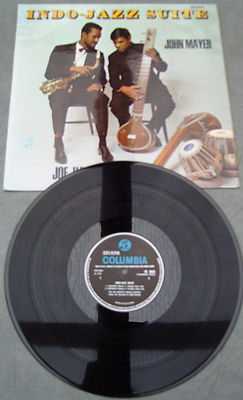
JOE HARRIOTT DOUBLE QUINTET-INDO-JAZZ SUITE-V.RARE ORIG.UK 1st PRESS MONO LP '66
£
18
$
23


Favourite Auctions
To save auctions to your favourites, please login
If you don't have an account, please register
Description
JOE HARRIOTT DOUBLE QUINTET - INDO-JAZZ SUITE - VERY RARE ORIGINAL UK 1st PRESS MONO COLUMBIA LP - 1966
Very Rare Original 1st Press Album by The Joe Harriott Double Quintet
Under the direction of John Mayer
“Indo-Jazz Suite”
John Mayer, Joe Harriott
MONO
Released on the Black/Silver/Blue Columbia Record Label
E.M.I. Records
Lansdowne Series
MADE IN GT. BRITAIN
(P) 1966
SX 6025
(‘Lansdowne’ Series)
Matrix:
XAX 2963 – 1U
XAX 2962 – 1U
“It was Rudyard Kipling, that Laureate of Empire, who declared the East was East and West was West and never the Twain would meet! Ever since, both life and art have been proving him wrong. The latest demonstration is the cultural miscegenation of Indo-Jazz Suite, wherein five jazz players join with four Indian musicians – with a concert flautist “standing amidships” and linking both sides. It is experimental music, but it is also an indication of the way things are going, for jazz aficionados have been bending an ear to Indian music for some time now, while, at the further-out end of concert music, composer Pierre Boulez recently admitted that Oriental music had been as much an inspiration to him as the work of the European masters.
There were problems to be faced in bringing the two kinds of music – jazz and Indian – into such close proximity. John Mayer, an Indian composer who came to Britain from Calcutta in 1952, had previously written several concert works which link Indian scalar forms and rhythm with Western modes, and these have been performed by various European orchestras and soloists. But this was his first attempt at fusion with jazz musicians. Joe Harriott, already famous as one of the most adventurous jazz musicians in Europe, responded nobly to the challenge. Indeed, it is likely that his work here is some of the finest he has ever put on record.
Three of the pieces in this suite – Contrasts, Megha and Gaud-Saranga – are based upon Indian ragas. “The rage”, explains John Mayer, “is an Indian scale, which utilises varying ascending and descending patterns – certain notes on the way up and certain notes on the way down – but always in the set sequence. A raga never has fewer than five notes, which is the minimum required for a tune.
Harmony, in the sense that it is used in European music, does not exist in Indian music. But the raga always returns to the tonic, the starting note. The rhythm is provided by the table player (or drummer), while the tambura – with either three or four strings, two of them tuned to the tonic – supplies a drone which is a basis for the soloist, in this case the sitar player, to relate to”.
The jazz improvisers faced unusual problems in these compositions. “I gave them the notes of the particular raga in each case”, says Mayer. “Pat Smythe stuck rigidly to them in all his piano solos, which is why his improvisations sound so uncompromisingly Indian. But Joe Harriott often moved outside the framework, playing his own free-form jazz. As for the flute, this is used as a kind of intermediary, sometimes playing the notes of the raga – as a reminder to our jazz associates – sometimes playing jazz parts. The flute part, however, was completely written-out. And I play harpsichord a couple of times, to keep the raga line going when the sitar is doing something else. The sound, after all, is very similar”.
Overture – the whole of which, incidentally, was scored, including the passages for jazz players – is not based upon a raga. It utilises a metre of five beats, which extend to ten. For example, the sitar plays a melody in Jhap Tala, a rhythm of ten beats divided here into 2,3,3,2. The table plays this sub-divided rhythm, but the jazz bass and drums hold to a rhythm of five beats -3,2.
Contrasts opens with scored passages for flute and for alto saxophone and trumpet. The harpsichord is heard during the bridge passage, leading into improvisation on the six-note raga, Raga Kirwani. The rhythm here is Teen-Tala – sixteen beats, divided evenly into 4,4,4,4 – but later, behind the jazz solos, the table plays Ada Tala, a rhythm of four beats
The third piece, using the very popular Megha Raga, begins with a melodic form – the Alap. It consists of four sections: Sthayee, the basic notes of the raga played on flute; Arohana, a short melodic development, on flugelhorn; Sanchari, a mixture of the two, on alto sax, followed here by the reappearance of Sthayee on flute, and, finally, Abhog, or coda, on harpsichord and piano. The improvisation starts at this point. The sitar plays the raga notes in 6/4 time, spreading them over three bars, and this theme – either on sitar or harpsichord – forms a groundwork for the remainder of the piece. The rhythm here is the most adventurous in the suits, being of eighteen beats divided into three groups of six.
The final piece is based on the raga Gaud-Saranga, the notes of which are introduced by the flute. These are taken up by the sitar player, who first improvises freely, then uses the Jhala technique, repeating the tonic note after every melodic note. Almost immediately afterwards John Mayer, on violin, also uses the Jhala technique. Flute and trumpet play a bridge passage which moves into the rhythm of Jhap-Tala – ten beats – but divided in half, unlike the rhythm, of the Overture. Sitar, trumpet, alto saxophone and piano are heard in improvised solos before the work ends with a repetition of the bridge passage.
Indo-Jazz Suite, in fact, is entering territory that looks like being explored more and more during the years to come. And as well as being a considerable technical achievement it is music both exciting and rewarding for the sensitive listener. Joe Harriott, John Mayer – indeed, all concerned in this production, can feel equal pride. In one fell swoop (to mix slightly shop-siled metaphors) they have brought jazz a step forward, opened up new avenues for the age-old musical forms of India, and most refreshingly, shown Rudyard Kipling where he gets off!”
The Track List is as follows:
SIDE ONE
1. OVERTURE (Mayer)
2. CONTRASTS (Mayer)
SIDE TWO
1. RAGA MEGHA (Mayer)
2. RAGA GAUD-SARANGA (Mayer)
Personnel:
JOE HARRIOTT (Alto Sax)
EDDIE BLAIR (Trumpet and Flugelhorn)
PAT SMYTHE (Piano)
RICK LAIRD (Bass)
ALAN GANLEY (Drums)
JOHN MAYER (Violin, Harpsichord)
DIWAN MOTIHAR (Sitar)
CHANDRAHAS PAIGANKAR (Tambura)
KESHAV SATHE (Tabla)
CHRIS TAYLOR (Flute)
Production:
Supervision: DENIS PRESTON
Sleevenote: CHARLES FOX
Sleeve Design: DENIS PRESTON
Photography: MICHAEL JOSEPH
Engineer: ADRIAN KERRIDGE
The LP is in Very Good Condition with some surface marks and surface scratches, and there is a small ‘dent’ at the end of track 2 on side one, and another at the end of track 2 on side two.
It doesn’t jump and generally plays very well
The Sleeve is in Very Good Condition with only a small amount of scuffing and laminate creasing, and on the back “32/6” is pencilled in the top left hand corner and there is a small label “The Disc Shop” stuck centre top. It has been kept in a plastic folder
EVERY RECORD IS PLAYED AND FULLY CHECKED BEFORE LISTING
I am NOT a Business Seller – All my records come from my personal collection and I do my utmost to grade them to the best of my ability. What I hear and What I see is reflected in my grading of the condition of both the vinyl and the covers.
I Discount P&P when anyone buys more than one item from me
I have quoted 2 levels of postage - one is International Signed For which is insured, and the other is standard airmail which is not insured and therefore at your own risk.
I highly recommend you take the first option should your bid be successful.
The prices quoted are not just for the postage, but include my packaging costs.
All Records are sent in Defenda Music Max Boxes which have been especially designed to protect Vinyl Records when posting.
I also use extra bubble wrap packing,
All parcels are clearly marked - Fragile and Do Not Bend - and are sellotaped
Securely.
price rating


![Brainchild ?– Healing Of The Lunatic Owl [New & Sealed] 12](https://www.popsike.mobi/php/thumbnail.php?url=https://www.popsike.pics/pix/20200910/124332579635.jpg)




![Miles Davis - Someday My Prince Will Come LP Columbia [CS 8456] ORIG (VG+/VG+)](https://www.popsike.mobi/php/thumbnail.php?url=https://www.popsike.pics/pix/20240316/256447726895.jpg)