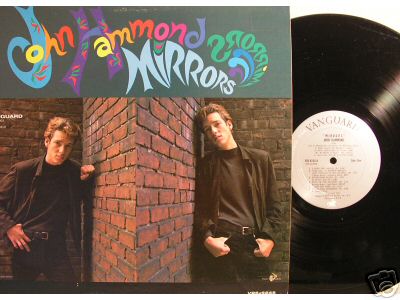
JOHN HAMMOND -Mirrors 1967 LP on Vanguard MONO NM
$
33


Favourite Auctions
To save auctions to your favourites, please login
If you don't have an account, please register
Description
GREAT BLUES ALBUM FROM 1967, SIDE 1 ELECTRIC WITH BLOOMFIELD, ROBERTSON, MUSSELWHITE AND LEVON HELM, SIDE 2 ACOUSTIC SOLO
Joihn Hammond - "Mirrors", mono, on Vanguard VRS 9245. Great album, super condition. Hammond has proven himself to be one of the top white bluesmen of all time. Son of Columbia talent giant John Hammond, Sr., you could say it's in the genes.Record Grade: Near Mint
Cover Grade: VG+, minor wear, cut out hole bottom right corner
Labels: Silver and black
About the Artist: by Richard Skelly
With a career that now spans in excess of three decades, John Hammond is one of handful of White blues musicians who was on the scene at the beginning of the first blues renaissance of the mid-'60s. That revival, brought on by renewed interest in folk music around the U.S., brought about career boosts for many of the great classic blues players, including Mississippi John Hurt, Rev. Gary Davis and Skip James. Some critics have described Hammond as a White Robert Johnson, and Hammond does justice to classic blues by combining powerful guitar and harmonica playing with expressive vocals and a dignified stage presence. Within the first decade of his career as a performer, Hammond began crafting a niche for himself that is completely his own: the solo guitar man, harmonica slung in a rack around his neck, reinterpreting classic blues songs from the 1930s,'40s and '50s. Yet, as several of his mid-'90s recordings for the Pointblank label demonstrate, he's also a capable bandleader who plays wonderful electric guitar. This guitar-playing and ensemble work can be heard on Found True Love and Got Love If You Want It, both for the Pointblank/Virgin label. Born November 13, 1942, in New York City, the son of the famous Columbia Records talent scout, John Hammond, Sr., what most people don't know is that young Hammond didn't grow up with his father. His parents split when he was young, and he would see his father several times a year. He first began playing guitar while attending a private high school, and he was particularly fascinated with slide guitar technique. He saw his idol, Jimmy Reed, perform at New York's Apollo Theatre, and he's never been the same since. After attending Antioch College in Ohio on a scholarship for a year, he left to pursue a career as a blues musician. By 1962, with the folk revival starting to heat up, Hammond had attracted a following in the coffeehouse circuit, performing in the tradition of the classic country blues singers he loved so much. By the time he was just 20 years old, he had been interviewed for the New York Times before one of his East Coast festival performances, and he was a certified national act. When Hammond was living in the Village in 1966, a young Jimi Hendrix came through town, looking for work. Hammond offered to put a band together for the guitarist, and got the group work at the Cafe Au Go Go. By that point, the coffeehouses were falling out of favor and instead the bars and electric guitars were coming in with folk-rock. Hendrix was approached there by Chas Chandler, who took him to England to record. Hammond recalls telling the young Hendrix to take Chandler up on his offer. "The next time I saw him, about a year later, he was a big star in Europe," Hammond recalled in a 1990 interview. In the late '60s and early '70s, Hammond continued his work with electric blues ensembles, recording with people like Band guitarist Robbie Robertson (and other members of the Band when they were still known as Levon and the Hawks), Duane Allman, Dr. John, harmonica wiz Charlie Musselwhite, Michael Bloomfield and David Bromberg. As with Dr. John and other blues musicians who've recorded more than two dozen albums, there are many great recordings that provide a good introduction to the man's body of work. His self-titled debut for the Vanguard label has now been reissued on compact disc by the company's new owners, the Welk Music Group, and other good recordings to check out (on vinyl and/or compact disc) include I Can Tell, (recorded with Bill Wyman from the Rolling Stones), Southern Fried (1968), Sourcepoint (1970, Columbia) and his most recent string of early- and mid-'90s albums for Pointblank/Virgin Records, Got Love If You Want It, Trouble No More (both produced by J.J. Cale), and Found True Love. He didn't know it when he was 20, and he may not realize it now, but Hammond deserves special commendation for keeping many of the classic blues songs alive. When fans see Hammond perform them, as Dr. John has observed many times with his music and the music of others, the fans often want to go back further, and find out who did the original versions of the songs Hammond now plays. Although he's a multi-dimensional artist, one thing Hammond has never professed to be is a songwriter. In the early years of his career, it was more important to him that he bring the art form to a wider audience by performing classic — in some cases forgotten — songs. Now, more than 30 years later, Hammond continues to do this, touring all over the U.S., Canada and Europe from his base in northern New Jersey. Anything can happen at a John Hammond concert, and he selects tunes from his vast repertoire like buckets of water from a well. Whether it's with a band or by himself, Hammond can do it all. Seeing him perform live, one still gets the sense that some of the best is still to come from this energetic bluesman.
Song Titles:
- They Call it Stormy Monday
- Statesboro Blues
- Keys ot the Highway
- I Just Got Here
- Travelling Riverside
- Stones in My Passway
- Walking Blues
- Death Don't Have No Mercy
- Motherless Willie Johnson
- When You are Gone
- Rock Me Mama
- Get Right Church
MY GRADING SYSTEMS: I’ve been told that I grade conservatively. My NM (near mint) is my highest grade for opened records (which would also include unplayed records). It’s a 9 or 10 on a 1-10 scale. M- would be equivalent to an 8; VG++ to a 7; VG+ to a 6; VG to a 5; VG- to a 4; G to a 3; F to a 2 and P to a 1. The same scale applies when I grade covers (jackets). Significant defects are specifically noted and taken into consideration in the grade.
GRADING DESCRIPTIONS
RECORDS:- GRADING Grading is based on the following criteria
- Sealed = store stock new
- Near Mint = like new or near new with only one or two small insignificant defects, a 9 or better on a 1-10 scale
- Mint- = extremely nice. Would be Near Mint, except for a couple of light hairlines or scuffs, which do not affect play
- VG++ = still a very nice record with all or nearly all of its original gloss but may have a few more light, surface marks, hairlines, needle tracks or the like which should not materially effect play
- VG+ = a nice, but used record that may have a series of light scuffs or scratches. It probably plays with a few pops, but has no serious problems.
- VG = a well-used record that still should sound OK when played, but may have moderate surface noise, pops, etc.
- VG- = a very well-worn record that plays through without skipping, but will do until a better copy comes along.
- Good = not actually good at all but probably will play through but with much in the way of surface noise, pops, crackles, etc. Still, will have no cracks, chips or the like
- Fair = you’re getting this record just to own but not to play
- Poor = the sky’s the limit, generally I will discard a record this bad (and sell the cover, jacket or sleeve alone) unless the label holds some particular interest
VISUAL GRADING: All records are visually graded only unless I state that they are play-graded. Some labels such as RCA, Capitol, Colpix, Atlantic, MGM were pressed on better quality vinyl and will sound better than a record which visually appears the same on labels such as Crown, Score or Design. Recording techniques also varied. The sound on live albums may be far inferior to studio recordings. There may also be defects in the pressing which are invisible. The point is that an album on RCA graded VG+ may sound far better than an album on Crown graded Near Mint. I have no problem issuing a refund if you are dissatisfied with the sound on a record as long as it’s requested as per my stated return policy below. But please don’t be shocked if a record visually graded Near Mint doesn’t sound state of the art. If I base my grade on a PLAY GRADE, I will state this specifically in my grading section.
COVERS: There are really too many possible defects regarding covers to be as specific in my definitions as I had been with my record grades. But please keep in mind these general grading guidelines:
- I will give greater weight to the condition of the front cover than back cover when assigning an overall grade
- No cover with a cut out hole or saw mark will be graded Near Mint even if it is still in factory shrink and there is no other wear
- I will not reduce the grade of a cover for stickers which are glued to the jacket by the record company (eg. Contains the hit song Tennessee Stud); but will reduce the grade for stickers glued on the cover by stores, previous owners, etc.
- If I write that a cover has a bb hole, I’m talking about a small cut out hole
- A saw mark is a narrow cut in the perimeter of the cover, could be anywhere and vary in length from 1/2” to 2” at the most.
- The overall grade takes into consideration any stated defects. For example, if I grade a cover VG+ and then state it has 6” top and bottom seam splits - I’ve already reduced the grade because of the seam splits. If the seams weren’t split, the cover would be graded higher such as VG++ or Mint-.
Shipping Costs:
As before, the buyer pays for shipping. For one or two albums, the cost for priority mail in the United States is $6.50. for media rate postage within the U.S. the cost will be $3.00.The cost for shipping a 7” record via 1st class is $2.50 and the cost for shipping a compact disc via 1st class is $3.20. Save money when I mail 2 or more records or items in the same package.
Insurance is optional but highly recommended for “high ticket” purchases. The cost for insurance in the U.S. is $1.30 for up to $50; $2.20 for up to $100; $3.20 for up to $200 and $1.00 additional for each additional $100 of insurance. Rates are quoted in my winning bid notices. The shipping charges for box sets, multi-record sets and other items of non-standard size and weight will be quoted.
If you live in a foreign country, please provide me with your address after the auction closes and I will give you postage rates.
Please check out my other eBay auctions
. I’ve been listing all types of records - mostly LP’s - including 50’s and 60’s rock ‘n’ roll, country, folk jazz, blues, personalities, new wave and punk, surf, psych, spoken word, comedy, etc., etc....... I try to list unusual, unique or obscure records, not the ones that you see all the time. While a majority of my listings are albums, you’ll often find a nice selection of 45’s, EP’s or picture sleeves...and an occasional 78 or two.My return policy: I don’t get many returns but customers are important to me so I like to offer a relatively hassle-free return policy. However, in order to return the record or other item, you must notify me by e-mail of your intent shortly after your receipt of the record or other item and within a reasonable time after the auction’s close. Also, the item must be returned in its original condition , i.e. the way it was shipped when it left my hands. While a very high percentage of my records arrive safe and sound (I use professional mailers and a filler or two, more for 78’s), they occasionally are damaged in transit. If that happens, I won’t accept the return of the record or other item - that’s why you have the option of obtaining insurance.
My Feedback Policy: Because I've been burnt on a few occasions, I've decided I'm only going to respond to feedback once it is left for me (and I'll try to do so on a weekly basis if not more often). Most recently, a fellow from Belgium e-mailed me after a couple of weeks and said he never received his Reparata & the Delrons album which he won for $7.50. I told him it was mailed about two weeks before and he should be a bit patient. A couple of weeks later, he e-mails me again and said it didn't arrive. I offered to mail him a copy of my postal receipt if that would make him feel better. Next thing I know, I get negative feedback. When I attempted to leave him an appropriate response, I discovered I had already left him positive feedback. This is about the 4th time this has happened over the years, getting unfavorable feedback thru no fault of my own. Unwarranted negative feedback can end up costing me $. Unfortunately a few bad apples ruin it for the large percentage of honest and reasonable folks.
Any other questions? About anything? Please e-mail me at ibuyvinyl@nc.rr.com .
price rating










![CARCASS-Necroticism - Descanting The Insalubrious [2013 FDR LP VIOLET LIM. 200]](https://www.popsike.mobi/php/thumbnail.php?url=https://www.popsike.pics/pix/20220301/265572837421.jpg)