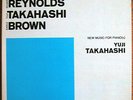
JOJI YUASA+YUJI TAKAHASHI+MATSUDAIRA AVANT LP JAPAN MICHIO KAI-ALM RECORDS-RARE
$
100


Favourite Auctions
To save auctions to your favourites, please login
If you don't have an account, please register
Description
YUJI TAKAHASHI / JOJI YUASA / KATSUHIRO TSUBONOH / YORI-AKI MATSUDAIRA / SESSHU KAI
MICHIO KAI PLAYS AVANT-GARDE FLUTE PIECES LP
ALM Records
w/insert
Excellent japanese original avant-garde compositions by Johi Yuasa, Yuji Takahashi, Matsudaira, Kai and Tsubonoh performed by Michio Kai and Yuji Takahashi.
Some info on the release: Rare original issue, released in Japan sometime in the late 70's on the great ALM Records label (Jo Kondo, Toshi Tsuchitori, Akio Suzuki, Somei Satoh, East Bionic Symphonia, GAP, Kaoru Abe, Morton Feldman, etc.). Excellent abstract avant-garde pieces performed by Michio Kai and Yuji Takahashi.
Yuasa began to compose experimental piano pieces and, in 1951, joined the brand new Jikken-Koubou experimental workshop. Jikken-Koubou was still just months old, and had been founded by the musicologist Kuniharu Akiyama and his colleagues Syozo Kitadai, Hiroyoshi Suzuki along with the soon-to-become legendary Japanese composer Toru Takemitsu. The following year, Nodaira performed one of Yuasa?s piano solos, the nine minutes long ?Three Score Set?, but Yuasa was developing a fascination for tape music, and the inner journeys that such music would take him on. As he later wrote: ?Tape music was completely unknown field at the time. Even reversed playing of recorded sound, change of tape speed, filtering and feedback echo were totally new for the ear.? However, as Yuasa?s knowledge of technology was still rudimentary, his piano music continued to dominate his compositions throughout the 1950s, and, by 1955, Yuasa was well respected enough for his ?Projection For Seven Players? to be premiered, on July 12th, by a septet from the NHK Symphony Orchestra. More piano works followed, including the seven minutes long ?Projection Topologic? solo piano work, which was performed, in 1957, by the 19-year-old prodigy Yuji Takahashi.
However, it was Joji Yuasa?s vocal and tape experiments which set him apart from other experimental composers of the era, and his epic ?Aoi No Ue?, recorded throughout 1961, was a dazzling and proto-psychedelic half hour of shamanic chanting. Throughout the performance, music concrete comprised of ?birdsong, water drops, glasses, warped sound of vibraphone, some generated electronic sound and others? was mixed into the performance by engineer Zyunoske Okuyama. Yuasa also learned belatedly that he had won the Jury's Special Prize of the 1961 Berlin Film Festival Japanese experimental music began 1962 with something of a bang at the Sogetsu Kaikan Hall, with four performances by the experimental puppet theatre group Hitomi-za, who had chosen to have their performances orchestrated with the music of Group Ongaku, Naozumi Yamamoto, Joji Yuasa and the musicologist/cultural activist Kuniharu Akiyama. Unfortunately, the Group Ongaku own contribution to ?Moment Grand-Guignolesques? was never recorded, so we can only imagine the performances of Messrs. Kosugi, Tone and company. However, Kunihara Akiyama produced as mysterious a piece of musique concrete as I?ve yet heard, while Yuasa?s brief work, also entitled ?Moment Grand-Guignolesques, was an epic collage of ripped newspapers, crushed brown paper and dropped telephone books that sounds uncannily reminiscent of Psychic TV?s 1988 epic ?Kondole?, still awaiting birth 17 years hence.
Yuasa composed his experimental ?Interpenetration for 2 Flutes? flute duet between Masao Yoshida and Ryu Noguchi for 1963, and another epic solo voice piece followed in 1964, entitled ?Kansoku?. Yuasa won the prestigious Prix Italia in 1966 and 1967, learning of the second award while in the NHK Electronic Music Studio composing and recording the 13-minute long electronic piece ?Icon On The Source Of White Noise?. The Japanese Society Fellowship awarded him scholarship grants for 1968 and ?69, during which time he recorded the 20-minute vocal and electronic piece ?Voices Coming? at NHK?s Electronic Workshop, and the 15-minutes of ?Music For Space projection? which had been commissioned for Japan?s EXPO ?70. Thereafter, he was invited to lecture in Hawaii at their portentously named. At the beginning of 1972, after many years abroad, the brilliant pianist Yuji Takahashi returned to Japan and invited Yuasa to form the composers? group TranSonic along with himself, Toshi Ichiyanagi, Hiraki Hiyashi, Minao Shibata, Yoriaki Matsudaira and Toru Takemitsu. This septet was to wield considerable force in the experimental scene, and Takahashi celebrated Japanese return with a premier of Yuasa?s prosaically titled solo piano piece ?On The Keyboard?. In 1973, Yuasa?s epic ?Chronoplastic For Orchestra?, premiered the previous August, won the composer both the 21st Otaka Prize and the Japan Arts festival?s Grand Prix. This 14-minute work had been commissioned by NHK and involved ninety-three members of the Tokyo Metropolitan Symphony Orchestra, all of which was in sharp contrast to the following year?s quintet work ?Territory? with its strange configuration of marimba, flutes and clarinets. In 1975, The Koussevitzky Foundation commissioned another huge orchestral piece. The result was the 20-minute ?Time For Orchestral Time 1? involving ninety-four members of the Tokyo Metropolitan Symphony Orchestra. But far more interesting to readers of this book is Yuasa?s epic and empty 1975 electronic work ?My Blue Sky?, in which the composer eschewed the use of white noise in favour of ?clicks, pulses and various kinds of beats?. Hereafter, Joji Yuasa?s story becomes only of passing interest as his music more and more moved into computers and the like.
Condition: Vinyl lies in excellent condition, looks super clean and plays nicely, while cover lies in mint- shape, like new (see picture).
Tracklist
A1 Sesshu Kai – Musik Für Soloflöte 7:40 A2 Yori-Aki Matsudaira – Brilliancy 8:12 A3 Yuji Takahashi – Jit 7:24 B1 Joji Yuasa – Der Beriech 9:18 B2 Katsuhiro Tsubonoh – Das Fest Des Fuchsköigs 11:27SHIPPING & PAYMENT
Shipping: Shipping for this LP is 14$ airmail in Europe / 16$ for the rest of the world
Registered mail: +5$
Insurance: optional
Combined shipping: BIG discounts
Payment: Paypal
Packaging: I am a collector too and i know