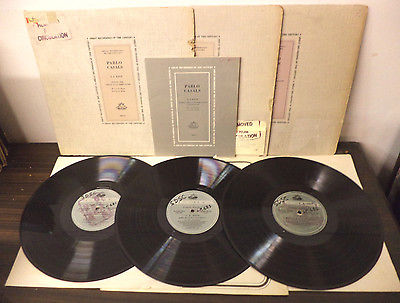
J.S. BACH Pablo Casals, No. 1,2,3,4,5,6, Angel Records, 33 LP
$
41


Favourite Auctions
To save auctions to your favourites, please login
If you don't have an account, please register
Description
J.S. BACH Pablo Casals
No. 1,2,3,4,5,6
Angel Records, 33 LP
Johann Sebastian Bach[1] (31 March [O.S. 21 March] 1685 – 28 July 1750) was a German composer and musician of the Baroque period. He enriched established German styles through his skill in counterpoint, harmonic and motivic organisation, and the adaptation of rhythms, forms, and textures from abroad, particularly from Italy and France. Bach's compositions include the Brandenburg Concertos, the Goldberg Variations, the Mass in B minor, two Passions, and hundreds of cantatas. His music is revered for its technical command, artistic beauty, and intellectual depth.
Bach was born in Eisenach, Saxe-Eisenach, into a great musical family. His father, Johann Ambrosius Bach, was the director of the town musicians, and all of his uncles were professional musicians. His father probably taught him to play the violin and harpsichord, and his brother, Johann Christoph Bach, taught him the clavichord and exposed him to much contemporary music.[2][3] Apparently at his own initiative, Bach attended St. Michael's School in Lüneburg for two years. After graduating he held several musical posts across Germany: he served as Kapellmeister (director of music) to Leopold, Prince of Anhalt-Köthen, Cantor of the Thomasschule in Leipzig, and Royal Court Composer to Augustus III.[4][5] Bach's health and vision declined in 1749, and he died on 28 July 1750. Modern historians believe that his death was caused by a combination of stroke and pneumonia.[6][7][8]
Bach's abilities as an organist were respected throughout Europe during his lifetime, although he was not widely recognised as a great composer until a revival of interest and performances of his music in the first half of the nineteenth century. He is now generally regarded as one of the greatest composers of all time.[9]
Bach's musical style arose from his skill in contrapuntal invention and motivic control, his flair for improvisation, his exposure to North and South German, Italian and French music, and his devotion to the Lutheran liturgy. His access to musicians, scores and instruments as a child and a young man and his emerging talent for writing tightly woven music of powerful sonority, allowed him to develop an eclectic, energetic musical style in which foreign influences were combined with an intensified version of the pre-existing German musical language. From the period 1713–14 onward he learned much from the style of the Italians.[95]
During the Baroque period, many composers only wrote the framework, and performers embellished this framework with ornaments and other elaboration.[96] This practice varied considerably between the schools of European music; Bach notated most or all of the details of his melodic lines, leaving little for performers to interpolate. This accounted for his control over the dense contrapuntal textures that he favoured, and decreased leeway for spontaneous variation of musical lines. At the same time, Bach left the instrumentation of major works including The Art of Fugue open.[97]
Bach's devout relationship with the Christian God in the Lutheran tradition[98] and the high demand for religious music of his times placed sacred music at the centre of his repertory. He taught Luther's Small Catechism as the Thomaskantor in Leipzig,[99] and some of his pieces represent it;[100] the Lutheran chorale hymn tune was the basis of much of his work. He wrote more cogent, tightly integrated chorale preludes than most. The large-scale structure of some of Bach's sacred works is evidence of subtle, elaborate planning. For example, the St Matthew Passion illustrates the Passion with Bible text reflected in recitatives, arias, choruses, and chorales.[101]
Bach's drive to display musical achievements was evident in his composition. He wrote much for the keyboard and led its elevation from continuo to solo instrument with harpsichord concertos and keyboard obbligato.[102] Bach produced collections of movements that explored the range of artistic and technical possibilities inherent in various genres. The most famous example is The Well-Tempered Clavier, in which each book presents a prelude and fugue in every major and minor key. Each fugue displays a variety of contrapuntal and fugal techniques.[103]
Cherish B5
**3 ALBUMS** Ship together
price rating