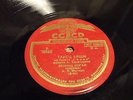
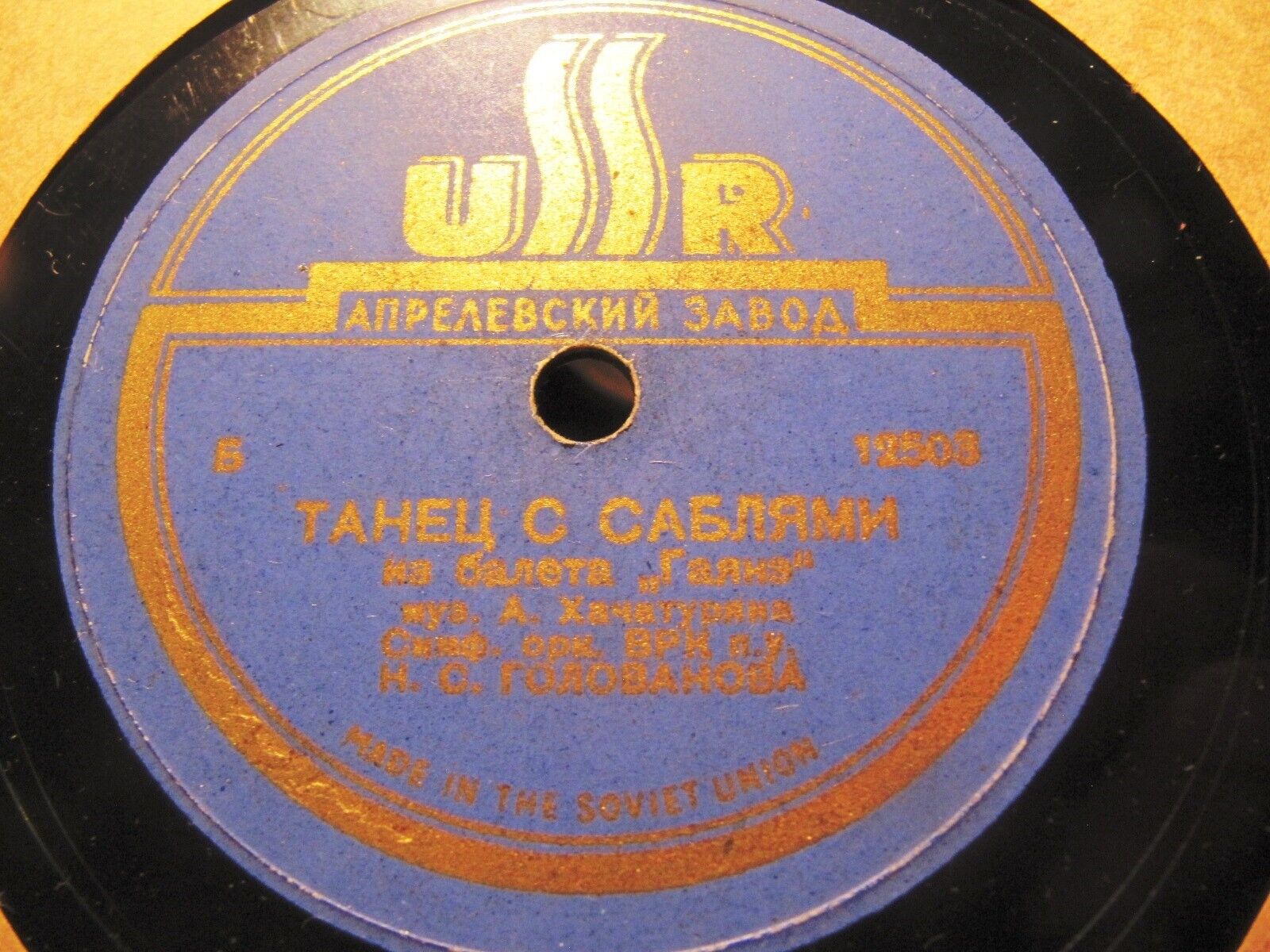
Khachaturian SABRE DANCE NIKOLAI GOLOVANOV Russian Furtwängler GAYANE Lezginka
$
50


Favourite Auctions
To save auctions to your favourites, please login
If you don't have an account, please register
Description
A series of great Russian, Polish, Czech and Yugo-Slav Records from early G&Ts to World War II recordings on 78 rpm Victrola Records
Click this link for more Russian and Slavic Records in my other listings!
Click on this link to see more great Conductors and Orchestral Records!
NICOLAI GOLOVANOV
The "Russian Furtwaengler" remains almost entirely unknown to record collectors of the West. Vagaries of sound reproduction, political climate and record distribution confined his admirers to a relative handful until the advent of the compact disc.
Here in the first recording of the famous Sabre DanceI believe these were the very first commercial recordings of these pieces, both from Khachaturian's 1942 opera "Gayaneh".
The VRK symphony orchestra (potentially Simfonicheskij orkestr vsesoyuznogo radio, or All-Union Radio Symphony) plays Sabre Dance, a movement from Aram Khachaturian's 1942 ballet, Gayane.
12804
armenian symphony orchestra
Russian Dance (Ballet «Gayane») (Aram Khachaturyan)
All-Union Radio Committee Symphony Orchestra, Conductor Nikolay Golovanov 1945
Moscow Aprelevka Plant ? 879
Click for playback
12805
armenian symphony orchestra
Russian Dance (Ballet «Gayane») (Aram Khachaturyan)
All-Union Radio Committee Symphony Orchestra, Conductor Nikolay Golovanov 1945
Moscow Aprelevka Plant ? 879
Please see top of the page for condition
Nikolai Semyonovich Golovanov (Russian: ??????? ????????? ?????????, Nikoláy Semyónovich Golovánov) ([o.s. 9] 21 January 1891 – 28 August 1953) was a Soviet conductor and composer, who was married to the soprano Antonina Nezhdanova.
He conducted the premiere performances of a number of works, among them Nikolai Myaskovsky's Sixth Symphony in May 1924.[1]
Golovanov held some of the highest musical positions in the USSR, including an extensive association with the Bolshoi Opera. In her autobiography, Galina Vishnevskaya terms him the theater's chief conductor, and tells of his dismissal from the Bolshoi and his death - which she attributed to the humiliation of the experience of losing this position. It has been reported that Golovanov's firing was the result of Stalin's displeasure at Golovanov's having tried to use a Jewish singer, Mark Reizen, in the title role of Tsar Boris Godunov in his recording of Mussorgsky's opera. Golovanov actually did record the opera with Reizen as Boris, but later remade Reizen's part with another Boris, Alexander Pirogov.
Golovanov's recorded output was substantial and quite individual in interpretive approach. In his discography we find all but one of the Liszt tone poems, the complete Scriabin symphonies and Piano Concerto, Tchaikovsky's First and Sixth symphonies, as well as shorter works, Beethoven's First Symphony, Violin Concerto and Triple Concerto, Rimsky-Korsakov's Scheherazade and his operas Sadko and Christmas Eve, Mussorgsky's Boris Godunov and Pictures at an Exhibition, Rachmaninoff's Second and Third symphonies, the opera Aleko and other compositions, Glazunov's Fifth, Sixth and Seventh symphonies, and scores by Grieg, Mozart and others. Based upon the evidence of his recordings, Golovanov's characteristic performance mode was full-blooded and nearly vehement in tone, with a powerful, almost overloaded sense of sonority, and extreme flexibility in matters of tempo, phrasing and dynamics.
Golovanov was also a composer; his works include the opera "Princess Yurata", a symphony and other orchestral works.[2]price rating



![[WORLD MUSIC] [AFRICA] NM 12](https://www.popsike.mobi/php/thumbnail.php?url=https://www.popsike.pics/pix/20240920/126682436670.jpg)