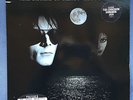
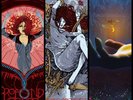
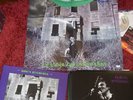
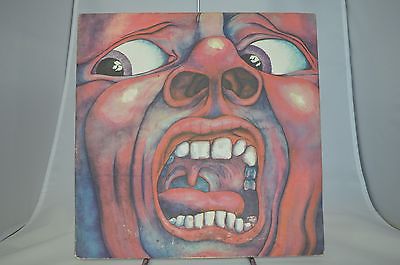
King Crimson vinyl lp 7 albums from 1969 - 1974 12"
$
50


Favourite Auctions
To save auctions to your favourites, please login
If you don't have an account, please register
Description
The group's definitive album, and one of the most daring debut albums ever recorded by anybody. At the time, it blew all of the progressive/psychedelic competition (the Moody Blues, the Nice, etc.) out of the running, although it was almost too good for the band's own good -- it took King Crimson nearly four years to come up with a record as strong or concise. Ian McDonald's Mellotron is the dominant instrument, along with his saxes and Fripp's guitar, making this a somewhat different-sounding record from everything else they ever did. And even though that Mellotron sound is muted and toned down compared to their concert work of the era (e.g., Epitaph), it is still fierce and overpowering, on an album highlighted by strong songwriting (most of it filled with dark and doom-laden visions), the strongest singing of Greg Lake's entire career, and Fripp's guitar playing that strangely mixed elegant classical, Hendrix-like rock explosions, and jazz noodling. Lineup changes commenced immediately upon the album's release, and Fripp would ultimately be the only survivor on later King Crimson records. King Crimson opened 1970 scarcely in existence as a band, having lost two key members (Ian McDonald and Michael Giles), with a third (Greg Lake) about to leave. Their second album -- largely composed of Robert Fripp's songwriting and material salvaged from their stage repertory ("Pictures of a City" and "The Devil's Triangle") -- is actually better produced and better sounding than their first. Surprisingly, Fripp's guitar is not the dominant instrument here: The Mellotron, taken over by Fripp after McDonald's departure -- and played even better than before -- still remains the band's signature. The record doesn't tread enough new ground to precisely rival In the Court of the Crimson King. Fripp, however, has made an impressive show of transmuting material that worked on stage ("Mars" aka "The Devil's Triangle") into viable studio creations, and "Cadence and Cascade" may be the prettiest song the group ever cut. "The Devil's Triangle," which is essentially an unauthorized adaptation of "Mars, Bringer of War" from Gustav Holst's The Planets, was later used in an eerie Bermuda Triangle documentary of the same name. [In March of 2000, Caroline and Virgin released a 24-bit digitally remastered job that puts the two Mellotrons, Michael Giles' drums, Peter Giles' bass, and even Fripp's acoustic guitar and Keith Tippett's acoustic piano practically in the lap of the listener.] Lizard is very consciously jazz-oriented -- the influence of Miles Davis (particularly Sketches of Spain) being especially prominent -- and very progressive, even compared with the two preceding albums. The pieces are longer and have extensive developmental sections, reminiscent of classical music, and the lyrics are more ornate, while the subject matter is more exotic and rarified -- epic, Ragnarok-like battles between good and evil that run cyclically. The doom-laden mood of the first two albums is just as strong, except that the music is prettier; the only thing missing is a sense of humor. Jon Anderson of Yes guests on one key number, "Prince Rupert Awakes" (which vocalist/bassist Gordon Haskell never completed), and the album is stronger for his presence. At the time of its release, some critics praised Lizard for finally breaking with the formula and structure that shaped the two preceding albums, but overall it's an acquired taste. The weakest Crimson studio album from their first era is only a real disappointment in relation to the extraordinarily high quality of the group's earlier efforts. The songs are somewhat uneven and draw from three years of inspiration. "The Letter" is an adaptation of "Drop In," a group composition that was featured in the early set of the original Crimson lineup from 1969, while "Song of the Gulls" goes back to the pre-King Crimson trio of Giles, Giles & Fripp for its source ("Suite No. 1"). There are also a few surprises, such as the Beatles-like harmonies on the raunchy "Ladies of the Road" and the extraordinary interweaving of electric guitar and Mellotron by Robert Fripp on "A Sailor's Tale, which is one of the highlights of the early- to mid-period group's output. Some of the music overstays its welcome -- several of the six tracks are extended too far, out of the need to fill up an LP -- but the virtuosity of the band picks up most of the slack on the composition side: Collins' saxes and Wallace's drums keep things much more than interesting in tandem with Fripp's guitar and Mellotron, and guest vocalist Paulina Lucas' keening accompaniment carries parts of "Formentera Lady" that might otherwise have dragged. [After an unfortunate history of mediocre pressings, in March of 2000 Virgin Records released a 24-bit digitally remastered CD that captured the original intact.] King Crimson reborn yet again -- the newly configured band makes its debut with a violin (courtesy of David Cross) sharing center stage with Robert Fripp's guitars and his Mellotron, which is pushed into the background. The music is the most experimental of Fripp's career up to this time -- though some of it actually dated (in embryonic form) back to the tail end of the Boz Burrell-Ian Wallace-Mel Collins lineup. And John Wetton was the group's strongest singer/bassist since Greg Lake's departure three years earlier. What's more, this lineup quickly established itself as a powerful performing unit working in a more purely experimental, less jazz-oriented vein than its immediate predecessor. "Outer Limits music" was how one reviewer referred to it, mixing Cross' demonic fiddling with shrieking electronics, Bill Bruford's astounding dexterity at the drum kit, Jamie Muir's melodic and usually understated percussion, Wetton's thundering (yet melodic) bass, and Fripp's guitar, which generated sounds ranging from traditional classical and soft pop-jazz licks to hair-curling electric flourishes. [The remastered edition, which appeared in the summer of 2000 in Europe and slightly later in America, features beautifully remastered sound -- among other advantages, it moves the finger cymbals opening the first section of the title track into sharp focus, with minimal hiss or noise to obscure them, exposes the multiple percussion instruments used on the opening of "Easy Money," and gives far more clarity to "The Talking Drum." This version is superior to any prior CD release of Larks' Tongues in Aspic, and contains a booklet reprinting period press clippings, session information, and production background on the album.] King Crimson fell apart once more, seemingly for the last time, as David Cross walked away during the making of this album. It became Robert Fripp's last thoughts on this version of the band, a bit noiser overall but with some surprising sounds featured, mostly out of the group's past -- Mel Collins' and Ian McDonald's saxes, Marc Charig's cornet, and Robin Miller's oboe, thus providing a glimpse of what the 1972-era King Crimson might've sounded like handling the later group's repertory (which nearly happened). Indeed, Charig's cornet gets just about the best showcase it ever had on a King Crimson album, and the truth is that few intact groups could have gotten an album as good as Red together. The fact that it was put together by a band in its death throes makes it all the more impressive an achievement. Indeed, Red does improve in some respects on certain aspects of the previous album -- including "Starless," a cousin to the prior album's title track -- and only the lower quality of the vocal compositions keeps this from being as strongly recommended as its two predecessors. As Robert Fripp had done with King Crimson's first live LP, Earthbound (1972), USA (1974) is a single-disc concert package documenting the quartet during its most concurrent swing through North America. As with its predecessor, USA was also issued as a sonic cenotaph of the concurrently defunct Krim. So insistent that the band would not be resurrected, Fripp concluded the LP's liner notes at the time with another three-letter epitaph: "R.I.P." The 1973/1974 King Crimson included the collective efforts of Fripp (guitar/mellotron), David Cross (violin), John Wetton (bass/vocals), and Bill Bruford (drums/percussion). USA also includes notable violin overdubs by Eddie Jobson on the tracks "Larks' Tongues in Aspic, Pt. 2" and "21st Century Schizoid Man," as well as electric piano addendums to "Lament." The opening drone -- indexed as "Walk On....No Pussyfooting" for the 30th anniversary release in 2002 -- re-creates the typical performance prelude, which is lifted directly from the Fripp and Brian Eno sonic sculpture No Pussyfooting (1973). The brusque juxtaposition of the ethereal opening to the aggressive "Larks' Tongues in Aspic, Pt. 2" jolts the audience into the rips and snorts found during this tautly rendered instrumental. The readings of "Lament" and "Exiles" demonstrate this band's overwhelming sonic sensibilities. They are able to contrast and incorporate thick, viscous melodies and rhythms with alternately underlying sensitive, as well as ultimately beautiful, musical responses. A majority of the release is taken from a performance on June 28, 1974, at the Casino in Asbury Park, NJ, with the notable exception of "21st Century Schizoid Man," which was recorded two nights later at the Palace Theater in Providence, RI. The previously mentioned 30th anniversary edition marks the legitimate digital debut of USA. The extended CD format allows for the addition of "Fracture" and "Starless" from the Casino show. Additional live recordings of this band can be found on the four-disc The Great Deceiver collection and Night Watch, as well as Live in Central Park, NYC '74 and Live in Mainz 1974 from the King Crimson Collectors' Club.
price rating