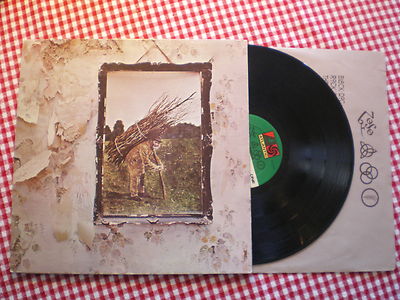
LED ZEPPELIN IV 4 record lp album 1971 vinyl st-a-712285-mo Stairway to heaven
$
31


Favourite Auctions
To save auctions to your favourites, please login
If you don't have an account, please register
Description
Here is a GREAT item from our collection.
LED ZEPPELIN IV 4 record lp album 1971 vinyl st-a-712285-mo Stairway to heaven
GREAT INSIDE ART-- SEE BELOW
The fourth album by the English rock band Led Zeppelin was released on 8 November 1971. No title is printed on the album, so it is usually referred to as Led Zeppelin IV, following the naming sequence used by the band's first three studio albums. The album has alternatively been referred to as , Four Symbols, The Fourth Album (those two titles each having been used in the Atlantic catalogue), Untitled, Runes, The Hermit, and ZoSo, the latter of which is derived from the symbol used by Jimmy Page for the album sleeve. Page often had the ZoSo symbol embroidered on his clothes.[1]
Containing many of the band's most famous songs, including "Black Dog", "Rock and Roll", "Going to California" and the band's signature song, "Stairway to Heaven", Led Zeppelin IV was a commercial and critical success. The album is one of the best-selling albums worldwide at 32 million units.[2] It is also certified twenty-three times platinum by the RIAA, making it the third-best-selling album ever in the US.[3]
In 2003, the album was ranked 69th on
Rolling Stone magazine's list of "The 500 Greatest Albums of All Time".
The four symbols
The four symbols representing (from left to right);at the top; Page, Jones
at the bottom; Bonham and Plant
The idea for each member of the band to choose a personal emblem for the cover was Page's.[8] In an interview he gave in 1977, he recalled:
"After all this crap that we'd had with the critics, I put it to everybody else that it'd be a good idea to put out something totally anonymous. At first I wanted just one symbol on it, but then it was decided that since it was our fourth album and there were four of us, we could each choose our own symbol. I designed mine and everyone else had their own reasons for using the symbols that they used."[8]
Page stated that he designed his own symbol[5][6] and has never publicly disclosed any reasoning behind it. However, it has been argued that his symbol appeared as early as 1557 to represent Saturn.[13][14] The symbol is sometimes referred to as "ZoSo", though Page has explained that it was not in fact intended to be a word at all.[5]
Bassist John Paul Jones' symbol, which he chose from Rudolf Koch's Book of Signs,[5] is a single circle intersecting three vesica pisces (a triquetra). It is intended to symbolise a person who possesses both confidence and competence.[6]
Drummer John Bonham's symbol, the three interlocking (Borromean) rings, was picked by the drummer from the same book.[5] It represents the triad of mother, father and child.,[6][15] but also happens—inverted—to be the logo for Ballantine beer.[6]
Singer Robert Plant's symbol of a feather within a circle was his own design, being based on the sign of the supposed Mu civilisation.[5][6]
Sandy Denny's symbol, which in Christianity is an old symbol for the Godhead "beyond that nothing is known about it".There is also a fifth, smaller symbol chosen by guest vocalist Sandy Denny representing her contribution to the track "The Battle of Evermore"; it appears in the credits list on the inner sleeve of the LP, serving as an asterisk and is shaped like three triangles touching at their points.
During Led Zeppelin's tour of the United Kingdom in winter 1971, which took place shortly following the release of the album, the band visually projected the four symbols on their stage equipment. Page's symbol was put onto one of his Marshall amplifiers, Bonham's three interlinked circles adorned the outer face of his bass drum, Jones had his symbol stencilled onto material which was draped across his Fender Rhodes keyboard, and Plant's feather symbol was painted onto a side speaker PA cabinet. Only Page's and Bonham's symbols were retained for subsequent Led Zeppelin concert tours.[16]
Album cover and inside sleeve
The 19th-century rustic oil painting on the front of the album was purchased from an antique shop in Reading, Berkshire by Plant.[5][6][17] The painting was then juxtaposed and affixed to the internal, papered wall of the partly demolished suburban house for the photograph to be taken.
Page has explained that the cover of the fourth album was intended to bring out a city/country dichotomy that had initially surfaced on Led Zeppelin III:
It represented the change in the balance which was going on. There was the old countryman and the blocks of flats being knocked down. It was just a way of saying that we should look after the earth, not rape and pillage it.[8]
However, regarding the meaning of the album cover, he has also stated:
The cover was supposed to be something that was for other people to savour rather than for me to actually spell everything out, which would make the whole thing rather disappointing on that level of your own personal adventure into the music.[18]
The album cover was among the ten chosen by the Royal Mail for a set of "Classic Album Cover" postage stamps issued in January 2010.[19]
The inside illustration, entitled "The Hermit" and credited to Barrington Colby MOM, was influenced by the design of the card of the same name in the Rider-Waite tarot deck.[6] This character was later portrayed by Page himself in Led Zeppelin's concert film, The Song Remains the Same (1976). The inner painting is also referred to as View in Half or Varying Light and was sold at auction under that name in 1981.[20]
Varied versions of the artwork within the album exist. Some versions depict a longhaired and bearded supplicant climbing at the base of the mountain, while some others do not show the six pointed star within the hermit's lantern. If the inside cover of the album is held vertically against a mirror, a man's face can be seen hidden in the rocks below the hermit. Speculation exists that the face is actually that of a black dog.[20]
The typeface for the lyrics to "Stairway to Heaven", printed on the inside sleeve of the album, was Page's contribution. He found it in an old arts and crafts magazine called The Studio which dated from the late 19th century. He thought the lettering was interesting and arranged for someone to work up a whole alphabet.[17]
Track listing
Side oneNo. Title Writer(s) Length
1. "Black Dog" John Paul Jones, Jimmy Page, and Robert Plant 4:54 2. "Rock and Roll" John Bonham, Jones, Page, and Plant 3:40 3. "The Battle of Evermore" Page and Plant 5:51 4. "Stairway to Heaven" Page and Plant 8:02 Side two
No. Title Writer(s) Length
5. "Misty Mountain Hop" Jones, Page, and Plant 4:38 6. "Four Sticks" Page and Plant 4:44 7. "Going to California" Page and Plant 3:31 8. "When the Levee Breaks" Bonham, Jones, Memphis Minnie, Page, and Plant 7:07
Cover and sleeve in great shape.. words to Stairway to heaven
are on one side.. the LP is very good with light scratches
tested no skips..
A MUST TO ADD TO YOUR COLLECTION
ADD $1.00 per additional auction won.. from our other lp auctions.
with the initial $4.00 of the first winning auction
please use the zoom over with mouse feature for more detailed info
BID WITH CONFIDENCE
Winning bidder to pay within 2 days of close of auction with all live auctions,
if a store purchase "Buy it now" means immediate payment please!
Please email with any and all questions prior to bidding...
We may not catch everything, these are used items and we are not professional graders
or collectors. AGAIN, if ANY questions at all please email before end of auction. GOOD LUCK!
great feedback and amazing shipping.. BID WITH CONFIDENCE!
lotsatoyz only sells quality store-like items unless noted in our auction.
Comes from a smoke free environment as well as humidified.
We combine shipping and carefully package with recycled or green products, GO GREEN!
see our other auctions for similar -related items!
price rating