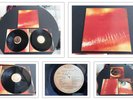
LED ZEPPELIN IV LP 1971 ATLANTIC 2401012 RED PLUM ZOSO
£
53
$
70


Favourite Auctions
To save auctions to your favourites, please login
If you don't have an account, please register
Description
LED ZEPPELIN IV (four symbols) 1st PRESSING LP
1971ATLANTIC 2401012
SLEEVE.... gatefold sleeve is in excellent+ condition
VINYL.....condition is excellent +++ with jet black mirror like surfaces (has only a few very tiny faint lines)
LABELS.....both labels are in excellent ++condition
MATRIX NUMBERS.... 240102 A//31/32 240102 B//3124
has the porky peco etchings in the dead wax and comes with the original inner sleeve in very good / excellent condition
"Zoso" redirects here. For the member of Led Zeppelin to whom this refers, see Jimmy Page. Led Zeppelin IV
Led Zeppelin IV is the common, but unofficial name of the untitled fourth album of English rock band Led Zeppelin. It was released on November 8, 1971. It has no official title printed anywhere on the album, but is generally called Led Zeppelin IV after the band's previous three numbered albums. Atlantic Records catalogs have used the names Four Symbols (see below) and The Fourth Album; it has also been referred to as Zoso, which the first symbol appears to spell. Led Zeppelin guitarist Jimmy Page frequently refers to the album in interviews as "the fourth album" and Led Zeppelin IV,[1][2] while singer Robert Plant thinks of it as "the fourth album, that's it".[3]
Led Zeppelin IV was a huge success commercially and critically when it was released. Most of the album's songs are staples on classic rock radio stations, including "Black Dog", "Going to California", "Misty Mountain Hop", "Rock and Roll", "When the Levee Breaks", and "Stairway to Heaven". The album is one of the best-selling albums in history at 40 million units, with over 23 million sold in the United States, third most for any album all-time.[4] In 2003, the album was ranked number 66 on Rolling Stone magazine's list of the 500 greatest albums of all time
Overview
The album was initially recorded at Island Records's newly opened Basing Street Studios, London at the same time as Jethro Tull's Aqualung,[5] before further recordings took place at Headley Grange, a remote Victorian house in East Hampshire, England, as well as Sunset Sound in Los Angeles, CA.
After the lukewarm, if not confused and sometimes dismissive, critical reaction Led Zeppelin III had received in the autumn of 1970, Jimmy Page decided that the next Led Zeppelin album would not have a title, but would instead feature four hand-drawn symbols on the inner sleeve and record label, each one chosen by the band member it represents. "We decided that on the fourth album, we would deliberately play down the group name, and there wouldn't be any information whatsoever on the outer jacket", Page explained. "Names, titles and things like that do not mean a thing."[6]
Page has also stated that the decision to release the album absent of any written information on the album sleeve was contrary to strong advice given to him by a press agent, who said that after a year's absence from both records and touring, the move would be akin to "professional suicide".[1] In the words of the guitarist: "We just happened to have a lot of faith in what we were doing."[1]
Owing to the lack of an official title, Atlantic Records initially distributed graphics of the symbols in many sizes to the press for inclusion in charts and articles. The album was one of the first to be produced without conventional identification, and this communicated an anti-commercial stance that was controversial at the time (especially among certain executives at Atlantic Records).
Reception
In 1998, Q magazine readers voted Led Zeppelin IV the 26th greatest album of all time; in 2000 "Q" placed it at #26 in its list of the 100 Greatest British Albums Ever. In 2003, the album was ranked number 66 on Rolling Stone magazine's list of the 500 greatest albums of all time. It is #7 on Pitchfork Media's Top 100 Albums of the 1970s. A 2005 listener poll conducted by Toronto, Ontario classic rock station Q107 named Led Zeppelin IV the #2 best classic rock album of all time. In 2006, the album was rated #1 on Classic Rock magazine's 100 Greatest British Albums poll; that same year it was voted #1 in Guitar World 100 Greatest Albums readers' poll and was ranked #7 in ABC media's top ten albums.
The symbols
Each member of the band chose a personal emblem for the cover, an idea which came from Jimmy Page.[1] In an interview he gave in 1977, Page explained:
“ After all this crap that we'd had with the critics, I put it to everybody else that it'd be a good idea to put out something totally anonymous. At first I wanted just one symbol on it, but then it was decided that since it was our fourth album and there were four of us, we could each choose our own symbol. I designed mine and everyone else had their own reasons for using the symbols that they used.[1] ”Left to right, their members and meanings:
- Jimmy Page's symbol is generally referred to as "ZoSo," although the symbol is a pictograph and not a word to be pronounced in that fashion. Page designed it by altering a symbol he found in a book on alchemy. The four symbols on the label and inside sleeve of Led Zeppelin IV, representing Jimmy Page, John Paul Jones, John Bonham, and Robert Plant (from left to right) respectively, they are also thought to represent fire, water, earth and air. The symbols are ancient Pagan sigils for these four elements, and may be referred to as both Runes and sigils. [citation needed]
- John Paul Jones' symbol is a single circle intersecting 3 vesica pisces (a triquetra). According to The Book of Signs by Rudolf Koch, it symbolises a person with confidence and competence, and also represents water which is one of the base elements.[7]
- John Bonham's symbol, the three interlocking rings, represents the trinity of mother, father and child. It could also depict an aerial view of a drum kit. It does in fact represent the idea of trilogies and trios, and, more commonly, is a Christian symbol for the Trinity. It is also a Pagan symbol for the Celtic Goddess Brigid (Breed), Goddess of the home, hearth, forge and poetry. In the 1990 Bonham tribute radio special, "It's Been a Long Time," son Jason Bonham stated that the symbol was chosen as a representation of man, woman, and child.
Jones's and Bonham's symbols fitting together — one to the other inside out, inverse images — is no accident. In many bands, the bassist and drummer form interlocking parts of a rhythm section. The symbol also happens to be the logo for Ballantine beer, and it also represents earth which is a base element.[6] Former Nirvana drummer and Foo Fighters frontman Dave Grohl has Bonham's symbol tattooed on his right wrist and Silverchair drummer Ben Gillies has Bonham's symbol tattooed on the back of his neck.
- Robert Plant's symbol is the feather of the Egyptian goddess Ma'at, (representing purity, order, truth, justice, fairness, and the wholeness of the Universe), encapsulated by an unbroken circle representing the cyclical and perpetual concept of life so important to the Egyptians. According to Egyptian mythology, after a person dies, their soul is led into a hall of judgment in Duat by Anubis (God of Mummification and Death). The deceased's heart, which is the record of the morality of the owner, is weighed against a single feather representing Ma'at (the concept of truth and order). A heart that weighs the same or less than the feather is considered a pure heart, not weighed down by the guilt or wrongfulness of one's actions in life, resulting in the spirit of the deceased being taken by Osiris (the God of the Afterlife)to Aaru, from where the spirit will be reborn. A heart which weighs more than the feather of Ma'at is laden with guilt and wrongdoing, resulting in it being devoured by the monster Ammit (Eater of Hearts) -a garish mix of crocodile, hippo and lion- and will remain in Duat for eternity, rather than proceeding to the Afterlife and subsequent rebirth. [8]
There is also a fifth, smaller symbol chosen by guest female vocalist Sandy Denny representing her contribution to "The Battle of Evermore"; it appears in the credits list on the inner sleeve of the LP, serving as an asterisk and is shaped like three triangles touching at their points and is another Pagan symbol.
During Led Zeppelin's tour of the United Kingdom in Winter 1971, which took place shortly following the release of the album, the band visually projected the four symbols on their stage equipment. Jimmy Page's "Zoso" symbol was put onto one of his Marshall amplifiers, John Bonham's three interlinked circles adorned the outer face of his bass drum, John Paul Jones had his symbol stenciled onto material which was draped across his Fender Rhodes keyboard and Robert Plant's feather symbol was painted onto a side speaker PA cabinet. Only Page's and Bonham's symbols were retained for subsequent Led Zeppelin concert tours.[9]
Album cover and inside sleeve
"The Hermit"The painting on the front of the album, showing an old man carrying a bundle of sticks, was allegedly purchased from a junk shop in Reading, Berkshire by a Led Zeppelin roadie (Jimmy Page has stated it was bought by Robert Plant)[10] and affixed to the internal, papered wall of the partly demolished house for the photograph to be taken. The tower block on the back of the full gatefold album cover is Butterfield Court in Dudley, England.[11]
The inside illustration was "The Hermit"(as seen in The Song Remains The Same), credited to Barrington Colby Mom, influenced by the design of the card of the same name in the Rider-Waite tarot deck. If the inside cover is held vertically against a mirror, a hideous face can be seen hidden in the rocks below the hermit.
Led Zeppelin IV outer gatefold album coverThe typeface for the lyrics to "Stairway to Heaven", printed on the inside sleeve of the album, was Page's contribution. He found it in an old arts and crafts magazine called Studio Magazine which started in the late 1800s. He thought the lettering interesting and arranged for someone to work up a whole alphabet.[10]
Page has explained that the cover of the fourth album was intended to bring out a city/country dichotomy that had initially surfaced on Led Zeppelin III:
“ It represented the change in the balance which was going on. There was the old countryman and the blocks of flats being knocked down. It was just a way of saying that we should look after the earth, not rape and pillage it.[1] ”Track listing
Side one # Title Writer(s) Length 1. "Black Dog" Jimmy Page, Robert Plant, John Paul Jones 4:57 2. "Rock and Roll" Page, Plant, Jones, John Bonham 3:40 3. "The Battle of Evermore" Page, Plant 5:52 4. "Stairway to Heaven" Page, Plant 8:00 Side two # Title Writer(s) Length 1. "Misty Mountain Hop" Page, Plant, Jones 4:38 2. "Four Sticks" Page, Plant 4:46 3. "Going to California" Page, Plant 3:31 4. "When the Levee Breaks" Page, Plant, Jones, Bonham, Memphis Minnie 7:07Personnel
- Jimmy Page – acoustic guitar, electric guitar, mandolin, producer, remastering, digital remastering
- Robert Plant – vocals, harmonica
- John Paul Jones – synthesizer, bass guitar, keyboards, mandolin, recorders
- John Bonham – drums
- Ian Stewart – piano (on "Rock and Roll", uncredited)
- Sandy Denny – vocals (on track 3)
- Peter Grant – executive producer
- George Chkiantz – mixing
- Andy Johns – engineer, mixing
- Graphreaks – design coordinator
- Barrington Colby Mom – inside illustration (The Hermit)
my records are condition graded visually in accordance with Record Collector's Grading System as follows:
MINT (M): Unplayed, pristine condition, often still sealed.
NEAR MINT (NM): The record itself is in almost brand new condition with no apparent surface marks, full original vinyl lustre, and no deterioration in sound quality.The cover and any extra items are in near perfect condition.
EXCELLENT (EX): The record shows signs of having been played, but there is very little lessening in sound quality. The cover and/or packaging might have slight wear and/or creasing.
VERY GOOD (VG): The record obviously has been played many times, but displays no major deterioration in sound quality, despite noticeable surface marks and the occasional light scratch. Normal wear and tear on the cover and/or extra items, without any major defects, is acceptable.
GOOD (G): The record has been played so much that the sound quality has deteriorated noticeably, perhaps with some distortion and/or scratches. The cover and/or contents may suffer from folding, scuffing, spine-splits, major discolouration, etc.
+ or - indicates a grading in between the given categories
Postage and Packing: UK 2nd class £3.50 ; Europe airmail £8.00; ROW airmail £9.00 sent fully insured & signed for
I offer reduced postage rates for combined multiple purchases as follows:
UK mainland: Price as quoted above for the first LP plus £1.50 for each additional LP
Overseas: Price as quoted above for the first LP plus £2.00 for each additional LP
The above prices apply to a maximum combination of 4 x LP records only. Purchasers of multiple items should await invoice before making payment. fully insured & signed for
Please note that, all my vinyl will be packed in proper mailers with at least 2 cardboard stiffeners for added protection to ensure that you will receive it in the same condition as despatched
Whilst I endeavour to dispatch items as quickly as possible after payment has been received and/or cleared, please allow up to 14 days for delivery (21 days if overseas) before reporting non-receipt. You will, however, nearly always receive your goods much quicker than this as I post-out at twice a week, usually on a Tuesday and Friday. Items paid for by the Wednesday evening will normally catch that same week's dispatch; where payment has not been received by the Friday there may be an additional delay.
IF FOR ANY REASON THAT ANY ITEM SHOULD NOT REACH THE STANDARD REQUIRED PLEASE DO NOT HESITATE TO CONTACT ME BEFORE LEAVING NEGATIVE FEEDBACK AS I WILL ALWAYS SORT SOMETHING OUT
IF YOU ARE NOT HAPPY WITH MY TERMS AND CONDITIONS THEN PLEASE, PLEASE DO NOT BID!
Thanks for your interest and good luck bidding and/or buying!
price rating



![QUEEN - Absolute Greatest [2009, Factory Sealed, Deluxe 3 x LP Vinyl Box Set]](https://www.popsike.mobi/php/thumbnail.php?url=https://www.popsike.pics/pix/20111001/270826914363.jpg)