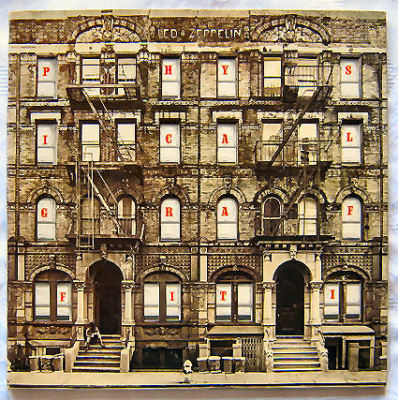
LED ZEPPELIN - PHYSICALGRAFFITI: M-/EX++ 1st UK Pressng
£
63
$
83


Favourite Auctions
To save auctions to your favourites, please login
If you don't have an account, please register
Description
LED ZEPPELIN - PHYSICALGRAFFITI
Near mint/Ex(++) 1st UK Pressing: Thick Card sleeve/inners, Made in UK/England marking, 1-5-1-1 matrices,
no Warner logo/text on labels, top-opening outer sleeve with red spine lettering,
side-opening inner sleeves with A/B designations, Gothic Print Finishers/London Swan Song Address
Double vinyl album, Swan Song Records (SSK 89400), released in 1975, Stereo, manufactured in the U.K.. Matrix Nos: SSK-89400-A1, B5, C1 & D1
SUMMARY
This is a superbly cared-for 1st pressing* instance of one of rock's iconic albums, with its original unique die-cut cover, inner slip and individual record sleeves all in the impressively bright, clean and solid condition that would normally be associated with an album that had been bought in the last couple of years - except that these are 35+ years old! And the vinyls - played probably no more than dozen times in that period, and only on quality equipment - are every bit as rewarding, both visually and aurally.
In context, while there are undoubtedly other 1st pressing copies of Physical Graffiti in as good a condition as this one, most of them are likely to either already be in the hands of collectors, or being offered for sale at a significantly higher price than asked here, so if you would like to own an exceptionally well-preserved copy of one of rock's most memorable and distinct albums, this may be the opportunity you've been waiting for.
PRESSING* DETAILS
First UK pressing, as evidenced by the following features found on those copies:
- A1, B5, C1 & D1 dead-wax/run-off matrices;
- “Made in UK/England” printed on labels and white inner slip;
- “484 Kings Road, London SW10” address on both outer sleeve/cover and white inner slip;
- all packaging (outer sleeve/cover, inner slip and inner record sleeves) made in relatively heavy card;
- the rim text on the labels doesn’t have either the black “Warner” logo or the wording “A Warner Communications Company”;
- “Gothic Print Finishers Ltd” sleeve manufacture/printing credit on inner slip;
- top-opening outer sleeve/cover;
- red block lettering on the spine, and
- side-opening inner card sleeves with A or B designation in lower corners.
CONDITION - SUMMARY
All components of this two-record album are in excellent (+) through to mint (-) condition, with the only deterioration as detailed below.
Outer sleeve/cover
- has minimal colour fading, some very light surface rubbing, slight lift at top corner join, light squashing marks on one edge and corner, slight wear/softness at most of the corners, minimal top/open edge feathering and very slight discolouration inside.
Inner slip
- has minor top edge crease, very slight discolouration on the outer fold-lines and inner top edges, plus the odd light outer surface scuff mark.
Inner sleeves
- have a little very light corner/edge wear, a few minor surface creases, a small score mark (on one of them) and slight general, storage-related surface wear.
The vinyls
- have one minor instance of a visible surface mark (side 3 - no impact on sound quality) and very slight surface sound/noise on some of the run-ins (varies with stylus set-down),
*******************************************************************************************
DETAILED DESCRIPTION
THE MUSIC
While there was no doubt that by the mid-70s, Led Zeppelin had established a solid fan-base and reputation as a - if not the - top live blues/rock act, their five albums released up to that time had not been greeted with unanimous enthusiasm. Indeed the most recent of them, Houses Of The Holy [HotH], had generated considerable negative critical comment, which simply added to the group’s reticence towards the music press. For all this though, with time and the opportunity for live airing, several tracks from that album had found their way into the group’s coveted classic material category.
Come 1975 (February 24th to be precise, and almost two years after the release of HotH), the group had largely quietened the doubters and were close to what would prove to be their musical peak, so the auspices for release of their next long-player, Physical Graffiti, were most definitely favourable.
However, even the most dyed-in-the-wool fan could hardly have been ready for the four sides of musical riches that made up the first Zeppelin double album, and from the first reviews, this release has garnered continual praise such that, even some 35 years on, it is widely regarded as “the” Led Zeppelin album to have.
Part of its massive appeal was the way it allowed the band to substantiate the variety of styles and influences that they had been at pains to stress - from their very first day - that made up the sound that was Led Zeppelin. This variety was so much easier to demonstrate with a double album, and is clear to hear.
The first two sides focus on the hard blues-rock energy that had been evident in their music from the outset and, in that respect, it’s arguably difficult to find a pair of tracks with more impassioned rock riffs than Trampled Underfoot and Custard Pie. Yet at the same time, the two longer cuts on this first slice of vinyl - the bluesy In My Time Of Dying and Eastern-tinged epic Kashmir - present different but equally powerful examples of their musical intensity, delivered, particularly the latter, in more of a layered form and both enriched by the influence of other styles.
Indeed, despite the seemingly eternal popularity of Stairway To Heaven (from the group’s Untitled fourth album), Kashmir, with its very moody feel, is repeatedly cited by fans and critics alike as being in the top 2 or 3 favourite songs that Zep recorded. And the power of these first two sides is solidly maintained by the other two tracks, The Rover and Houses Of The Holy.
To balance the sustained energy generated in the first half of this set, the third and fourth sides present some almost experimental cuts where a variety of the band’s “other” influences - including folk, 50s rock, Oriental and African rhythms, simple acoustic sound and even a hint of country - are for the most part clearly audible.
Furthermore, the feeling that this is music created by musicians enjoying themselves is clearly evidenced in the light-hearted, almost flippant nature of Boogie With Stu, where pianist Ian Stewart (the occasional “6th” Rolling Stone) joins in - to the obvious delight of the others.
And it is here (on sides three and four) where Plant’s voice, by this time showing unmistakable signs of the wear of 7 years’ intense usage, comes through at its most evocative. This is however, not to say that he is anonymous in any way on the up-tempo rockers (far from it) on the first half of this set, rather though that the slower songs allow a better appreciation of both his vocal range and interpretive abilities, as In The Light and Down By The Seaside in particular bear witness.
Interestingly, though excelling throughout the first album, the scope and majesty of Jimmy Page’s guitar also comes through with greater clarity on the second half, in particular on Ten Years Gone and the above-noted In The Light.
Throughout this release, the often unheralded contributions of drummer John Bonham and bassist/organist John Paul Jones are first class, providing just the platform needed for Plant and Page.
Overall, this is an album which, through its diversity, is not just a listening pleasure from start to finish, but also an incredibly honest effort where the group play what they enjoy, with no concessions to either commerciality or what they think their fans must have.
The result is consistently good music which, because of both the players’ talent and their ability to work together so well, comes across superbly almost from the first play. Suffice it to say that claims of Physical Graffiti being Zeppelin’s “White Album” are not far from the mark.
THE SLEEVE/PACKAGING
In this respect, Physical Graffiti is more like Zeppelin’s “Sgt Pepper”, because its packaging is amongst the most imaginative and adventurous seen on any rock album, at that time or since. And whilst first pressing copies share with - early copies of - the White Album, the characteristic of having a top-opening sleeve, that’s where the packaging comparison of the two ends.
Graffiti’s outer cover/sleeve presents two similar views of an old American city building, complete with its fire escapes and the trash cans outside. The building has some 60 windows, of which 41 are actually die-cut out to reveal an inner slip/sleeve which, on the front, shows the album name in red lettering spread over 16 of the 20 openings on the sleeve front. For the remaining 4 front openings plus the 21 on the back, the inner sleeve shows window blinds, many of them fully down.
The group name appears both on the front - at the top of the building in a similar colour to its background - and together with the album title, record label (Swan Song) and catalogue number on the left-hand spine, where it is in red block lettering.
Inside, the white inner slip folds at the bottom to form both the backdrop to the outer die-cut windows, and also a wrap for the two record sleeves. The window openings on the outer cover are matched with interior images on this inner slip, which also features the song titles (shown using a variety of printing fonts/styles - a curious predecessor of sorts to the style adopted on the Sex Pistols’ first album some 3 years later), writing credits and playing times listed between the windows.
Both inner and outer sleeve have the Swan Song logo and the company’s Kings Road, London address. The inner sleeve/slip also has the words “printed and made in England by Gothic Print Finishers Ltd., London SE9 2EQ”.
Other information shown (on the inner slip/sleeve) includes studio name plus recording/engineering and other related credits, and (on the front) music publishing, packaging design, photography, illustration and tinting credits.
Then there are the inner sleeves for the two records which, like the rest of the packaging for first pressing copies, are made of the same relatively heavy card, as well as being side-openers: later issues had conventional top-opening inners. They have the same two building views as on the outer cover, but with coloured images in each of the windows that - mostly - correspond to those with the die-cuts. Some of the images feature the group members, but most feature an eclectic range of other subjects.
The group name appears at the top/front of each cover (as on the outer sleeve) but otherwise there is no written information on these sleeves apart from the catalogue number - in the lower, back, right corner - followed by either an A or B, indicating the first or second record in the set.
PRESSING DETAILS
First UK pressing, as evidenced by the following features found on those copies:
- A1, B5, C1 & D1 dead-wax/run-off matrices, with C 23, D 2C, C V & A[?] 40 respective stampers;
- “Made in UK/England” printed on labels and white inner slip;
- “484 Kings Road, London SW10” address on both outer sleeve/cover and white inner slip;
- all packaging (outer sleeve/cover, inner slip and inner record sleeves) made in relatively heavy card;
- the rim text on the labels doesn’t have either the black “Warner” logo or the wording “A Warner Communications Company”;
- “Gothic Print Finishers Ltd” sleeve manufacture/printing credit on inner slip;
- top-opening outer sleeve/cover;
- red block lettering on the spine, and
- side-opening inner card sleeves with A or B designation in lower corners.
HISTORY/CONDITION
This copy of the album was bought within days of release, and immediately the records were put into poly-lined inner sleeves and returned to their card sleeves. The whole album was then put into a tough polythene outer sleeve for on-going general protection.
The record has, for most of the 35+ years since, been stored upright and snugly alongside other records in my collection and the majority of what little wear, etc. there is - described below - is storage-related and, in that respect, somewhat inevitable given the record’s age.
It was, furthermore, recorded onto cassette fairly soon after purchase, and since then has been played probably no more than a dozen times in all.
THE PACKAGING
All of this retains its original colouring, shape/solidity, texture, and physical appearance (including the 41 die-cut windows, which are in perfect condition), with no stains, tears, writing, creasing, serious fading, sticker or other extraneous marks, splits or other apparent wear/deterioration. What relatively little wear, etc. that is present is detailed below.
In this respect, three of the most striking characteristics of this copy’s packaging are the continuing brightness of the colouring, the simple cleanliness of all the surfaces (printed or otherwise) and the enduring solidity of the material.
Outer Cover/Sleeve:
a. Main surfaces
Some very light, storage-related surface rubbing, and the very top left corner on the back (about 2mm x 1mm) has lifted a little at the join with the sides.
b. Bottom/side edges (with the corners, usually a cover’s most vulnerable parts)
Left/spine side has minor colour fade, some light wear at the very top/bottom and along the edge shoulder, plus a very small squash/crease mark - which extends approx. ¼” onto the back surface - near the bottom. The thin red block lettering has faded a little (primarily from exposure to light) but is complete and still clearly legible. The right side has light wear at the top/bottom and about two-thirds the way down, and the bottom edge has minor colour fade, plus very light rubbing towards the back and at the very ends.
c. Corners (with the edges, usually a cover’s most vulnerable parts)
The top pair have minimal surface wear and some minor feathering, so are a little soft to the touch but not broken or otherwise damaged or worn. Both lower corners have minor feathering on their exposed join edges (and also slightly soft to the touch) and the right corner is very slightly squashed at the back, with minor related surface colour wear.
d. Open top edges
The very tops have some wear and minor feathering, with minimal colour fade which is slightly more apparent on the back.
e. Inside
In direct light, the top has a slight hint of discolouration.
Note: Most unusually and quite impressively, when all the contents have been removed and the outer cover/sleeve is laid flat on its back on a level surface, there is just minimal, if any, “sag” in the middle of the open end, indicating that there has been virtually no deterioration over 35+ years in the strength of the card walls of the outer sleeve opening.
Graded: Ex (+)
Inner Slip/Sleeve:
a. Outside surface
Very minor crease near top front edge, slight discolouration on/around fold lines in middle, some light creases in the middle and at both ends of the fold lines and a few very minor scuff marks on the surface.
(Note: The running time shown for The Rover is 5:44 but on the label it is 5:54.)
b. Inside surface
Very minor discolouration along the very top edges, most on the left side.
Graded: M (-)
Inner Sleeves:
a. Disc 1/A
i) Edges & corners
Light wear on corners (tiny crease at t/r corner) and in places along edges.
ii) Surfaces
Back has a light crease, a small score mark and very minor storage-related wear.
ii) Inside
No wear/discolouring or any other deterioration.
Graded: Ex (++)
b. Disc 2/B
i) Edges & corners
Very light wear on corners and, in places, along edges.
ii) Surfaces
Back has a light crease and minimal storage-related wear.
ii) Inside
No wear/discolouring or any other deterioration.
Graded: M (-)
THE VINYL
Both records are still very shiny with no dull patches, only one minor instance of any visible marks, minimal surface noise on some of the run-ins which are otherwise, like the run-outs, silent, and virtually no extraneous noise between or during the tracks. What little wear, etc. that is present is detailed below.
And a pre-auction play-through shows them to have a smooth, virtually flat rotation and produce a sound that is still full and very clear, so listening is a real pleasure right from the start of Side One through to the end of Side Four.
a) Record 1, side 1 [A]
No visible marks or sound deficiencies.
Graded: M (-)
b) Record 1, side 2 [B]
Very minor run-in background noise, depending on where the stylus enters the groove.
Graded: M (-)
c) Record 2, side 1[C]
One visible mark - a tiny speck mid-way through track 1 - which has no impact on the sound, and minimal run-in background noise.
Note: Still a very tight fit on the spindle.
Graded: Ex (++)
d) Record 2, side 2 [D]
Minimal run-in background noise - a two/three pops at most.
Note: Still a very tight fit on the spindle.
Graded: Ex (++)
15 Tracks:
Side 1: Custard Pie; The Rover & In My Time Of Dying.
Side 2: Houses Of The Holy; Trampled Underfoot & Kashmir.
Side 3: In The Light; Bron-Yr-Aur; Down By The Seaside & Ten Years Gone.
Side 4: Night Flight; The Wanton Song; Boogie With Stu; Black Country Woman & Sick Again.
Note: Except where free postage is offered, I give postage discounts for multiple purchases that can be packaged together.
IMPORTANT AUCTION TERMS!
Please take a moment to read my terms below, and ask any questions BEFORE bidding.
PAYMENT
I accept payment via PayPal ONLY, so a PayPal account is required for you to bid and, as I require payment within 4 days of auction close, you MUST HAVE SUFFICIENT FUNDS in your (paypal) account at the time of the auction closing, because payment by e-cheque will not arrive within the 4 days I allow. Please do not ask me to make an exception in your case as I no longer respond to these requests and have made my payment preferences clear at the start of this paragraph.
If you are bidding on more than one of my auctions, please let me know after you win the first. I can then hold off on your final invoice until the later batch of auctions has finished. Payment will then be required within four days of my sending the final invoice. If payment is not received within the specified time and via the payment method I have specified, the item may go to the next highest bidder or be relisted. If appropriate I will file non-paying bidder alerts with Ebay in order to recover my final value fees & will block that bidder from my future auctions and - if payment is only received as a result of my filing non-paying bidder - I will not offer a refund. If you have a problem that may delay payment please let me know. I am a nice seller, but I don't like to be mucked about or have my payment terms ignored.
POSTAGE & SHIPPING
Postage rates are specified on each auction. (Not advised, but parcel post and surface mail rates are avaiIable if desired-please ask). I always weigh items for postage costs, and allow a bit extra for the packaging. I put a lot of effort and care into packaging, and often use custom, cut to fit sturdy cardboard that has given excellent delivery results. I will be happy to combine multiple purchases and hopefully be able to reduce the postage costs on your total. Royal Mail includes compensation cover (insurance) free on values up to £28, and I will generally add insurance on items over that amount for my own protection and yours. I now normally ship twice a week, on Mondays and Thursdays (if a holiday then the following day). Your package will be posted no later than the first Monday or Thursday following payment.
Thanks for looking and happy bidding. For more info on my auctions please see my Ebay "About Me" page.
On 08-Mar-05 at 10:46:46 GMT, seller added the following information: Pay instantly with your debit or credit card through PayPal.price rating