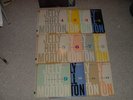
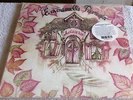
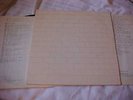
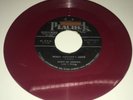
LED ZEPPLIN III 1970 LP Volvelle Spinning Disk Cover IMMIGRANT SONG GALLOWS POLE
$
25


Favourite Auctions
To save auctions to your favourites, please login
If you don't have an account, please register
Description
This is a 33 1/3 record to LED ZEPPLIN III 1970 LP Volvelle Spinning Disk Cover IMMIGRANT SONG GALLOWS POLE
A volvelle is a type of interactive paper instrument, often found in books, consisting of overlapping, rotating circles or discs used for calculations and information display.
These "moving parts" have been around for centuries, particularly in areas like astronomy, medicine, and even for creating visual aids to understand complex topics.
Here's a more detailed look:
What it is: A volvelle is essentially a paper-based, rotating chart, often made of concentric circles or discs.
These discs are typically attached at the center and can be rotated relative to each other.
Each disc has markings or windows that, when aligned, reveal information, perform calculations, or illustrate a concept.
How it works:
The user manipulates the rotating discs to align specific markings or windows.
This alignment reveals a result, a specific piece of information, or illustrates a relationship between different elements.
Think of it as an early form of a slide chart or a paper-based analog computer.
Examples of use:
Astronomy: Calculating the phases of the moon, positions of celestial bodies. Medicine: Calculating due dates, tracking menstrual cycles, illustrating anatomical relationships. General Knowledge: Displaying information on a variety of topics, such as verb conjugations, color combinations, and even inventory control.
Historical Significance:
The word "volvelle" comes from the Latin "volvere," meaning "to turn".
Volvelles have a long history, appearing in medieval Europe and potentially originating from the Arabic world.
They were used to disseminate knowledge and make complex information accessible to a wider audience.
Led Zeppelin III is the third studio album by the English rock band Led Zeppelin, released on 5 October 1970.
It was recorded in three locations.
Much of the work was done at Headley Grange, a country house, using the Rolling Stones Mobile Studio.
Additional sessions were held at Island Studios and Olympic Studios in London.
As with the prior album, the band eschewed the use of guest musicians, with all music performed by band members Robert Plant (vocals), Jimmy Page (guitars), John Paul Jones (bass, keyboards), and John Bonham (drums).
The range of instruments played by the band was greatly enhanced on this album, with Jones especially emerging as a talented multi-instrumentalist, playing a wide range of keyboard and stringed instruments, including various synthesizers, mandolin and double bass, in addition to his usual bass guitar.
As with prior albums, Page served as producer on the album, with mixing done by Andy Johns and Terry Manning.
The album showed a progression from straightforward rock towards folk and acoustic music.
While hard rock influences were still present, such as on "Immigrant Song", acoustic-based songs such as "Gallows Pole" and "That's the Way" showed Led Zeppelin were capable of playing different styles successfully.
The band wrote most of the material themselves, but as with prior records, included two songs that were re-interpretations of earlier works: "Gallows Pole", based on a traditional English folk song, by way of American singer Fred Gerlach; and "Hats Off to (Roy) Harper", a reworking of a blues song by Bukka White.
The acoustic material developed from a songwriting session between Plant and Page at Bron-Yr-Aur cottage in Wales, which influenced the musical direction.
The album was one of the most anticipated of 1970, and its shipping date was held up by the intricate inner sleeve design based around a volvelle, with numerous images visible through holes in the outer cover.
It was an immediate commercial success upon release and topped the UK and US charts.
Although many critics were initially confused over the change in musical style and gave the album a mixed response, Led Zeppelin III has since been acknowledged as representing an important milestone in the band's history and a turning point in their music.
Three songs on Led Zeppelin III were written by Page and Plant while holidaying in Bron-Yr-Aur cottage.
By 1970, Led Zeppelin had achieved commercial success in both the UK and the US with their first two albums.
They were determined to have a proper break, having recorded most of Led Zeppelin II in various locations while on tour, financing the sessions with the album sales and tour receipts.
Following an exhausting concert tour of North America that spring, lead singer Robert Plant recommended to guitarist and producer Jimmy Page that they should retreat to Bron-Yr-Aur, an 18th-century cottage in Snowdonia, Wales, on a hilltop overlooking the Dyfi Valley, three miles (4.8 km) north of the market town Machynlleth.
Plant had spent holidays there with his family.
This remote setting had no running water or electric power, which encouraged a slight change of musical direction for the band towards an emphasis on acoustic arrangements.
Page later explained that the tranquillity of Bron-Yr-Aur stood in sharp contrast to the continual touring of 1969, affecting the overall tone of the songwriting and dominance of acoustic guitars.
His playing was influenced by folk guitarists Davey Graham and Bert Jansch, who regularly used alternative guitar tunings.
Plant also recalled the band were "obsessed with change" and enjoyed listening to John Fahey.
The band specifically wanted a change in direction, to show they could play any style of music they wanted.
Minor Cover Edge Wear please see pics
THIS RECORD IS IN VINTAGE GOOD please see pics CONDITION
I HAVE NO WAY TO TEST THIS so please see pics
ITEM sold AS-IS so please see pics
.
price rating