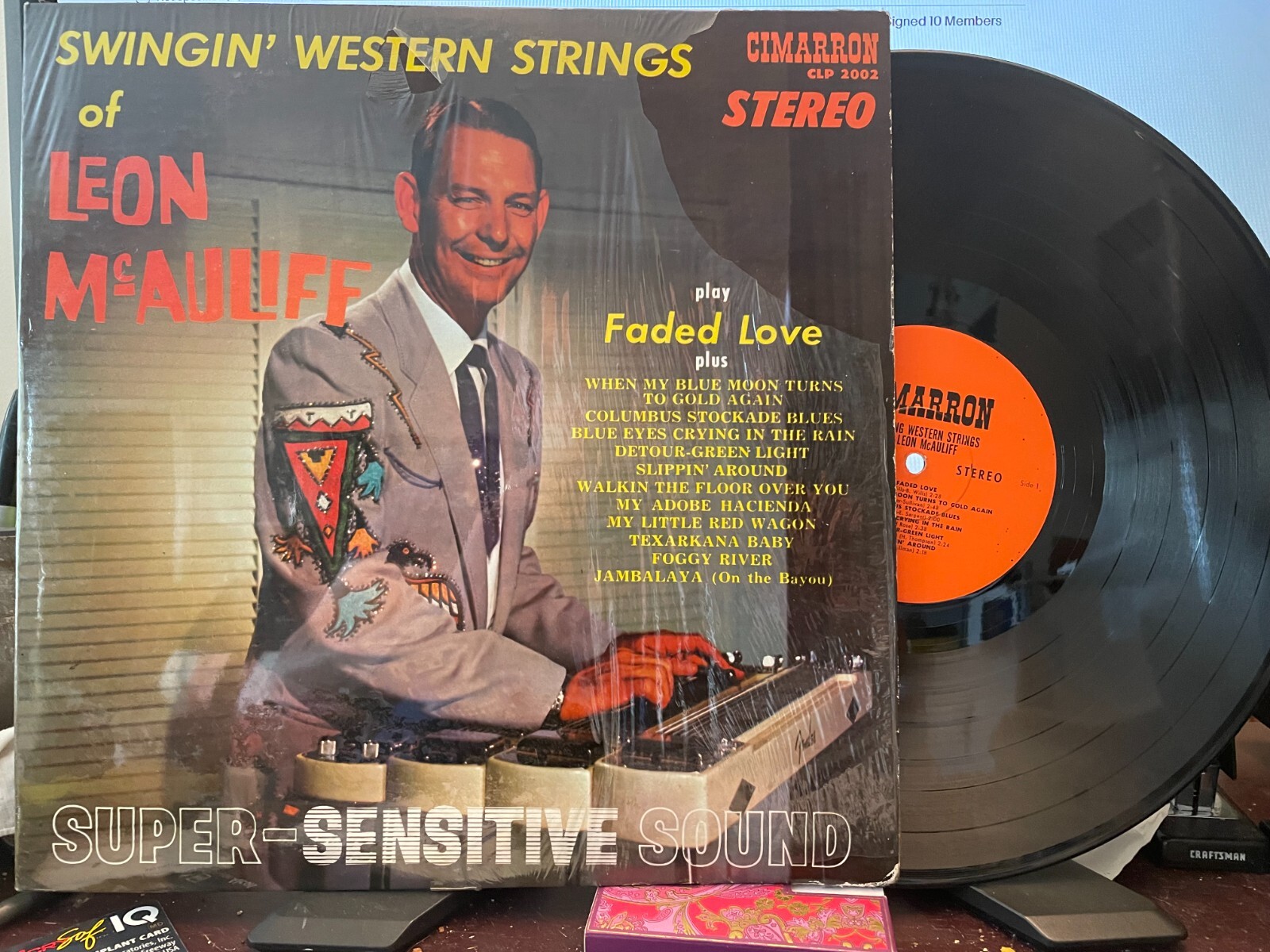
LEON McAULIFF "Swingin' Western Strings of" LP NM/NM Shrink 1962 Steel guitarist
$
33


Favourite Auctions
To save auctions to your favourites, please login
If you don't have an account, please register
Description
Leon McAuliffe Biography by Steve Huey
Steel guitarist Leon McAuliffe made his name as a member of Bob Wills' Texas Playboys, ranking as one of the best of his era on his chosen instrument. Born William Leon McAuliffe in Houston in 1917, he started playing both acoustic and steel guitar at 14, and quickly joined the Waikiki Strummers, a Hawaiian-style group, on the latter instrument in 1931. In 1933, he joined the early Western swing band the Light Crust Doughboys, and found a major influence in Milton Brown's steel guitarist Bob Dunn, who taught him how to electrically amplify his instrument. In 1935, he moved on to the Texas Playboys, who would soon become the premier Western swing band in existence. One of their earliest recordings was "Steel Guitar Rag," an instrumental showcase that McAuliffe had adapted from bluesman Sylvester Weaver's "Guitar Rag." The record helped make McAuliffe a star and a standard-setter on his instrument, and Wills' directive of "Take it away, Leon!" became something of a musical catch phrase. McAuliffe remained with the Texas Playboys until being called to serve in World War II in late 1942, during which time he worked as a flight instructor.
After the war, McAuliffe decided to form his own big band, which he dubbed the Cimarron Boys. The group played regularly on a Tulsa radio station and soon signed a contract with Columbia, and McAuliffe's instrumental showcase "Panhandle Rag" became a Top Ten hit in 1949. Over the course of the '50s, McAuliffe's band mixed down-home Western tunes with smooth big band jazz, which sometimes brought him fairly close to mainstream swing territory. He recorded for a variety of labels during the '60s, including Dot, Capitol, and Starday, but by this time Western swing was a phenomenon of the past, and he performed mostly on a local basis; he later purchased a radio station in Rogers, AR. He played on a reunion recording with Wills in 1973, and led occasional Texas Playboys reunions following Wills' death a short time later. McAuliffe himself passed away in 1988.
Leon McAuliffe – Swingin' Western Strings Of Leon McAuliff Leon McAuliffe - Swingin' Western Strings Of Leon McAuliff album cover More imagesLabel: Cimarron – CSLP-2002, Cimarron – CLP 2002 Format: Vinyl, LP, Album, Stereo Country: US Released: 1962 Genre: Folk, World, & Country Style: Country, Western Swing A1 Faded Love Written-By – B. Wills*, J. Wills* A2 When My Blue Moon Turns Gold Again Written-By – Walker - Sullivan* A3 Columbus Stockade Blues Written-By – E. Sargent*, J. Davis* A4 Blue Eyes Crying In The Rain Written-By – Fred Rose A5 Detour-Green Light Written-By – H. Thompson*, Westmoreland* A6 Slippin' Around Written-By – Floyd Tillman B1 Walking The Floor Over You Written-By – E. Tubb* B2 My Adobe Hacienda Written-By – Penny*, Massey* B3 My Little Red Wagon Written-By – Griffin* B4 Texarkana Baby Written-By – Clark*, Willing* B5 Foggy River Written-By – Fred Rose B6 Jambalaya (On The Bayou) Written-By – Hank Williams Bass – Ken Cobb Clarinet – Jack Lloyd (9) Drums – Sol Gamboa Engineer – Dick McGrew Fiddle – Bob White (6), Curly Lewis, Keith Coleman Guitar – Chuck Jennings Lead Guitar – Bill Dozier Piano – Clarence Cagle Steel Guitar – Leon McAuliffe Tenor Saxophone – Jack Lloyd (9) According to the back cover "recorded August 15 & 16, 1962 at Dallas, Texas".
GOLDMINE GRADING
MINT ---- It should appear to be perfect. No scuffs or scratches, blotches or stains, labels or writing, tears or splits. Mint means perfect.
NEAR MINT ---- Otherwise mint but has one or two tiny inconsequential flaws that do not affect play. Covers should be close to perfect with minor signs of wear or age just becoming evident: slight ring-wear, minor denting to a corner, or writing on the cover should all be noted properly.
VERY GOOD PLUS ---- The record has been handled and played infrequently or very carefully. Not too far from perfect. On a disc, there may be light paper scuffs from sliding in and out of a sleeve or the vinyl or some of the original luster may be lost. A slight scratch that did not affect play would be acceptably VG+ for most collectors.
VERY GOOD ---- Record displays visible signs of handling and playing, such as loss of vinyl luster, light surface scratches, groove wear and spindle trails. Some audible surface noise, but should not overwhelm the musical experience. Usually a cover is VG when one or two of these problems are evident: ring wear, seam splits, bent corners, loss of gloss, stains, etc.
GOOD ---- Well played with little luster and significant surface noise. Despite defects, record should still play all the way through without skipping. Several cover flaws will be apparent, but should not obliterate the artwork.
POOR ---- Any record or cover that does not qualify for the above "Good" grading should be seen as Poor. Several cover flaws..
price rating














![The Best of the Animals [Abkco] by The Animals.](https://www.popsike.mobi/php/thumbnail.php?url=https://www.popsike.pics/pix/20190402/183757904345.jpg)


