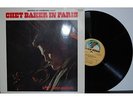
LESTER YOUNG TRIO-MERCURY MG-C-104 A & B-VERY RARE
$
51


Favourite Auctions
To save auctions to your favourites, please login
If you don't have an account, please register
Description
Lester Young
trio
UP FOR AUCTION: Lester Young “Lester Young Trio” Mercury Records MG-C-104 A & B. Under the personal supervision of Norman Granz. Long Playing Microgroove employing the Reeves-Fairchild Thermo-Dynamic Margin Control. The cover is in good condition. All three seams are torn completely. Two piece of adhesive tape hold it together. There is no sleeve. The vinyl has a little gloss wear and scatches in the inner margin. The label has the Mercury Trumpeter on both sides.
LISTEN:
I Cover The Waterfront
Somebody Loves Me
I've Found A New Baby
Back To The Land
ALBUM REVIEW:
Lester Young is a strange guy. Sometimes the most productive of jazz men; and, sometimes, seemingly barren of feeling. The reason, of course, is that his sensitivity often renders him unable to feel to play. Unless he's got "eyes" (to borrow one of his favorite expressions) nothing happens; but when he does have "eyes" - look out. For, as any musician will tell you, when Pres wants to he'll blow everyone out.
In this album Pres was right. He had with him two great rhythm men - the intelligent, tasty Aye Guy on piano, and the driving, forceful Buddy Rich on drums. He selected three standards and one blues for this album. Lester always complained he was not given enough chance to play ballads - so here I gave him the chance. I told him to go for himself, pick any ballad he liked and go to it. Lester's selection, I COVER THE WATERFRONT, lends itself to the beautiful, poignant interpretation he gives it. At the time we recorded this album, a blues date was taking place in the next studio. Pres heard it and said to me, "Let's really do some blues; some way back blues," and the blues being the Pres' idiom, he sure did, as did Aye Guy.
As it is unusual for many people to think of Lester's playing a ballad, it is just as usual for them to think of Lester's swinging in an up-tempo tune. Listen to SOMEBODY LOVES ME, and the brighter, faster FOUND
A NEW BABY. These are Lester at his best. (Incidentally, catch the wonderful humor and taste in the interplay between Buddy and Guy).
This is really the President's album I think here some of the finest, if not the finest sounds I've heard in jazz come out of his horn. I hope you ' like his sounds too.
NORMAN GRANZ
ALBUM REVIEW:
One of Lester Young's most memorable post-World War II dates came in 1946, when he entered a Los Angeles studio and formed a trio that employed Nat King Cole on piano and Buddy Rich on drums. In 1994, the results of that classic encounter, which Norman Granz produced for his Clef label, were reissued on the CD Lester Young Trio. Unfortunately, the sound is pretty scratchy, and one wishes that Verve had used digital remastering to reduce the noise. But the performances themselves are outstanding. From the blues "Back to the Land" to the soulful ballad statements of "The Man I Love" and "I Cover the Waterfront," Lester Young Trio explodes the absurd myth that Young's postwar output is of little or no value — a myth that many jazz critics have been all too happy to promote. The CD's four bonus tracks (which include "Sweet Lorraine," "Rosetta" and "I've Found a New Baby") come from a 1943 or 1944 session that didn't employ Young at all, but rather, was led by tenor saxophonist Dexter Gordon and features trumpeter Harry "Sweets" Edison and Cole, among others. Listeners might ask what that session, which was Gordon's first as a leader, has to do with Young, and the answer is that it illustrates Young's tremendous influence on Gordon. At that point, Gordon still sounded a lot like Young, was still playing swing rather than bebop and had yet to develop a recognizable sound of his own, although by 1945, Gordon would become quite distinctive and influential himself. Highly recommended.
ARTIST BIOGRAPHY:
Lester Young was one of the true jazz giants, a tenor saxophonist who came up with a completely different conception in which to play his horn, floating over bar lines with a light tone rather than adopting Coleman Hawkins' then-dominant forceful approach. A non-conformist, Young (nicknamed "Pres" by Billie Holiday) had the ironic experience in the 1950s of hearing many young tenors try to sound exactly like him.
Although he spent his earliest days near New Orleans, Lester Young lived in Minneapolis by 1920, playing in a legendary family band. He studied violin, trumpet, and drums, starting on alto at age 13. Because he refused to tour in the South, Young left home in 1927 and instead toured with Art Bronson's Bostonians, switching to tenor. He was back with the family band in 1929 and then freelanced for a few years, playing with Walter Page's Blue Devils (1930), Eddie Barefield in 1931, back with the Blue Devils during 1932-1933, and Bennie Moten and King Oliver (both 1933). He was with Count Basie for the first time in 1934 but left to replace Coleman Hawkins with Fletcher Henderson. Unfortunately, it was expected that Young would try to emulate Hawk, and his laid-back sound angered Henderson's sidemen, resulting in Pres not lasting long. After a tour with Andy Kirk and a few brief jobs, Lester Young was back with Basie in 1936, just in time to star with the band as they headed East. Young made history during his years with Basie, not only participating on Count's record dates but starring with Billie Holiday and Teddy Wilson on a series of classic small-group sessions. In addition, on his rare recordings on clarinet with Basie and the Kansas City Six, Young displayed a very original cool sound that almost sounded like altoist Paul Desmond in the 1950s. After leaving Count in 1940, Young's career became a bit aimless, not capitalizing on his fame in the jazz world. He co-led a low-profile band with his brother, drummer Lee Young, in Los Angeles until re-joining Basie in December 1943. Young had a happy nine months back with the band, recorded a memorable quartet session with bassist Slam Stewart, and starred in the short film Jammin' the Blues before he was drafted. His experiences dealing with racism in the military were horrifying, affecting his mental state of mind for the remainder of his life.
Although many critics have written that Lester Young never sounded as good after getting out of the military, despite erratic health he actually was at his prime in the mid- to late-'40s. He toured (and was well paid by Norman Granz) with Jazz at the Philharmonic on and off through the '40s and '50s, made a wonderful series of recordings for Aladdin, and worked steadily as a single. Young also adopted his style well to bebop (which he had helped pave the way for in the 1930s). But mentally he was suffering, building a wall between himself and the outside world, and inventing his own colorful vocabulary. Although many of his recordings in the 1950s were excellent (showing a greater emotional depth than in his earlier days), Young was bothered by the fact that some of his white imitators were making much more money than he was. He drank huge amounts of liquor and nearly stopped eating, with predictable results. 1956's Jazz Giants album found him in peak form as did a well documented engagement in Washington, D.C., with a quartet and a last reunion with Count Basie at the 1957 Newport Jazz Festival. But, for the 1957 telecast The Sound of Jazz, Young mostly played sitting down (although he stole the show with an emotional one-chorus blues solo played to Billie Holiday). After becoming ill in Paris in early 1959, Lester Young came home and essentially drank himself to death. Many decades after his death, Pres is still considered (along with Coleman Hawkins and John Coltrane) one of the three most important tenor saxophonists of all time.
COVER ARTIST:
David Stone Martin was born in Chicago and studied at the Chicago Art Institute there. During the 1930's and 1940's he worked for Government agencies, as supervisor of mural projects of the Federal Artists Project, art director for the Tennessee Valley Authority, graphic arts director for the Office of Strategic Services and art director for the Office of War Information, where he was a colleague and friend of Ben Shahn, the artist.
Martin's work is included in the collections of the Museum of Modern Art and the Metropolitan Museum of Art in New York City, the Art Institute of Chicago and the Smithsonian Institution. He won numerous awards from the Society of Illustrators and the Art Directors Clubs of New York City, Boston and Detroit.
His diverse pieces included illustrations for books and numerous posters, billboards and advertisements for film, television and the theater, including the Lincoln Center Repertory Theater productions of the 1960's and 1970's.
Martin's portraits for Time Magazine covers included Robert F. Kennedy, Eugene J. McCarthy, Mao Zedong and George C. Wallace. He also worked for Time's sister publication, Life Magazine.
Martin designed several hundred album covers, primarily those of jazz musicians album portraits, mostly done in distinctive heavy black-ink lines, included likenesses of Stan Getz, Count Basie, Charlie Parker, Billie Holiday, Coleman Hawkins, John Coltrane, Ella Fitzgerald, Dizzy Gillespie, Jelly Roll Morton and Duke Ellington. Martin did nearly all the covers for the Asch, Clef and Jazz at the Philharmonic labels of the 1940's and 1950's.
Terms:
1. We ship worldwide & international bidders are appreciated.
2. We are proud to offer honest descriptions & expert packing.
3. We pack records in stiff cardboard with the record separated from the cover
4. Everything is sold as described and it is not our policy to give refunds so please read descriptions carefully & asks any questions that you may have.
5. We play test records so that any problems can be noted
6 Winning bidders must pay for item(s) won within 2 days of auction end date and if this requirement isn't met the item will be relisted.
7. Nonpaying bidders will be reported to eBay
6. We only accept payments through PayPal.
7. All packages sent within the United States are sent United States Postal System.
8. The winning bidder has the option to send as they wish, but insurance is required.
9. International packages are sent via United States Postal System First Class International we're happy to combine items to save on shipping.
10. We take no responsibility for damaged or lost packages that do not carry insurance.
Use the FREE Counters 1 million sellers do - Vendio!
price rating