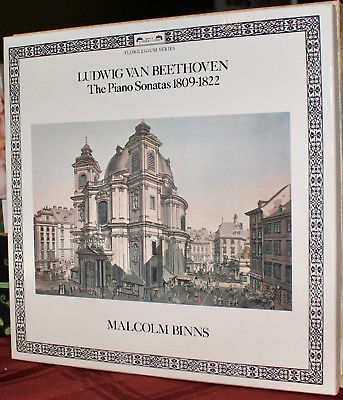
L'OISEAU LYRE 3-LPs D185D3: BEETHOVEN Piano Sonatas 1809-22, M. BINNS 1981 DUTCH
$
42


$ 42
Sold For
Aug 24, 2018
Sold Date
Nov 3, 2017
Start Date
$ 60
Start price
1
Number Of Bids
USA
Country Of Seller
eBay
Sold at
Favourite Auctions
To save auctions to your favourites, please login
If you don't have an account, please register
Description
****Welcome to our listing, thanks very much for looking!
****See our own website! We have lots of out of print and rare LPs and CDs! Find us on the web at -
hearthedifference.net
****Shipping cost is only an estimate - it depends on the actual weight and size of the package as well as the service required. We do not profit from shipping costs, so if we overcharge, we will refund the difference back to you. It's always best to wait for our invoice before paying for your item. We will combine shipping for multiple items purchased.
****Please see our other listings for more great LPs and CDs - new items added daily!
****To access our eBay store click on the little red door at the top right section of any of our eBay listings or, click on -
http://stores.ebay.com/Hear-The-Difference
Background -
Ludwig van Beethoven wrote his 32 piano sonatas between 1795 and 1822. Although originally not intended to be a meaningful whole, as a set they comprise one of the most important collections of works in the history of music. Hans von Bülow called them "The New Testament" of music (Johann Sebastian Bach's The Well-Tempered Clavier being "The Old Testament").Beethoven's piano sonatas came to be seen as the first cycle of major piano pieces suited to concert hall performance. Being suitable for both private and public performance, Beethoven's sonatas form "a bridge between the worlds of the salon and the concert hall".
Beethoven's late sonatas were some of his most difficult works and some of today's most difficult repertoire. Yet again, his music found a new path, often incorporating fugal technique and displaying radical departure from conventional sonata form. The Hammerklavier was deemed to be Beethoven's most difficult sonata yet. In fact, it was considered unplayable until almost 15 years later, when Liszt played it in a concert.
Malcolm Binns (born 29 January 1936) is a British classical pianist.
Malcolm Binns was born in Nottingham in 1936. He studied music at the Royal College of Music in London from 1952 to 1956. He made his London debut in 1957 and his Wigmore Hall debut in 1958.
He has frequently appeared at the Proms in London, starting in 1960. In 1961 he gave the British premiere of the Piano Concerto No. 4, for left hand, by Prokofiev. From 1961 to 1964 he was a professor at the RCM. He first started working in a chamber duo with the violinist Manoug Parikian in 1966.
Binns is a noted authority on British piano music, his repertoire thereof including works by Arnold Bax, Richard Rodney Bennett, William Sterndale Bennett (he has recorded 5 of the 6 piano concertos), Frank Bridge, Benjamin Britten, Hamilton Harty, John Ireland, Patrick Piggott, Alan Rawsthorne, Edmund Rubbra and Charles Villiers Stanford.
His recordings include the first complete recording of the Beethoven sonatas on original instruments, concertos by Balakirev and Rimsky-Korsakov, the Transcendental Studies of Lyapunov, works by Hummel and Medtner, as well as works from the standard repertoire by Bartók, Brahms, Chopin, Falla, Franck, Gershwin, Grieg, Liszt, Mozart, Poulenc, Rachmaninoff, Ravel and Schumann.
He has appeared with the London Philharmonic Orchestra every year since 1962. He has appeared with many other orchestras and conductors internationally and performed on numerous BBC radio broadcasts.
He celebrated his 60th birthday with an all-Chopin recital which included the complete studies from Opp. 10 and 25.
In the late 1970s Malcolm Binns became the first pianist to record all 32 Beethoven piano sonatas on period keyboard instruments. The cycle appeared in a series of boxed sets on the L'Oiseau-Lyre label and never was issued on CD--until now. Each of the last five sonatas features a different instrument, and the unusually vivid engineering certainly helps listeners assess timbral similarities and differences between them. Interestingly, both the oldest and most recent fortepianos (an 1814 Graf and an 1825 model by Georg Haschka) retain the most pronounced harpsichord-like "twang" in the upper register's highest octave. Given the lighter action and tactile immediacy characterizing such instruments, it would stand to reason that they lend themselves to the faster tempos fashionable among many of today's early-piano practitioners.
Indeed, you might argue that Beethoven's optimistic metronome markings for the Hammerklavier (Op. 106) are more viable on the fortepiano than on the heavier-action modern grand. That said, Binns generally favors measured tempos and enough rhetorical legroom to channel the spirit of Furtwängler. In other words, he's Claudio Arrau trapped in Robert Levin's body!
Slow movements and extended lyrical sequences elicit Binns' best playing. Notice the proportioned poetry he brings to Op. 109's first movement, the Hammerklavier's great Adagio, the Adagio ma non troppo leading into and including the beginning of Op. 110's fugue, and the long introduction to the Hammerklavier's fugue. By contrast, Binns treads the knotty passagework in Op. 111's first movement with inhibition and lacks rhythmic ferocity in Op. 101's March movement and the fugal finale. Op. 109's second movement is a shade square and anything but the Prestissimo Beethoven specifies, while Binns underplays Op. 110's second-movement accents and rhythmic displacements.
So far as individual releases of Beethoven sonatas on fortepiano go, the catalog offers slim pickings. To my mind, Peter Serkin's incisive, imaginative Graf fortepiano accounts of the last six sonatas for the Pro Arte label remain unsurpassed, and desperately deserve reissue. — Jed Distler, ClassicsToday.com
These recordings first appeared on a Decca L'Oiseau-Lyre LP in 1980, when Malcolm Binns was one of the pioneers of Beethoven performance on period instruments. Others have recorded Beethoven on fortepiano since, but I am not aware of any other fortepiano set of the final five sonatas currently available. Recorded on five different fortepianos of Beethoven’s time, these readings are certainly worth hearing if historical Beethoven performance interests you.
Interpretatively, Binns is no pedant. He does not adhere rigidly to metronome markings and does not play the sonatas with quick and crisp tempi and articulation, as has come to be the norm for period performance. He takes the "authentic" approach to Beethoven of playing the music with a sense of fantasy, in the moment. If you think of the young Barenboim's approach to these sonatas in his EMI recordings, and transfer that approach to period keyboards, you will have something of the flavour of Binns' readings.
Binns performs the 28th sonata on an Erard Brothers fortepiano which dates from two years after the sonata's composition. Although the action of this keyboard is Viennese - like that of all of the fortepianos used here - it is closer in design to the English action on which modern pianos are based. That being the case I expected a fuller tone from this keyboard. I found it light in the bass and a little brittle sounding. Binns’ pace in the first movement is deliberate and he separates the notes of the opening theme. I was not impressed by the central movement. It should swagger and charm, like a sailor on shore leave, but here it is awkward and clunky. The final movement is much better, with lovely phrasing, gentleness when called for, firm fingers and enough mystery in the narrative to keep you listening, a few duff notes notwithstanding.
The Hammerklavier fares better. Binns turns to a bigger, tougher instrument George Haschka of c. 1825 - a wise move, given the immensity of this sonata. Beethoven’s score does not allow Binns the luxury of using the fortepiano’s fifth pedal - the "Turkish" effect pedal, complete with bells drums and cymbals, so the liner-notes say. Binns does, however, make use of the instrument’s bright tone, firm bass and full-throated resonance. The first movement is confident, full of dynamic and colouristic contrast. Binns takes a rhapsodic approach to the third movement and the concluding fourth movement almost seems to run away from him at times - it sounds like he is wrestling with Beethoven himself! This makes for an exciting but bewildering finale. Overall, this Hammerklavier is a little wilful but cogently argued. Again there are finger slips, but it is worth looking past them.
There is a lovely performance of sonata no. 30. The first movement and second movements are tracked together. The first has a free, song-like quality, but I missed the sheer energy of Pollini in the second movement. The third, though, is satisfying under Binns’ fingers. He clearly takes Beethoven’s direction "Gesangvoll, mit innigster Empfindung" (Songful, with most intimate feeling) very much to heart. Binns plays this sonata on a 1814 John Broadwood, with a lovely rounded tone, but a slightly stiff sounding action. If Binns wrestled with Beethoven in the Hammerklavier, he wrestles with the keyboard at times here, including for a minute or so from about nine minutes into the finale.
Binns turns to an 1819 Broadwood for sonata no. 31. The instrument sounds similar to the 1814, though it seems suppler and - to my ears, at least - suffers from tuning problems in the middle and lower registers. Binns’ performance is similar in conception to his rendition of sonata no. 30, but the third movement sounds more ponderous here than reflective. Again, this seems to stem from a need to fight the keyboard a little.
The final sonata receives a better performance. This is gruff and grumpy old Beethoven, with Binns’ firm left hand and lighter right hand almost arguing with each other. The enigmatic second movement is given a monumental treatment, spiced by Beethoven’s wry honky-tonk passages. The 1835 Conrad Graf fortepiano produces a tone of darker hue than the brighter sounding Broadwoods that precede it, and is well suited to Binns’ conception.
Interpretatively, then, this Binns set is a qualified success. The performances of sonatas 29, 30 and 32 are good, though it must be conceded that the Hammerklavier is not for everyday listening; the performances of sonatas 28 and 31 are not quite on the same level. The thing I found most interesting about this set, though, is the way it debunks the period performance myth that "it must have sounded just like this in Beethoven’s day". All of these instruments - except, of course, this particular Conrad Graf - were available during Beethoven’s lifetime. In fact, Beethoven had a 1803 Erard instrument - which he did not like - and a 1816 Broadwood - which he did like - in his own collection. The instruments themselves not only sound different in tone and timbre, but their actions and responsiveness audibly force the pianist to change his touch, his tempi and inevitably his interpretation. We are used to hearing pianists shaping these sonatas according to their conception of Beethoven’s music on pliable modern instruments, and it comes as a surprise to hear the instruments themselves dictating a pianist’s approach to some degree. Listening to these performances, I am struck by just how many variables contribute to how these sonatas - which Beethoven only ever heard in his head as pure sound, uninhibited by the quirks of individual instruments - are realised in performance. Others may think differently, but for me this set vidicates the modern Steinways, Yamahas, Kawais and Stuarts as the instruments of choice for Beethoven performance.
If you are looking for a set of the last piano sonatas to live with, there are better options out there. Pollini's polished set of the last five is available on Deutsche Grammophon's Originals imprint and is consistently impressive. Brendel's performances on a Philips Duo are equally distinguished - less imposing but more human - and by programming the sonatas out of chronological order, Philips makes room for the delectable 27th sonata. These two sets are my favourites and have been for many years. As a supplement and an historical corrective, though, Binns’ set is instructive, and one to which I will return. - Tim Perry
-
LP made by L'Oiseau Lyre Records, in the NETHERLANDS / HOLLAND / DUTCH
-
LP released in 1981
-
LP is recorded in STEREO
-
Record Catalog Number: D185D3
-
Record Labels are primarily PURPLE with SILVER lettering.
Beethoven // Malcolm Binns
LP title and music on this rare item -
The Piano Sonatas 1809-1822
Tracks -The Late Piano Sonatas - 1809-1822
• No. 24, op. 78, F sharp minor
• No. 25, op. 59, F major
• No. 26, op. 81a, E flat major (Les adieux)
• No. 27, op. 90, E minor
• No. 28, op. 101, A major
• No. 29, op. 106, B flat major (Hammerklavier)
• No. 30, op. 109, E major
• No. 31, op. 110, A flat major
• No. 32, op. 111, C minor
Performers / Credits -
• Piano – Malcolm Binns
Other Information -
Includes a 24-page, full sized libretto Box-set ? 1981
CONDITION Details:
The 3-LP box is in near mint minus condition! The box has NO splits or crushed corners! The corners and seams are solid with just some light shelf wear. The colors on the box are sharp and clean (see pictures with this listing as they are of the actual item).
The set comes complete with a large format paper insert/libretto.
The 3-LPs are in near mint minus condition! We found that the vinyl looked superb on this vintage LP set. There are no significant marks and the LPs retain much of the original gloss and sheen - obviously well taken care of! They do have a bit of dust and perhaps a finger print or two on them so they should be cleaned before playing. There are NO serious spindle marks on the record labels either. Just beautifully made vinyl! That said, acquiring a vintage LP like this is for the performance and rarity of the LP, not necessarily for the sound quality.A Short Note About LP GRADING -
- Mint = Only used for sealed items.
- Near Mint = Virtually flawless in every way.
- Near Mint Minus = Item has some minor imperfections, some audible.
- Excellent = Item obviously played and enjoyed with some noise.
- Very Good Plus = Many more imperfections which are noticeable and obtrusive.
For best results, always thoroughly clean your LPs before playing them.
LPs can be audiophile quality pressings (any collector of fine MFSL, half speeds, direct to discs, Japanese/UK pressings etc., can attest to the difference a quality pressing can make to an audio system).
Don't let this rarity slip by!!!price rating