LONDON 3-LP Box OSA-1391: Léo Delibes - Lakme - R. BONYNGE - 1973 UK ? SEALED
C$
60
$
43


Favourite Auctions
To save auctions to your favourites, please login
If you don't have an account, please register
Description
****Welcome to our listing, thanks very much for looking!
****See our own website! We have lots of out of print LPs and CDs! Find us on the web at -
hearthedifference.net
****Please see our other listings - new items added daily!
****Shipping cost is only an estimate - it depends on the actual weight and size of the package as well as the service required. We do not profit from shipping costs, so if we overcharge, we will refund the difference back to you. It's always best to wait for our invoice before paying for your item. We will combine shipping for multiple items purchased.
Background -
Factory SEALED since 1973Lakmé is a three-act opera with a libretto by Edmond Gondinet and Philippe Gille. Gondinet thought the subject particularly suited to the soprano voice of Marie van Zandt, a rising young vocal star whom he admired. The subject comes from a novel by Pierre Loti. Delibes composed the music between 1881 and 1882, but the premiere took place the following April 1883 at the Opéra-Comique of Paris. Typical of its age, the story makes use of an exotic location, Hindu religious rituals, tension and conflict between the natives and the British settlers, and conflicts surrounding the two main lovers, who both have obligations and loyalties that war with their passion for one another. The music is rich and sensuous, with an oriental flavor during the crowd scenes and scenes of religious rites. This oriental flavor defines the ambiance of the story, giving an aural background even where there is no narrative. Meyerbeer's L'Africaine makes similar use of the contrasts between Europeans and "pagans," and also has a love triangle which crosses ethnic boundaries in much the same way. And the subtle colors and harmonies that create this "exotic" world blending European culture with foreign elements were also inspired by Meyerbeer and Bizet. The opera was very well-received by the public and was produced many times at the Opéra-Comique. It achieved international popularity as well, and all in all is as great a work as Delibes' ballets Sylvia and Coppélia.
Lakmé was based on a novel by Pierre Loti, with strong autobiographical elements inspired by a romance the author experienced while living in Tahiti. Rarahu, the woman involved, eventually died from alcoholism. The basic outline of the story was retained, but Delibes transferred the story to India so that the cultural conflict could be one between the British and the Brahmin Hindus. And instead of alcohol being the cause of his heroine's downfall, Delibes chose as the means of her demise the poetic device of a poisonous flower, the datura (which outside of the operatic stage is not deadly).
The hinge-piece of the opera is the famous "Bell Song" (De la fille du paria). It is sung by Lakmé at the behest of her father, the Brahmin priest Nilakantha. Unbeknownst to her, he intends to use her beauty and beautiful singing to ensnare a trespasser. A British officer named Gérald is one of a group of Englishmen who has trespassed on holy ground despite a warning that this was forbidden on pain of death. He saw Lakmé and fell in love with her instantly, and she with him. Nilakantha observed the last part of their meeting, but fled without being clearly seen.
Delibes' topic suggested musical contrasts between the British and the Eastern characters and locales; it is modal melodies that give the opera its distinctiveness and particular charm. Besides the wonderful "Bell Song, " there are various "Oriental" dances and passages intended to depict Hindu ceremonial music. Even though the growth of world-spanning media and field recordings has shown us just how inauthentic this music is, the opera continues to seem exotic in mood. Even though the opera is a fairly rare visitor to the stage outside France, the "Bell Song" has always been popular - Rovi
Conductor Richard Bonynge began his studies at the New South Wales Conservatorium in Sydney as a piano student of Lindley Evans, a former accompanist of renowned Australian soprano Nellie Melba. At 14, Bonynge performed the Grieg Piano Concerto in A minor, an impressive beginning to an even more magical career. He later continued his studies at the Royal College of Music in London with pianist Herbert Fryer. This institution frowned upon his desire to add conducting to his course load as, effectively, a second major area of study. Consequently, Bonynge forfeited his scholarship and continued his education privately. Also, having developed a serious interest in vocal technique, Bonynge began serving as accompanist to soprano Joan Sutherland. This relationship led to the couple's marriage in 1954, perhaps the most remarkable such professional union to date. It was at this point that the young musician transferred his attention to research of the bel canto operatic repertoire.
His debut on the podium in 1962 was sudden: the conductor of the Saint Cecilia Orchestra in Rome canceled due to illness and his replacement was struck by an automobile, leaving only Bonynge to take the podium. He began, still without formal training, to conduct Sutherland's performances, beginning with Gounod's Faust in Vancouver and Bellini's La Sonnambula in San Francisco, both in 1963. After his Covent Garden debut in 1964 with a performance of Bellini's I Puritani, Bonynge and his wife returned to Australia the next year. There he assumed the position of music director of the Sutherland-Williamson International Grand Opera Company.
In 1966, Bonynge had his Metropolitan Opera debut with Sutherland performing the title role in Donizetti's Lucia di Lammermoor. As his reputation and career blossomed, the conductor enjoyed continued success when he was named artistic director of the Vancouver Opera, a position he held from 1974-1978. Concurrently, Bonynge acted as music director of the Australian Opera from 1975-1986. In 1977, he was awarded the Commander of the British Empire. In 1983 he was given the same honor in his native Australia, and in 1989 the French government gave him the rank of Commandeur de l'Ordre National de Mérite.
Bonynge championed a revival of the vocal ornamentation that had been customary during the late eighteenth and early nineteenth centuries. This period was dear to Bonynge, who has carefully studied the operas of Bellini as well as French opera of the period, and has composed cadenzas used by many singers (including Sutherland). One of the world's premiere opera conductors, Bonynge has directed the masterpieces of the genre at the leading opera houses worldwide. His list of recorded operas is no less impressive and includes many works (including a number of nineteenth century ballet scores) previously not familiar to opera connoisseurs, such as those by Delibes, Graun, and Massenet. Most of these recordings feature Sutherland.
At Joan Sutherland's last performances, Bonynge conducted in front of audiences in the United States, Great Britain, and Australia. After she had left the stage for the last time, Bonynge continued his acclaimed career without pause. He remains one of opera's most important figures and is an important supporter of Australian singers and of the young artists' program at the Australian Opera, established during his tenure as music director. With unquestionable devotion, Richard Bonynge gives his full attention to the world of opera. He has said, "I did not choose music, music chose me." One might observe, then, that opera chose a tireless and devoted champion. - David Brensilver
-
LPs made by LONDON Records, in either the UK or the NETHERLANDS (can't tell as this item is FACTORY SEALED)
-
LPs released in 1969
-
LPs are recorded in STEREO
-
Record Catalog Number: OSA 1391
-
Item is FACTORY SEALED
Léo Delibes // Richard Bonynge & Monte Carlo Opera Orchestra & Chorus
Léo Delibes: Lakmè
Track Listing -
LakmèA1. Prelude, Act One
A2. Act One
B1. Act Two
B2. Act Two
C1. Entr'acte, Act Three
C2. Act Three
Performers / Credits / Other Information -
• Baritone Vocals – Claude Calès
• Bass Vocals – Gabriel Bacquier
• Chorus – Monte Carlo Opera Chorus
• Composed By – Léo Delibes
• Conductor – Richard Bonynge
• Mezzo-soprano Vocals – Jane Berbié, Monica Sinclair
• Orchestra – Monte Carlo Opera Orchestra
• Soprano Vocals – Gwenyth Annear, Joan Sutherland, Josephte Clément
• Tenor Vocals – Alain Vanzo, Emile Belcourt
Contains 24-page full-size booklet, with synopsis, libretto and English translation.
Recorded: October 1967
CONDITION Details:
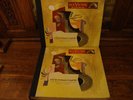
The 3-LP box is in near mint condition as this item is FACTORY SEALED! The box has NO splits or crushed corners and NO cut out marks. The corners and seams are solid. The colors on the box are sharp and clean. The second picture shown with this listing is of an OPEN copy of this title. The item for sale here is FACTORY SEALED.
The 3-LPs are assumed to be in mint condition as this item is factory SEALED!
A Short Note About LP GRADING -- Mint = Only used for sealed items.
- Near Mint = Virtually flawless in every way.
- Near Mint Minus = Item has some minor imperfections, some audible.
- Excellent = Item obviously played and enjoyed with some noise.
- Very Good Plus = Many more imperfections which are noticeable and obtrusive.
For best results, always properly clean your LPs before playing them.
The LP is an audiophile quality pressing (any collector of fine MFSL, half speeds, direct to discs, Japanese/UK pressings etc., can attest to the difference a quality pressing can make to an audio system).
Do not let this rarity slip by!
price rating