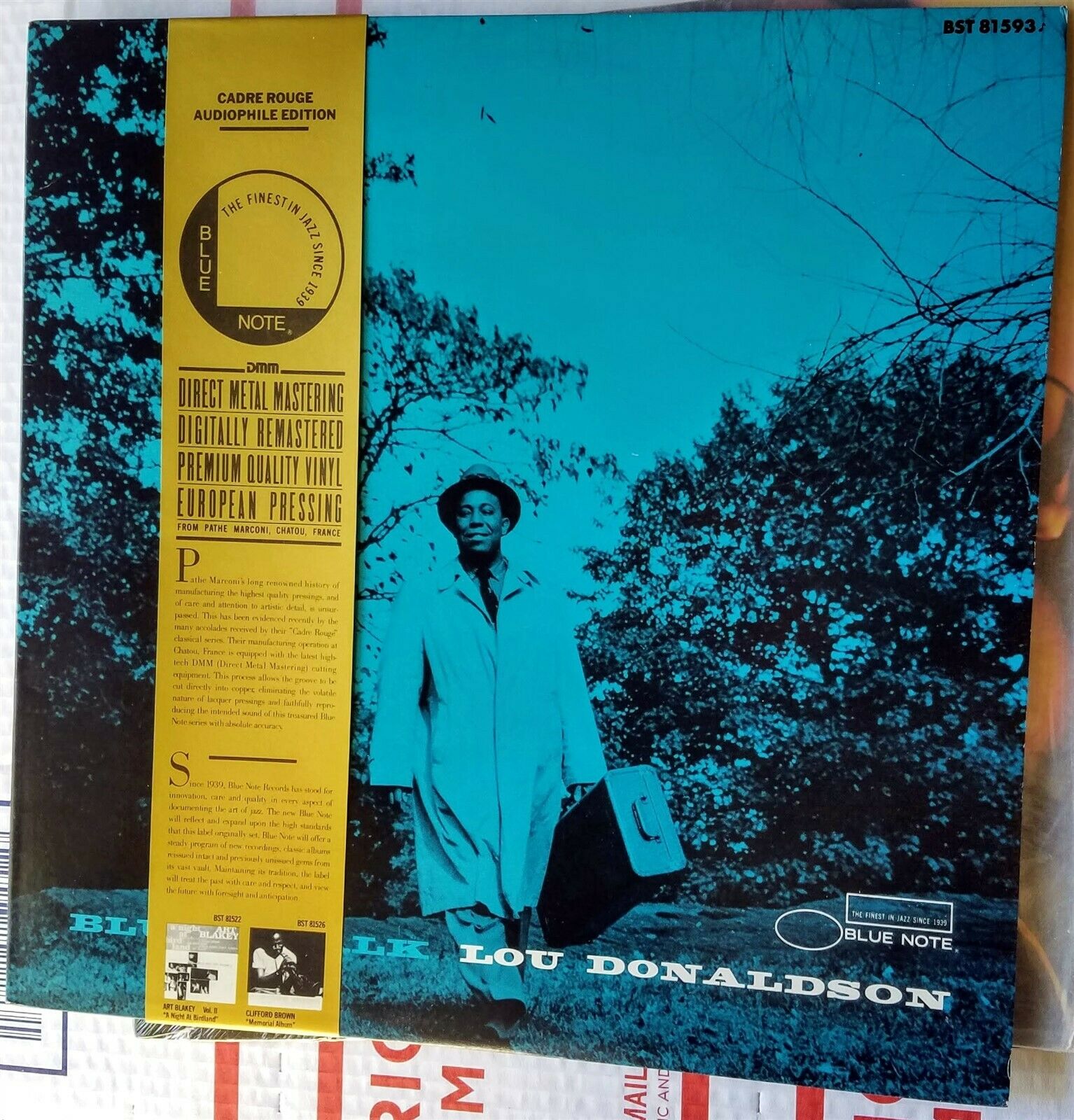
LOU DONALDSON Blues Walk LP NM+Obi BLUE NOTE Cadre Rouge audiophile remaster DMM
$
48



Favourite Auctions
To save auctions to your favourites, please login
If you don't have an account, please register
Description
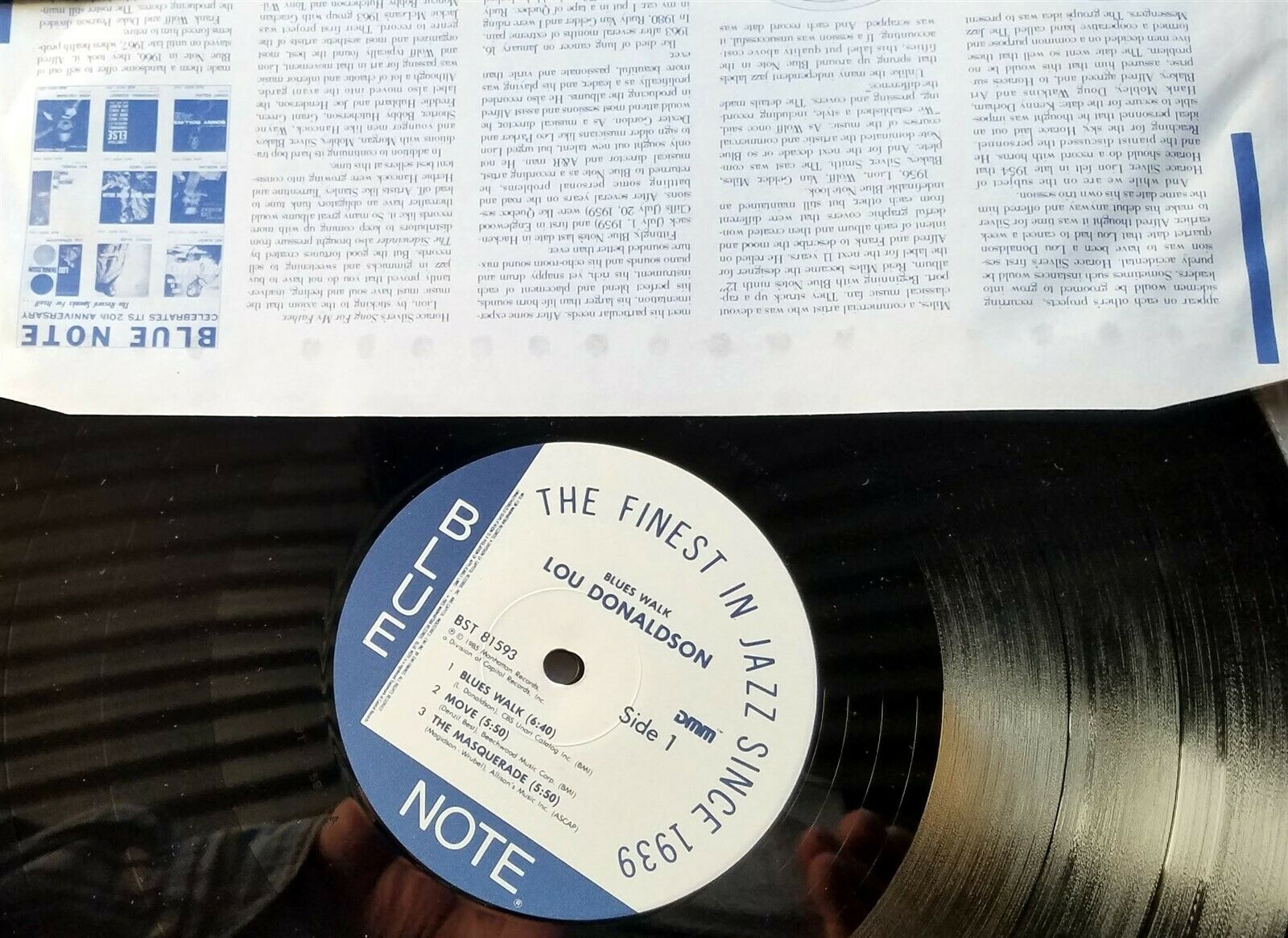
Record: Near Mint (NM or M-) near new, looks unplayed Cover: Very Good Plus (VG+) NO cut-out marks, NO splits, NO stickers, NO writing Labels: Clean! Lou Donaldson Blues Walk 1985 United States Blue Note BST 81593 12" Stereo LP SB-59619
Lou Donaldson
Blues Walk
1985 United States Blue Note 12" LP
Cadre Rouge series audiophile European press
Condition
Vinyl: Near Mint (NM or M-) near new, looks unplayed
Sleeve: Very Good Plus (VG+) with Obi intact NO cut-out marks, NO splits, NO stickers, NO writing
Please see item specifics section above for more details
Tracks:
Lou Donaldson ?– Blues Walk Label: Blue Note ?– BST 81593 Series: Cadre Rouge Audiophile Edition – Format: Vinyl, LP, Album, Reissue, Remastered, DMM Country: US Released: 1985 Genre: Jazz Style: Bop Tracklist Hide Credits A1 Blues Walk Written-By – L. Donaldson* 6:40 A2 Move Written-By – Denzil Best 5:50 A3 The Masquerade Is Over Written-By – Wrubel*, Magidson* 5:50 B1 Play Ray Written-By – L. Donaldson* 5:29 B2 Autumn Nocturne Written-By – Josef Myrow 4:51 B3 Callin' All Cats Written-By – L. Donaldson* 5:10 Companies, etc. Manufactured By – EMI France Phonographic Copyright (p) – Manhattan Records Copyright (c) – Manhattan Records Recorded At – Van Gelder Studio, Hackensack, New Jersey Pressed By – Pathé Marconi EMI, Chatou – 349351 Pressed By – Pathé Marconi EMI, Chatou – 349352 Published By – CBS Unart Catalog, Inc. Published By – Beechwood Music Corp. Published By – Allison's Music Inc. Published By – Warner Bros. Music, Inc. Credits Alto Saxophone – Lou Donaldson Bass – 'Peck' Morrison* Congas – Ray Barretto Drums – Dave Bailey Liner Notes – Ira Gitler Photography By [Cover Photo] – Francis Wolff Piano – Herman Foster Producer – Alfred Lion Recorded By [Recording By] – Rudy Van Gelder Notes Recorded on July 28, 1958. ?© 1985 Manhattan Records, a division of Capitol Records, Inc. A1, B1, B3 published by CBS Unart Catalog, Inc., BMI A2 published by Beechwood Music Corp., BMI A3 published by Allison's Music Inc., ASCAP B2 published by Warner Bros. Music, Inc., ASCAP (appears as Warner Bros., Inc.) Barcode and Other Identifiers Barcode (Text): 0 7777-81593-1 Barcode (Scanned): 077778159315 Matrix / Runout (Runout A, stamped): BST 81593 DA 21 M9 349351 3 Matrix / Runout (Runout B, stamped): BST 81593 DB 21 M9 349352 3 Rights Society (A1, A2, B1, B3): BMI Rights Society (A3, B2): ASCAP
LOU DONALDSON Blues Walk LP NM+Obi BLUE NOTE Cadre Rouge audiophile remaster DMM Lou Donaldson (born November 1, 1926) is a retired American jazz alto saxophonist. He is best known for his soulful, bluesy approach to playing the alto saxophone, although in his formative years he was, as many were of the bebop era, heavily influenced by Charlie Parker.[1] Contents Life and career Donaldson was born in Badin, North Carolina.[2] He attended North Carolina Agricultural and Technical State University in Greensboro[3] in the early 1940s. He enlisted in the U.S. Navy during World War II and was trained at the Great Lakes bases in Chicago where he was introduced to bop music in the lively club scene. At the war's conclusion, he returned to Greensboro, where he worked club dates with the Rhythm Vets, a combo composed of A and T students who had served in the U.S. Navy. The band recorded the soundtrack to a musical comedy featurette, Pitch a Boogie Woogie, in Greenville, North Carolina, in the summer of 1947. The movie had a limited run at black audience theatres in 1948 but its production company, Lord-Warner Pictures, folded and never made another film. Pitch a Boogie Woogie was restored by the American Film Institute in 1985 and re-premiered on the campus of East Carolina University in Greenville the following year. Donaldson and the surviving members of the Vets performed a reunion concert after the film's showing. In the documentary made on Pitch by UNC-TV, Boogie in Black and White,[4] Donaldson and his musical cohorts recall the film's making—he originally believed that he had played clarinet on the soundtrack. A short piece of concert footage from a gig in Fayetteville, North Carolina, is included in the documentary.[5] Donaldson's first jazz recordings were with the Charlie Singleton Orchestra in 1950 and then with bop emissaries Milt Jackson and Thelonious Monk in 1952,[6] and he participated in several small groups with other prominent jazz musicians such as trumpeter Blue Mitchell, pianist Horace Silver, and drummer Art Blakey.[1] In 1953, he also recorded sessions with the trumpet virtuoso Clifford Brown, and Philly Joe Jones. He was a member of Art Blakey's Quintet and appeared on some of their best regarded albums, including the two albums recorded at Birdland in February 1954 Night at Birdland.[7] He was inducted into the North Carolina Music Hall of Fame on October 11, 2012.[8] Also in 2012, he was named a NEA Jazz Master by the National Endowment for the Arts.[9] Jazz 1950s,Bebop Audiophile,Stock Label Inner Sleeve(s) 33 RPM Blue Note Records is an American jazz record label owned by Universal Music Group and operated under Capitol Music Group.[1] Established in 1939 by Alfred Lion and Max Margulis, it derived its name from the blue notes of jazz and the blues. Originally dedicated to recording traditional jazz and small group swing, the label switched its attention to modern jazz around 1947. Contents History Historically, Blue Note has principally been associated with the "hard bop" style of jazz (mixing bebop with other forms of music including soul, blues, rhythm and blues and gospel), but also recorded essential albums in the avant-garde and free styles of jazz. Horace Silver, Jimmy Smith, Freddie Hubbard, Lee Morgan, Art Blakey, Grant Green, Hank Mobley, Wayne Shorter, Bobby Hutcherson, and Jackie McLean were among the label's leading artists. During its heyday, the 1950s and 1960s, the photography and graphic art of Reid Miles created a series of iconic album covers, often incorporating session photos by Wolff, which added to Blue Note's artistic reputation. Early years Lion first heard jazz as a young boy in Berlin. He settled in New York City in 1937, and shortly after the first From Spirituals to Swing concert, recorded pianists Albert Ammons and Meade Lux Lewis in 1939 during a one-day session in a rented studio. The Blue Note label initially consisted of Lion and Max Margulis, a communist writer who funded the project. The label's first releases were traditional "hot" jazz and boogie woogie, and the label's first hit was a performance of "Summertime" by soprano saxophonist Sidney Bechet, which Bechet had been unable to record for the established companies. Musicians were supplied with alcoholic refreshments, and recorded in the early hours of the morning after their evening's work in clubs and bars had finished. The label soon became known for treating musicians uncommonly well—setting up recording sessions at congenial times, and allowing the artists to be involved in all aspects of the record's production. Francis Wolff, a professional photographer, emigrated to the US at the end of 1939 and soon joined forces with Lion, a childhood friend. In 1941, Lion was drafted into the army for two years. Milt Gabler at the Commodore Music Store offered storage facilities and helped keep the catalog in print, with Wolff working for him. By late 1943, the label was back in business recording musicians and supplying records to the armed forces. Willing to record artists that most other labels would consider to be uncommercial, in December 1943 the label initiated more sessions with artists such as pianist Art Hodes, trumpeter Sidney DeParis, clarinetist Edmond Hall, and Harlem stride pianist James P. Johnson, who was returning to a high degree of musical activity after having largely recovered from a stroke suffered in 1940. Lion and Wolff embrace bebop Towards the end of the war, saxophonist Ike Quebec was among those who recorded for the label. Quebec would act as a talent scout for the label until his death in 1963. Although stylistically belonging to a previous generation, he could appreciate the new bebop style of jazz, the creation of which is usually attributed to Dizzy Gillespie and Charlie Parker. In 1947, pianist Thelonious Monk recorded his first sessions as a leader for the label, which were also the Blue Note debut of drummer Art Blakey, who also recorded his first session as leader for the label at this time. Lion recorded several Monk sessions before he began to release the resulting sides. Monk's recordings for Blue Note between 1947 and 1952 did not sell well for some years, but have since come to be regarded as the most important of his career. Other bebop or modernist musicians who recorded for Blue Note during the late forties and early fifties were pianist Tadd Dameron, trumpeters Fats Navarro and Howard McGhee, saxophonist James Moody and pianist Bud Powell. The sessions by Powell are commonly ranked among his best. J. J. Johnson and trumpeter Miles Davis both recorded several sessions for Blue Note between 1952 and 1954, but by then the musicians who had created bebop were starting to explore other styles. The recording of musicians performing in an earlier jazz idiom, such as Sidney Bechet and clarinettist George Lewis, continued into the 1950s. Hard bop and beyond In 1951, Blue Note issued their first vinyl 10" releases. The label was soon recording emerging talent such as Horace Silver (who would stay with Blue Note for a quarter of a century) and Clifford Brown. Meanwhile, Milt Jackson (as the leader of what became the Modern Jazz Quartet) and the Jazz Messengers (originally organised as a cooperative, but soon to become Art Blakey's group) recorded for Blue Note. The Milt Jackson Quartet session was a one-off, but Blakey's various groups recorded for the label extensively, if intermittently, for the next decade. Rudy Van Gelder recorded most Blue Note releases from 1953, after Lion and Van Gelder's mutual friend, saxophonist and composer Gil Melle, introduced them. A difference between Blue Note and other independent labels (for example Prestige Records, who also employed Van Gelder) was that musicians were paid for rehearsal time prior to the recording session: this helped ensure a better end result on the record. Producer Bob Porter of Prestige Records once said that "The difference between Blue Note and Prestige is two days' rehearsal.[2] When the recording industry switched to 12" LP in the mid-1950s, Blue Note was in difficulties. Their catalog on the now outmoded 10" LP now had to be recreated on the newer format. Lion contemplated selling out to Atlantic at this time, an option which was not acted upon. A musician who was to become one of the label's best sellers was discovered. Jimmy Smith, the Hammond organist was signed in 1956, and performed on the label's first 12" LP album of new recordings. The mid to late 1950s saw debut recordings for Blue Note by (among others) Hank Mobley, Lee Morgan, Herbie Nichols, Sonny Clark, Kenny Dorham, Kenny Burrell, Jackie McLean, Donald Byrd and Lou Donaldson. Sonny Rollins recorded for the label in 1956 and 1957 and Bud Powell briefly returned. John Coltrane's Blue Train, and Cannonball Adderley's Somethin' Else (featuring Miles Davis in one of his last supporting roles) were guest appearances on the label. Blue Note was by then recording a mixture of established acts (Rollins, Adderley) and artists who in some cases had recorded before, but often produced performances for the label which by far exceeded earlier recordings in quality (Blue Train is often considered to be the first significant recording by Coltrane as a leader). Horace Silver and Art Blakey and the Jazz Messengers continued to release a series of artistically and commercially successful recordings. The early 1960s saw Dexter Gordon join the label. Gordon was a saxophonist from the bebop era who had spent several years in prison for narcotic offences, and he made several albums for Blue Note over a five-year period, including several at the beginning of his sojourn in Europe. Gordon also appeared on the debut album by Herbie Hancock - by the mid 1960s, all four of the younger members of the Miles Davis quintet (Hancock, Wayne Shorter, Ron Carter and Tony Williams) were recording for the label, and Hancock and Shorter in particular produced a succession of superb albums in a mix of styles. Carter did not actually record under his own name until the label's revival in the 1980s, but played double bass on many other musicians' sessions. Many of these also included Freddie Hubbard, a trumpeter who also recorded for the label as a leader. One of the features of the label during this period was a "family" of musicians (Hubbard, Hancock, Carter, Grant Green, Joe Henderson, Kenny Dorham, Lee Morgan, Blue Mitchell, Hank Mobley and many others) who would record as sidemen on each other's albums without necessarily being part of the leader's working group. The early 1960s also saw three Blue Note recordings by pianist/composer Freddie Redd, one of which, The Connection, used music written for the play by Jack Gelber and its film version. In 1963, Lee Morgan scored a significant hit with the title track of The Sidewinder album, and Horace Silver did the same the following year with Song for My Father. As a result, Lion was under pressure by independent distributors to come up with similar successes, with the result that many Blue Note albums of this era start with a catchy tune intended for heavy airplay in the United States. At the end of the 1950s, and in the early 1960s, Blue Note headquarters were located in New York City, at West 61st Street,[3][4][5] and at 47 W 63rd Street.[6] The avant-garde Although many of the acts on Blue Note were recording jazz for a wide audience, the label also documented some of the emerging avant-garde and free jazz players. Andrew Hill, a highly individual pianist, made many albums for the label, one featuring multi-instrumentalist Eric Dolphy. Dolphy's Out to Lunch! (featuring a celebrated cover by Reid Miles) is perhaps his best-known album. Saxophonist Ornette Coleman released two albums recorded with a trio in a Stockholm club, and three studio albums (including The Empty Foxhole, with his then ten-year-old son Denardo Coleman on drums). Pianist Cecil Taylor recorded a brace of albums for Blue Note, as did trombonist Grachan Moncur III, and saxophonist Sam Rivers, drummer Tony Williams, vibraphonist Bobby Hutcherson and organist Larry Young also recorded albums which diverged from the "hard bop" style usually associated with the label. Saxophonist Jackie McLean, a stalwart of the label's hard bop output since the late 1950s, also crossed over into the avant-garde in the early 1960s, whose notable avant-garde albums included One Step Beyond, Destination Out and on (as a side man) trombonist Grachan Moncur III's "Evolution". Though these avant-garde records did not sell as well as some other Blue Note releases, Lion thought it was important to document new developments in jazz. Cover art In 1956, Blue Note employed Reid Miles, an artist who worked for Esquire magazine. The cover art produced by Miles, often featuring Wolff's photographs of musicians in the studio, was as influential in the world of graphic design as the music within would be in the world of jazz.[7] Under Miles, Blue Note was known for their striking and unusual album cover designs. Miles' graphical design was distinguished by its tinted black and white photographs, creative use of sans-serif typefaces, and restricted color palette (often black and white with a single color), and frequent use of solid rectangular bands of color or white, influenced by the Bauhaus school of design.[8] Though Miles' work is closely associated with Blue Note and has earned iconic status and frequent homage, Miles was only a casual jazz fan, according to Richard Cook;[9] Blue Note gave him several copies of each of the many dozens of albums he designed, but Miles gave most to friends or sold them to second-hand record shops. A few mid-fifties album covers featured drawings by a then-unknown Andy Warhol.[10] Some of his most celebrated designs adorned the sleeves of albums such as Midnight Blue, Out to Lunch!, Unity, Somethin' Else, Let Freedom Ring, Hub-Tones, No Room for Squares, Cool Struttin', and The Sidewinder. Lion and Wolff retire Blue Note was acquired by Liberty Records in 1965 and Lion, who had difficulties working within a larger organization, retired in 1967. Reid Miles' association with the label ended around this time. For a few years most albums were produced by Wolff or pianist Duke Pearson, who had filled Ike Quebec's role in 1963, but Wolff died in 1971 and Pearson left in the same year. George Butler was now responsible for the label. The commercial viability of jazz was in question, and more borderline and outright commercial records were made (often by artists who had previously recorded "straight" jazz for the label—Bobby Hutcherson, Lou Donaldson, Donald Byrd, Grant Green, Horace Silver).[citation needed] At the end of the 1960s, the company headquarters were moved to 1776 Broadway.[11] Revival and ownership history In 1979, EMI purchased United Artists Records, which had absorbed Liberty Records in 1971,[12] and phased out the Blue Note label, which lay dormant until 1985, when it was relaunched as part of EMI Manhattan Records, both for re-issues and new recordings for which Bruce Lundvall was appointed. Some artists previously associated with Blue Note, such as McCoy Tyner, made new recordings, while younger musicians such as Bennie Wallace, Joe Lovano, John Scofield, Greg Osby, Jason Moran and arranger–composer Bob Belden have established notable reputations through their Blue Note albums. The label has also found great commercial success with the vocalist Norah Jones, and released new albums by established artists on the fringes of jazz such as Van Morrison, Al Green, Anita Baker and newcomer Amos Lee, sometimes referred to as the "male Norah Jones". Two of the leading trumpeters of the 1980s Jazz Resurgence, Wynton Marsalis and Terence Blanchard signed with the label in 2003. Hip-hop producer Madlib recorded Shades of Blue in 2003 as a tribute to Blue Note with samples from earlier records on the label. Blue Note has pursued an active reissue program since the mid-1980s revival. and Michael Cuscuna has worked as freelance advisor and reissue producer. Some of the original Blue Note's output has appeared in CD box sets issued by Mosaic Records (also involving Cuscuna). Blue Note Records became the flagship jazz label for Capitol Jazz, and was the parent label for the Capitol Jazz, Pacific Jazz, Roulette and other labels within Capitol's holdings which had possessed a jazz line. The "RVG series", Rudy Van Gelder remastering his own recordings from decades earlier began around 1998. Lou Donaldson Blues Walk 1985 United States Blue Note BST 81593 12" LP Cover: Very Good Plus (VG+) NO cut-out marks, NO splits, NO stickers, NO writing with Obi intact Record: Near Mint (NM or M-) near new, looks unplayed Labels: Clean! SB-59619
This exquisite slice of retro music history is a vinyl sound recording (not a CD). Please reference Item Specifics above for additional detail. Strict Goldmine grading -- Over 22 years on Ebay! Combine Items to Save $$$!
©A Sound Deal
price rating