LUC FERRARI:ELECTRONIC LP KAGEL-STOCKHAUSEN-XENAKIS-NWW
$
33


Favourite Auctions
To save auctions to your favourites, please login
If you don't have an account, please register
Description
LUC FERRARI
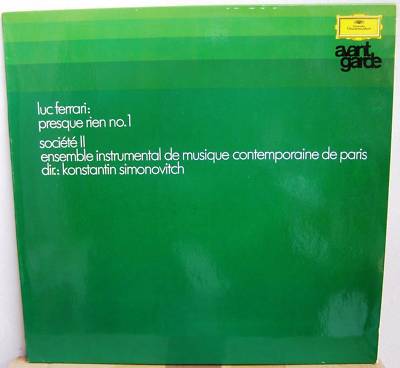
PRESQUE RIEN No1 / SOCIETE II LP
Deutsche Grammophon
Original 1st edition of Luc Ferrari's masterpiece that initiated a whole new genre of music: field recordings. "Music is all around us if only we had ears" (J. Cage).
Some info on the release: By 1970 Luc Ferrari had completed Presque Rien No. 1, a kind of musical photography, in which unassuming ambient sounds of a small village in Yugoslavia, recorded throughout a long day, are telescoped by means of seamless dissolves into a 21-minute narrative in which no apparent “musical” sounds are included. When the work was issued on a Deutsche Grammophon LP worldwide the response was first one of shock and then revelation. Finally, John Cage’s exhortation that “music is all around us if only we had ears,” had been taken seriously by a fellow composer. The piece documents a day on a beach. Ferrari's sound diary includes the sounds of insects and other animals, traffic, and human voices. He referred to this genre of his work, characterized by the use of sounds to tell a story, as 'anecdotal music'. In his words, "The problem is to try to express ideas, feelings, passing intuitions by different means to observe everyday life in all its realities, whether they are social, psychological or sentimental."
The work and aesthetics of Luc Ferrari continue to have a singular impact on several generations of American avant-garde composers. Like Alvin Lucier, Ferrari first obtained a thorough, traditional technique in composition. He took piano lessons with Alfred Cortot, composition lessons with Arthur Honegger and musical analysis with Olivier Messiaen. But he proceeded to become interested in the recording process to such a degree that he began to make tape pieces using altered ambient sounds and later incorporated electronics into his work in an effective and original manner.
In 1954, his life altered radically when he boarded a ship and traveled to New York to meet Edgard Varèse, after having been impressed by live radio broadcast of his Déserts for tape and orchestra. From Varèse, Ferrari learned to treat sound as a thing in and of itself; also to place sound objects in the right time and space, from both an audio and psychological point of view. By 1963-4 he had begun Hétérozygote, an extended tape piece in which ambient sounds unfold in narrative form, suggesting a dazzling variety of incidents, all unexplained. The composer’s program notes for these scores, themselves works of a poetic imagination, only added to the fascination.
Shortly thereafter, Ferrari appeared on KPFA Radio in Berkeley, and his interviewers, Richard Friedman and Charles Amirkhanian, decided to follow his lead and solicit ambient sound recordings from individuals all over the globe. The World Ear Project of KPFA proceeded to broadcast hundreds of such tapes, made on then-new cassette machines in the field, and numerous composers on the West Coast began to incorporate such sounds into their electronic works.
Beyond the mere acceptance of ambient sounds as musical, Ferrari found that his forays with the professional tape recorder into public places added a level of social engagement to his work. This led him to compose pieces in which the audience becomes voyeuristically involved with a kind of audio home movie. In such a state, a great deal is suggested, which is why radio remains such a powerful medium, even in the face of the wide acceptance of television. The disembodied voice of a human being in Ferrari’s work lures in the listener into an intimacy which is palpable.
Beyond his work involving technology, Ferrari has composed a large body of instrumental music, ranging from very early piano solos to works for large orchestra, such as Histoire du plaisir et de la désolation (1979-81), a towering 35-minute work in three movements which won the International Koussevitsky Prize for recordings when it was released in 1990. And among his important credits are a series of invaluable television films which he made about the rehearsal processes of Varése, Messiaen, Stockhausen and others. Ferrari belongs to the tradition of composers that researched the artistic routes opened by composers as John Cage, David Tudor, Detoni, Henri Chopin, Jon Appleton and Andre Almuro, Alvin Curran, Parmegiani and of course Iannis Xenakis, Richard Maxfield, Tod Dockstader, Jacques Lejeune and Christian Clozier, Herbert Eimert. Luc Ferrari is also featured in the Nurse with wound list of influences.
Condition: Vinyl lies in mint condition, looks unplayed and crystal clear, while cover lies in mint- condition, nearly perfect.
Tracklist
A Presque Rien No 1 (Le Lever Du Jour Au Bord De La Mer) Producer [Realized By], Mixed By - Luc Ferrari B Société II (Et Si Le Piano Était Un Corps De Femme) Composed By - Luc FerrariConductor - Konstantin Simonovitch
Engineer - Heinz Wildhagen
Ensemble - Ensemble Instrumental De Musique Contemporaine De Paris
Percussion - Gaston Sylvestre, Jean-Pierre Drouet, Sylvio Gualda
Piano - Gérard Frémy
Supervised By [Artistic Supervision] - Hansjoachim Reiser
SHIPPING & PAYMENT
Shipping: Shipping for this LP is 7$ airmail in Europe / 9$ for the rest of the world
Registered mail: +5$
Insurance: optional
Combined shipping: BIG discounts
Payment: Paypal
Packaging: I am a collector too and i know
price rating
![Carl Perkins - Some Things Never Change - Blue [New Vinyl LP] Blue, Colored Viny](https://www.popsike.mobi/php/thumbnail.php?url=https://www.popsike.pics/pix/20251024/177518577960.jpg)