? Led Zeppelin III ? Rare Atlantic Record Club Vinyl LP ? Near Mint ?
$
90


Favourite Auctions
To save auctions to your favourites, please login
If you don't have an account, please register
Description
Welcome to Classic Cadillac Records! My goal is to provide each and every customer with the best possible buying experience, no matter the size of the order. Unlike most sellers, I advertise all my items clearly and in as much detail as possible, without shouting at you in all caps. I take multiple high quality pictures and never use stock photos, so you know exactly what you’re buying. I take great pride in my work and go the extra mile, which can clearly be seen in my listings compared to other sellers that put minimal effort into theirs. I visually grade all my records as accurately as possible and will never grade anything above Near Mint unless it’s still sealed. Please note that a visual grade can differ from a play grade, and am happy to spot check a record upon request. All orders are shipped within 1 business day (usually sooner) and packed with extra care to ensure fast, safe arrival. I combine shipping on multiple orders to save you money and gladly ship worldwide. Please look closely at all pictures, read all relevant details and ask any questions you may have before buying. I offer a full 30-day return policy on everything I sell, so buy with confidence! And most importantly, thanks for looking!
Jump to navigationJump to search
Led Zeppelin III Studio album by Led Zeppelin Released 5 October 1970 Recorded November 1969 – August 1970 Studio- Rolling Stones Mobile Studio, Headley Grange, Hampshire
- Island Studios
- Olympic Studios, London
- Folk rock
- blues rock
(1969) Led Zeppelin III
(1970) Untitled
(1971) Singles from Led Zeppelin III
- "Immigrant Song"
Released: 5 November 1970
Led Zeppelin III is the eponymous third studio album by the English rock band Led Zeppelin, released in October 1970. It showed a progression from straightforward rock towards folk and acoustic music.
The acoustic material developed from a songwriting session between band members Jimmy Page and Robert Plant at Bron-Yr-Aur cottage in Wales, which influenced the musical direction. The songs were recorded using the Rolling Stones Mobile Studio, Headley Grange, Island Studios, and Olympic Studios in London. While hard rock influences were still present, such as "Immigrant Song", acoustic-based songs such as "Gallows Pole" and "That's the Way" showed Led Zeppelin were capable of playing different styles successfully.
The album was one of the most anticipated of 1970, and its shipping date was held up by the intricate inner sleeve design based around a volvelle, with numerous images visible through holes in the outer cover. It was an immediate commercial success upon release and topped the UK and US charts. Although critics were initially confused over the change in musical style and gave the album a mixed response, Led Zeppelin III has since been acknowledged as representing an important milestone in the band's history, and a turning point in their music.
Background
Many songs on Led Zeppelin IIIwere written by Jimmy Page and Robert Plant in Bron-Yr-Aur cottage in Wales.By 1970, Led Zeppelin had achieved commercial success in both the UK and the US with their first two albums. They were determined to have a proper break, having recorded most of Led Zeppelin II in various locations while on tour, and the album sales and tour receipts allowed this to happen. Following an exhausting concert tour of North America that spring, lead singer Robert Plant recommended to guitarist and producer Jimmy Page that they should retreat to Bron-Yr-Aur, an 18th-century cottage in Snowdonia, Wales, on a hilltop overlooking the Dyfi Valley, three miles (4.8 km) north of the market town Machynlleth. Plant had spent holidays there with his family.
This remote setting had no running water or electric power, which encouraged a slight change of musical direction for the band towards an emphasis on acoustic arrangements. Page later explained the tranquility of Bron-Yr-Aur stood in sharp contrast to the continual touring of 1969, and affected the overall tone of the songwriting, and the dominance of acoustic guitars. His playing was influenced by folk guitarists Davey Graham and Bert Jansch, who regularly used alternative guitar tunings. Plant also recalled the band were "obsessed with change" and enjoyed listening to John Fahey. The band specifically wanted a change in direction, to show they could play any style of music they wanted.
Recording
The first recording sessions for Led Zeppelin III took place at Olympic Studios in November 1969.[7] A press statement from manager Peter Grant said the group were recording a non-album track to be released as a single, but this was ultimately abandoned. Further sessions took place towards the end of the year, in between touring, before the decision to stop work and take a break at Bron-Yr-Aur. After preparing material for the album there, Page and Plant were joined by drummer John Bonham and bassist / keyboardist John Paul Jones at Headley Grange, a mansion in East Hampshire, to rehearse the songs. The rural atmosphere gave a relaxed feel to the sessions, and the band found it a more enjoyable environment to develop songs than a studio in the city.
The album was recorded between May and June 1970 at Headley Grange (using the Rolling Stones Mobile Studio) and at Olympic, with further recording at Island Records' Basing Street Studios in Notting Hill the following month. Mixing took place at Ardent Studios, Memphis, in August 1970 partway through the group's sixth American concert tour. The album was produced by Page and engineered by Andy Johns and Terry Manning. Page had first met Manning when the latter's band, Lawson and Four More had supported Page's old band the Yardbirds in 1966. Manning had been to several Led Zeppelin shows, and this led to Page asking him to engineer the new album.
Songs
Led Zeppelin III marked a change in focus for the band from late 1960s hard rock to a psychedelic folk and acoustic sound. These styles had been present to a lesser degree in the band's first two releases, such as "Babe I'm Gonna Leave You" and "Ramble On" from the first and second albums respectively. However, on this album, the group used more acoustic arrangements, and they would remain prominent to various degrees in the group's later releases. With Led Zeppelin III the group's songwriting dynamic also changed, from Page's domination of the first two albums towards a more democratic situation in which all four group members contributed their own compositions and ideas.
Side one
"Immigrant Song" was written about the Viking invasions of England and inspired by a short tour of Iceland in June 1970. It was released as a single in the US and became a top 20 hit. It was the opening song for the band's appearance at the Bath Festival of Blues and Progressive Music and subsequent gigs for the next two years. It was popularised in the 2003 movie School of Rock after Jack Black made a short video with fans asking for permission.
"Friends" is an acoustic track that uses C6 chord open tuning (C-A-C-G-C-E). It includes a string section arranged by Jones. The song was re-recorded as an experimental arrangement with the Bombay Orchestra in March 1972, along with "Four Sticks" from the following album. That arrangement appeared on the 2015 reissue of the retrospective album Coda. The song segues into "Celebration Day" via a moog synthesizer drone.
"Since I've Been Loving You" was one of the first songs to be written for the album in late 1969. It is a blues in the key of C minor featuring Jones on Hammond organ. The song became a live performance staple for the band throughout the rest of their career, replacing "I Can't Quit You Baby" from the first album as the band's slow blues showcase, with Page's guitar solo featured both on the recorded version and in the band's live show.
"Out on the Tiles" was written by Bonham, who came up with the idea for the riffs that run through the track. The introduction was used to open live versions of "Black Dog" (from 1971's untitled album), and Bonham's drum solo on the 1977 US tour.
Side two
"Gallows Pole" is an updated arrangement of a traditional folk song called "The Maid Freed from the Gallows", and was inspired by a version recorded by Fred Gerlach. Page played a variety of acoustic and electric guitars and banjo, while Jones played mandolin as well as bass. It was reworked by Page and Plant for their 1994 album No Quarter: Jimmy Page and Robert Plant Unledded.
"Tangerine" was written by Page in 1968 when the Yardbirds were still together. The track features pedal steel guitar as well as acoustic. It was added to the group's live acoustic set in 1971 and performed regularly into the following year. It was then revived as a four-part harmony arrangement in 1975.
"That's the Way" had the original title of "The Boy Next Door". It was written in Bron-Yr-Aur about the problems two people faced in a relationship, and the clashes with their families. The song became a staple part of the group's acoustic set throughout the 1970s, and was played at the Bath Festival, where Led Zeppelin performed acoustically for the first time in the UK. Page thought highly of Plant's lyrics and considered it a breakthrough in their development as a songwriting team.
"Bron-Y-Aur Stomp" was originally called "Jennings Farm Blues" and recorded as an electric arrangement at the end of 1969. It was subsequently reworked as an acoustic number, and featured Bonham playing spoons. The closing track, "Hats Off to (Roy) Harper" was based on the Bukka White blues song "Shake 'Em On Down" and named as a tribute to their friend and folk singer, Roy Harper. The original LP credited the arrangement to "Charles Obscure", a band in-joke.
Unreleased material
Six other songs that were recorded during the Led Zeppelin III sessions were released at a later date. "Poor Tom" was released on Coda, "Bron-Yr-Aur" was included on the 1975 double album Physical Graffiti, "Hey, Hey, What Can I Do" was released as the B-side to the 1970 "Immigrant Song" single, and the 1972 sampler album The New Age of Atlantic. It later appeared on the first box set in 1990 and then Coda (Deluxe Edition) in 2015 with "St. Tristan's Sword", and "Jennings Farm Blues" and "Key to the Highway/Trouble in Mind" later appeared on the 2014 deluxe edition of the album.
Packaging and artwork
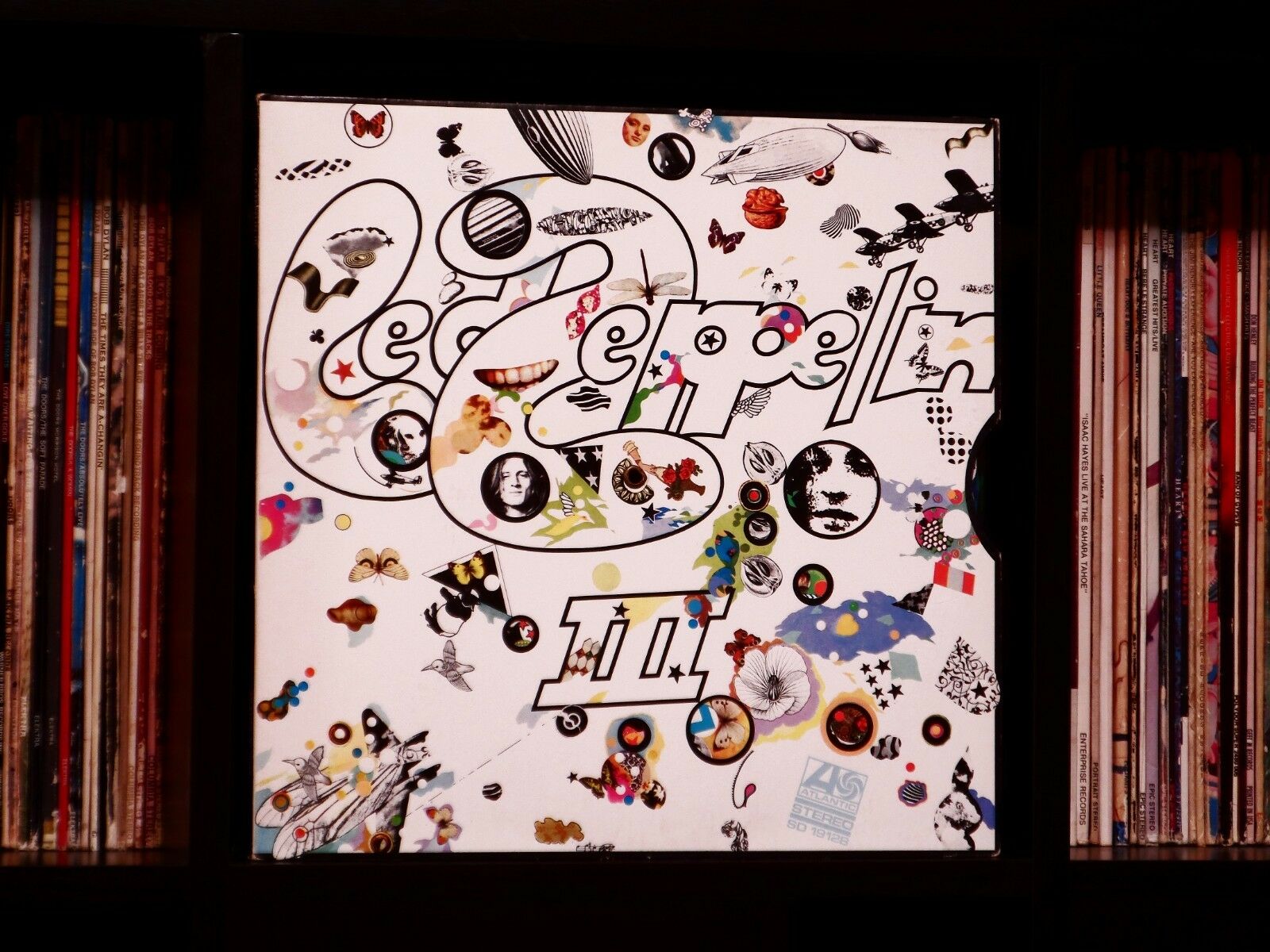
The volvelle used on the front coverLed Zeppelin III's original vinyl edition was packaged in a gatefold sleeve with an innovative cover, designed by Zacron, a multi-media artist whom Page had met in 1963 whilst Zacron was a student at Kingston College of Art. Zacron subsequently graduated at the Royal Academy of Arts and became a lecturer at the University of Leeds. Page asked him if he would help design a sleeve for the album, and on 24 January 1970 Zacron met the band at their gig at his university and agreed to do the cover. That spring, he met the band members individually and took a series of photos of each of them, which would be put into collage.
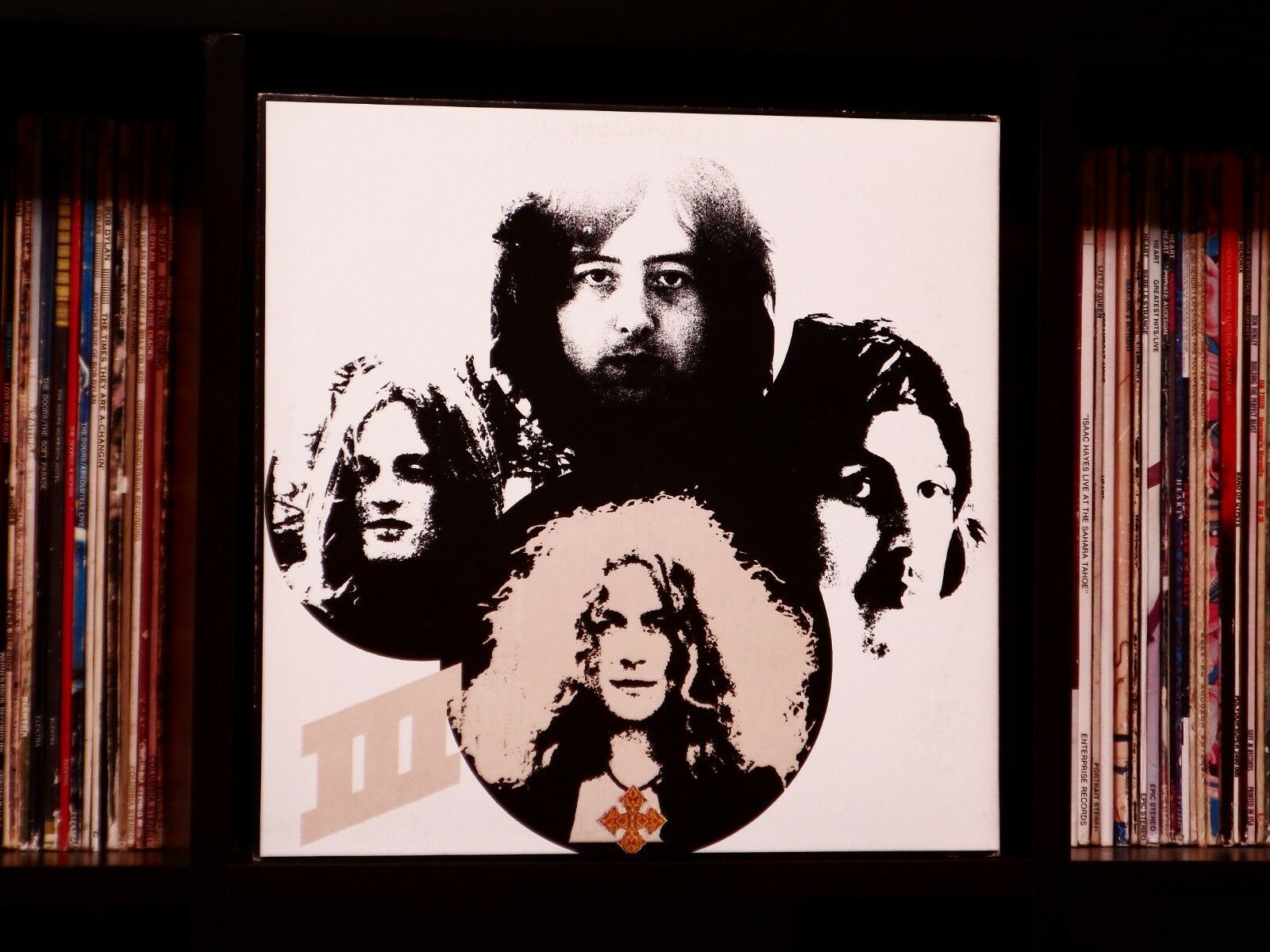
The cover and interior gatefold art consisted of a surreal collection of seemingly random images on a white background, many of them connected thematically with flight or aviation. Behind the front cover was a rotatable laminated card disc, or volvelle, covered with more images, including photos of the band members, which showed through holes in the cover; moving an image into place behind one hole would usually bring one or two others into place behind other holes. The back cover was a composite shot of the best photographs from the photography sessions. Zacron chose the images because he wanted to "show them as the giant force they were in music". In France, this album was released with a different album cover, simply showing a photo of the four band members.
Zacron later said that upon his completion of the artwork, Page telephoned him while he was in New York to express his satisfaction with the results, saying "I think it is fantastic". He later thought the artwork was unsatisfactory because of working to a deadline.
Release and reception
Retrospective professional ratings Review scores Source Rating AllMusic Christgau's Record Guide B+ The Daily Telegraph Encyclopedia of Popular Music The Great Rock Discography 9/10 Music Story MusicHound Rock 3.5/5 Q The Rolling Stone Album GuideLed Zeppelin III was one of the most anticipated albums of 1970, and advance orders in the US alone were close to the million mark. The volvelle-designed sleeve held up production, and caused a two-month delay. In the run-up to release, the group bought a full page advertisement in Melody Maker magazine at the end of September, which simply said "Thank you for making us the world's number one band." The album was released in the US on 5 October, then in the UK on 23 October. It immediately topped the British charts.
Although the band's expanding musical boundaries were greeted warmly by some, detractors attacked the heavier tracks as being mindless noise. In a representative review published in Rolling Stone magazine, critic Lester Bangs praised "That's the Way" as "beautiful and genuinely moving", while characterising the band's heavier songs as crude and little differentiated from each other. Others criticised the acoustic material for merely imitating the music of Crosby, Stills, Nash & Young, which Page refuted as the group had featured that style on their previous albums. Page has also said that the negative press given to the third album affected him so much that he did not give press interviews for 18 months after its release, and was also one of the reasons why the following album contained no written information on it at all. He subsequently realised journalists had little time to listen to the material and were simply looking for "the new Whole Lotta Love" instead of appreciating the material on its own merits.
A positive review came from Robert Christgau in The Village Voice, who assigned it an A-minus grade and wrote in his capsule review: "I have always approved theoretically of Led Zep's concept, and now the group has finally whipped it into shape. It's amazing to realize that Robert Plant's vocals can convey that same overbearing power when Page plays acoustic, as he does to great effect on several cuts here. No drum solos, either. Heavy."
Led Zeppelin III was a trans-Atlantic number one hit. In the UK, it reached No. 1 on 7 November 1970 and remained on the chart for 40 weeks. In the US, it entered the chart at No. 3 on 24 October and reached No. 1 the following week. It remained on the chart for 19 weeks and was certified Gold on 8 October 1970. However, following the lukewarm, if not confused and sometimes dismissive reception from critics, sales lagged after this initial peak.
Despite mostly indifferent reviews and lower sales than Led Zeppelin's previous two albums, Led Zeppelin III's reputation has recovered over time. The RIAA certified the album 2 times platinum in 1990, and 6 times platinum in 1999. The 2014 reissue of the album helped itself get back into the Billboard Top 10.
Accolades
Publication Country Accolade Year Rank The Book of Rock Lists US "The Top 40 Albums (1970)" 1981 39 Mojo UK "The 100 Greatest Albums Ever Made" 1996 99 Colin Larkin UK All Time Top 1000 Albums 1998 361 Q UK "50 Best British Albums Ever" 2004 9 Robert Dimery US 1001 Albums You Must Hear Before You Die 2005 * Classic Rock UK "100 Greatest British Rock Album Ever" 2006 31 (*) designates unordered lists.
Track listing
Standard edition
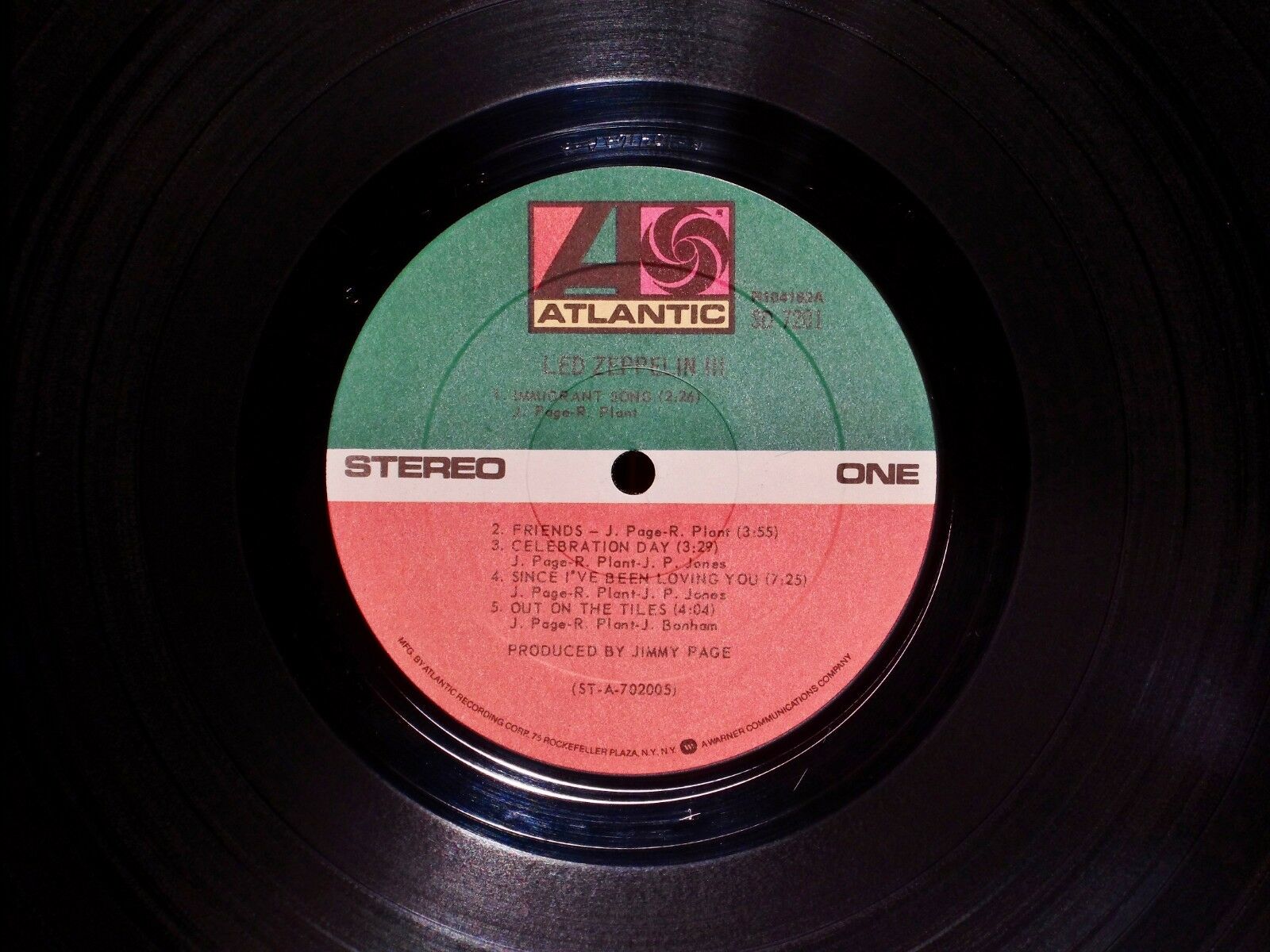
Side one No. Title Writer(s) Length 1. "Immigrant Song"- Jimmy Page
- Robert Plant
- Page
- Plant
- John Paul Jones
- Page
- Plant
- Jones
- Page
- Plant
- John Bonham
- Page
- Plant
- Page
- Plant
- Page
- Plant
- Jones
- Page
- Plant
price rating






![THE ROLLING STONES LET IT BLEED LONDON SLC-300 Japan [Vinyl ]](https://www.popsike.mobi/php/thumbnail.php?url=https://www.popsike.pics/pix/20230607/354833648163.jpg)