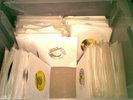
M. Zuccheri Emilio Vedova 'Parete 1967' art multiple LP
$
105


Favourite Auctions
To save auctions to your favourites, please login
If you don't have an account, please register
Description
Marino Zuccheri ' Parete 1967'
Die Schachtel LP box
Italy
Beautiful art record multiple issued in a tiny edition of 67 copies only, consisting in a vinyl LP inserted between two round slices of soft black rubber, and two custom laser-cut aluminum plates. This great work has been totally forgotten since today - this record is in fact a world premiere, and the final act of justice towards a man that contributed so much to the birth and development of Electronic Music.
In 1967 the painter Emilio Vedova was appointed by the Italian Government to create an installation for the Italian Pavilion of the Montreal Expo. Vedova came up with this great ideas of using small glass slides, especially created to reproduce his abstract painting, and then projected on the asymmetrical walls of the Pavilion. He then asked Nono to compose some electronic music, but Nono had no time, and suggested to ask Marino. He replied: "I could do something, but keep in mind that I am no composer". The result is Parete (Wall) 1967, a spectacular and intense 30-minutes loop of pure and intense electronics, a magmatic cascade of harsh sounds and deep drones, and a fantastic counterpart to the harsh and expressionistic painting of Vedova. As in Marino's word:
"I used some previously recorded sounds, the result of an early research: they were really rough. I created a great loop, which intersected another one, a 30 meters, 30-minutes tape ring. It was so long that it extended out of the Studio room, my colleagues thought I was gone totally nuts. You heard this very loud timbre…the music interacted freely with Vedova’s visuals, it really was a free encounter between sound and light."
Marino Zuccheri
Marino Zuccheri was the sound engineer of the famous Milan RAI (Italian Broadcasting Company) Electronic Music Studio, and he helped Berio, Nono, Maderna, Cage, Pousseur among the others, to give birth to some of the great masterpieces of early electronica. He was the man who actually knew and operated the machines (oscillators, tapes etc). That's why Umberto Eco (the philosopher and world famous writer - i.e. The Name of the Rose - who worked at RAI and especially with Berio on "Thema-Omaggio a Joyce") wrote about Zuccheri:
«Who is one of the most performed contemporary electronic composer in the world? Marino Zuccheri, the sound engineer of the RAI Studio of Fonologia in Milan. Illustrious figures in the history of contemporary music arrived there with State grants; but after many months, they still couldn’t figure out how to handle the machines. Then Marino (who, working with Berio and Maderna, had become a wizard), started mixing tapes and producing electronic sounds: that is why some of the compositions now being performed all over the world are by Marino Zuccheri.» (Umberto Eco)
CONDITION: still sealed
SHIPPING: Shipping cost is Euro 16 almost everywhere
PAYMENT: Paypal, Postepay, bank transfer, cash registered
RAI Studio of Musical Phonology in Milan | Studio di Fonologia RAI di Milano
The advent of Electronic music studios in musical history offer a transition in the development of composed instruments. Although considered an instrument only by a few, the Electronic music studio helped create the sense that composers were, if theychose to do so, able to create their own working environment. This began to be clear when, in 1951, the first electronic music studio was conceived from scratchat the WDR Radio of Cologne (Germany) to enable the composition of electronic music sounds.
Briefly, the concept of studios evolved up to the 1955 design of the Phonology studio in Milan by Luciano Berio and Bruno Maderna, With nine oscillators, various filters and other sophisticated equipment , the presence of a technician/musician [Marino Zuccheri] and of a scientist (Alfredo Lietti) who helped design and build specific processing devices, the studio was the best equipped in the world at that time. Composers, then, were required to adopt a low profile and accept the “conditions and limits” of the technical environment, and his or her work was to be mediated by the technician Marino Zuccheri.
price rating


![Mastodon - Crack the Skye [VINYL]](https://www.popsike.mobi/php/thumbnail.php?url=https://www.popsike.pics/pix/20220520/275318901583.jpg)