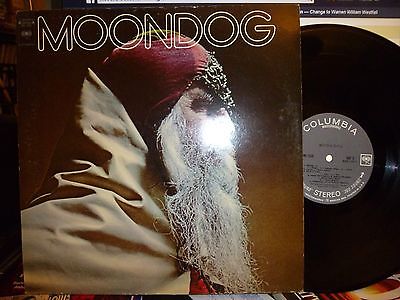
MOONDOG (aka Louis Thomas Hardin) (S/T) LP 1969 UNIPAK 2 EYE Stereo AVANT NM/EX
$
69


Favourite Auctions
To save auctions to your favourites, please login
If you don't have an account, please register
Description
Condition: To my NON US customers, do NOT ask me to alter / change the declared value of your purchase for purposes of avoiding taxes in your country. I will NOT do so.
AMG Review by Stewart Mason [-]
Moondog's second self-titled album (the first one came out in 1956 on the independent jazz label Prestige) was the idiosyncratic composer's first release in 12 years, and it shows how much Moondog's already rich music had matured since 1957's The Story of Moondog. Where Moondog's '50s records were jazz-based, Moondog showcases the composer's orchestral side; producer James William Guercio assembled an orchestra of over 40 musicians from the classical and jazz worlds (including flutist Hubert Laws and bassist Ron Carter), and although the pieces are quite compact -- ranging from the expansive three-part ballet suite "Witch of Endor" to the eight-second spoken poem "Cuplet" -- Moondog uses the expanded range of tonal colors and dynamics impressively. For someone who spent most of his career performing solo on a street corner in Manhattan, Moondog's arrangements on pieces like the jazz-canon's "Stamping Ground" are not only admirably complex, but also richly melodic. Although Moondog is often thought of as a mere exotica novelty, thanks to the composer's eccentricities, it is, in fact, one of the finest third stream jazz albums of its era. The best-known track on this album, "Bird's Lament," was the uncredited basis for dance DJ Mr. Scruff's "Get a Move On," which was used in an extended series of minivan commercials in 2002.
Moondog (2) ?– Moondog
Label: Columbia Masterworks ?– MS 7335 Format: Vinyl, LP, AlbumCountry: US Released: 1969 Genre: Jazz, Classical Style: Big Band, Contemporary
Tracklist
A1 Theme 2:35 A2 Stamping Ground 2:36 A3 Symphonique #3 (Ode To Venus) 5:51 A4 Symphonique #6 (Good For Goodie) 2:45 Mini-Sym #1 5:45 B1a I - Allegro B1b II - Andante Adagio B1c II - Vivace - B2 Lament I, "Bird's Lament" 1:42 Witch Of Endor 6:29 B3a I - Dance B3b II - Trio B3b1 A. Adagio (The Prophesy) B3b2 B. Andante (The Battle) B3b3 C. Agitato (Soul's Death) B3c III - Dance (Reprise) - B4 Symphonique #1 (Portrait Of A Monarch) 2:36Companies etc
- Manufactured By – Columbia Records
- Printed By – Uni-Pak
- Published By – Archimedes Music
- Published By – Skiff Music Corp.
Credits
- Baritone Saxophone – Wally Kane
- Bass – Alfred Brown, George Duvivier, Louis Hardin, Ron Carter
- Bass Clarinet – Ernie Bright*
- Bassoon – Don Macourt*, George Berg, Jack Knitzer, Joyce Kelly, Ryohei Nakagawa, Wally Kane
- Cello – Charles McCracken, George Ricci
- Clarinet – George Silfies, Jimmy Abato, Phil Bodner
- Composed By [All Selections], Liner Notes – Louis Hardin
- Contrabass – Joe Tekula
- Design [Album Design] – Ron Coro
- Engineer [Engineering] – Arthur Kendy, Fred Plaut
- English Horn – Henry Shuman*, Irving Horowitz
- Flugelhorn [Flügelhorn] – Joe Wilder
- Flute – Andrew Lolya, Harold Bennett
- French Horn – Brooks Tillotson, James Buffington*, Ray Alonge, Richard Berg (3)
- Percussion – Bob Rosengarden*, Dave Carey*, Elayne Jones, Jack Jennings
- Photography By [Cover] – Don Hunstein
- Photography By [Inside] – Fred Lombardi
- Piccolo Flute – Harold Jones (2), Hubert Laws
- Producer – James William Guercio
- Producer [Associate Producer For Poseidon Productions] – Alfred Brown
- Tenor Vocals [Tenore] – Eugene Becker, Raoul Poliakin
- Trombone [Bass] – Paul Faulise
- Trombone [Tenor] – Buddy Morrow, Charles Small*, Tony Studd
- Trumpet – Alan Dean, Joe Wilder, Mel Broiles*, Teddy Weiss
- Trumpet [Bass] – Danny Repole
- Tuba – Bill Stanley, Don Butterfield
- Tuba [Tenor] – Bill Elton, Bill Stanley, John Swallow, Phil Giardina
- Viola – David Schwartz, Emanuel Vardi, Eugene Becker, Raoul Poliakin
- Violin – Aaron Rosand, Paul Gershman
Notes
All copyrights are administred by Archimedes Music (ASCAP), a Division of James William Guerico Enterprises, Inc., except Theme (Archimedes Music/Skiff Music Corp. [ASCAP]).Library of Congress catalog card number R72-750723 applies to MS 7335.
Cover photo/inside photos: Columbia Records Photo Studio
Manufactured by Columbia Records
Unipak U.S. patent no. 3,426,960
Printed in U.S.A.
Gatefold sleeve
Barcode and Other Identifiers
- Rights Society: ASCAP
- Other (Library of Congress catalog card number): R72-750723
See our other EBAY auctions by using search by seller and using “recordcollectormichigan”
Ferndale, Michigan 48220
Phone: 248-548-9888
Hours: Monday thru Saturday NOON to 6:00 PM (Eastern)
GOLDMINE GRADING
MINT ---- It should appear to be perfect. No scuffs or scratches, blotches or stains, labels or writing, tears or splits. Mint means perfect.
NEAR MINT ---- Otherwise mint but has one or two tiny inconsequential flaws that do not affect play. Covers should be close to perfect with minor signs of wear or age just becoming evident: slight ring-wear, minor denting to a corner, or writing on the cover should all be noted properly.
VERY GOOD PLUS ---- The record has been handled and played infrequently or very carefully. Not too far from perfect. On a disc, there may be light paper scuffs from sliding in and out of a sleeve or the vinyl or some of the original luster may be lost. A slight scratch that did not affect play would be acceptably VG+ for most collectors.
VERY GOOD ---- Record displays visible signs of handling and playing, such as loss of vinyl luster, light surface scratches, groove wear and spindle trails. Some audible surface noise, but should not overwhelm the musical experience. Usually a cover is VG when one or two of these problems are evident: ring wear, seam splits, bent corners, loss of gloss, stains, etc.
GOOD ---- Well played with little luster and significant surface noise. Despite defects, record should still play all the way through without skipping. Several cover flaws will be apparent, but should not obliterate the artwork.
POOR ---- Any record or cover that does not qualify for the above "Good" grading should be seen as Poor. Several cover flaws.
price rating


