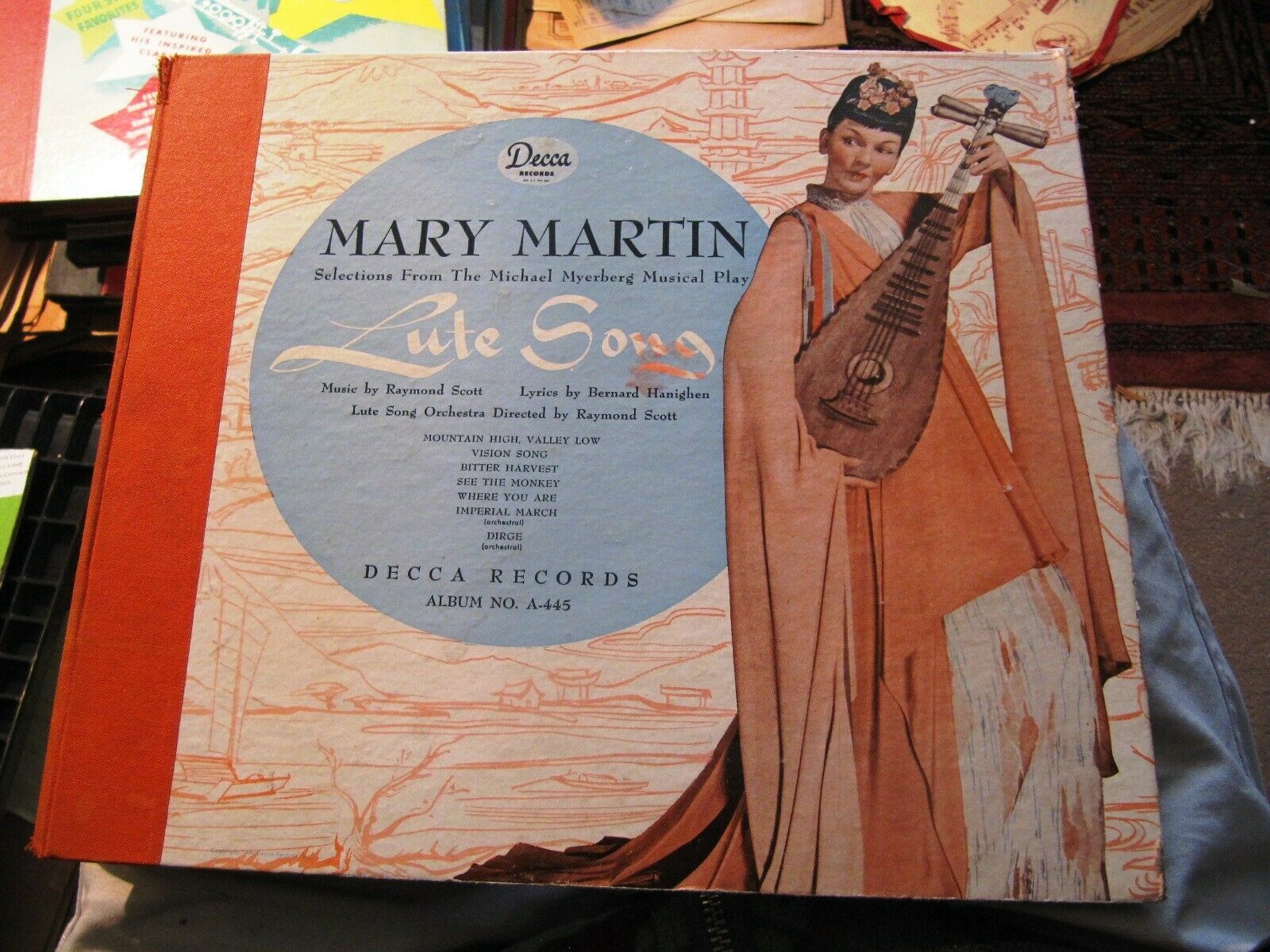
Mary Martin CHINESE BROADWAY HIT MUSICAL Lute Song Raymond Scott DECCA A-445 78
$
30


Favourite Auctions
To save auctions to your favourites, please login
If you don't have an account, please register
Description
Lute Song
Original Cast Album of Mary Martin's BROADWAY HIT Lute Song based on a 14th Century Chinese Tale
Time called it "the season's loveliest production and most charming failure [that] never quite catches the inner glow of art or the outward stir of theater." It continued, "There should have been either less spectacle or less story. As it is, the old tale is retold at considerable length, but loses much of its flow and human feeling through gorgeous interruptions and sumptuous distractions.
Lute Song is a 1946 American musical with a book by Sidney Howard and Will Irwin, music by Raymond Scott, and lyrics by Bernard Hanighen. It is based on the 14th-century Chinese play Tale of the Pipa (Pi-Pa-Ji) by Gao Ming.[1] Though not a great success, the show is significant for Mary Martin's meeting of then-unknown cast member Yul Brynner, whom she later recommended to her friends Rodgers and Hammerstein for the role of the Siamese monarch in the classic The King and I, which premiered on Broadway in 1951
It was also the only Broadway appearance of future U.S. First Lady Nancy Reagan.
Mary Martin ?– Selections From 'Lute Song'
Lute Song
A1 –Mary Martin Mountain High, Valley Low
A2 –Mary Martin Vision Song
A3 –Mary Martin Bitter Harvest
A4 –Mary Martin See The Monkey
A5 –Mary Martin Where You Are
A6 –Lute Song Orchestra Imperial March
A7 –Lute Song Orchestra Dirge
Directed By [Orchestra] – Raymond Scott
Lyrics By – Bernard Hanighen
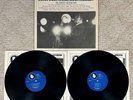
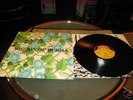
Orig issue Decca Album A-445 3x10" records
Condition: EXCELLENT MINUS, scuffs, plays E Very quiet lightest crackle
Album great, binding solid, small roughting to right side corners
Development
Cyril Birch, collaborator in a translation of The Peach Blossom Fan, wrote that presumably the basis of the American play was the 1846 Antoine (A. P. L.) Bazin French translation of the Chinese play Tale of the Pipa.[3]
Plot
The plot focuses on Tsai-Yong (Cai Yong), a young student who leaves his wife Tchao-Ou-Niang and parents to make a name for himself. He becomes a notable magistrate, but when he marries Princess Nieou-Chi, he is forbidden by her father to contact his family. His impoverished parents die of starvation during a famine, and Tchao-Ou-Niang is forced to sell her hair to pay for their funeral. She ultimately is reunited with her husband by Nieou-Chi, and is welcomed to the palace as his #1 wife.
Unlike the original work, Tsai-Yong has to decide between love and filial piety. Ultimately Tsai-Yong and Tchao-Ou-Niang are united.[4]
Production
The Broadway production was directed by John Houseman and was produced by Michael Meyerberg. It opened at the Plymouth Theatre on February 6, 1946 and closed on June 8 of the same year after running for 142 performances. Scenic, costume, and lighting design were by Robert Edmond Jones.
The cast included Yul Brynner as Tsai-Yong, Mary Martin as Tchao-Ou-Niang, Mildred Dunnock and Augustin Duncan as the parents, and Helen Craig as Nieou-Chi. Appearing as Si-Tchun, a Lady-in-Waiting, was Nancy Davis, making her first and only Broadway appearance.
A London production opened at the Winter Garden on October 11, 1948, produced by Albert de Courville and starring Brynner and Dolly Haas.
One factor in the change to the ending was the efforts of Mary Martin and her husband Richard Halliday, who acted as her manager, because of the belief that "'sharing a man was unworthy of a star of Mary's magnitude'".[4]
Song list
Act 1
Mountain High, Valley Low ..... Tchao-Ou-Niang and Tsai-Yong
Monkey See, Monkey Do ..... Tchao-Ou-Niang
Where You Are ..... Tchao-Ou-Niang
Act 2
Willow Tree ..... Tsai-Yong
Vision Song ..... Tchao-Ou-Niang and Tsai-Yong
Bitter Harvest ..... Tchao-Ou-Niang
Act 3
Mountain High, Valley Low (Reprise) ..... Tchao-Ou-Niang
Lute Song ..... Tchao-Ou-Niang
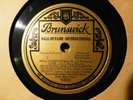
Decca Records released an album containing six tracks - four vocals by Martin and two instrumentals - on three 78 RPM records.[5]
Critical reception
Time called it "the season's loveliest production and most charming failure [that] never quite catches the inner glow of art or the outward stir of theater." It continued, "There should have been either less spectacle or less story. As it is, the old tale is retold at considerable length, but loses much of its flow and human feeling through gorgeous interruptions and sumptuous distractions. What's more, neither the writing nor the acting has quite the stylized quality it reaches after." [6]
price rating