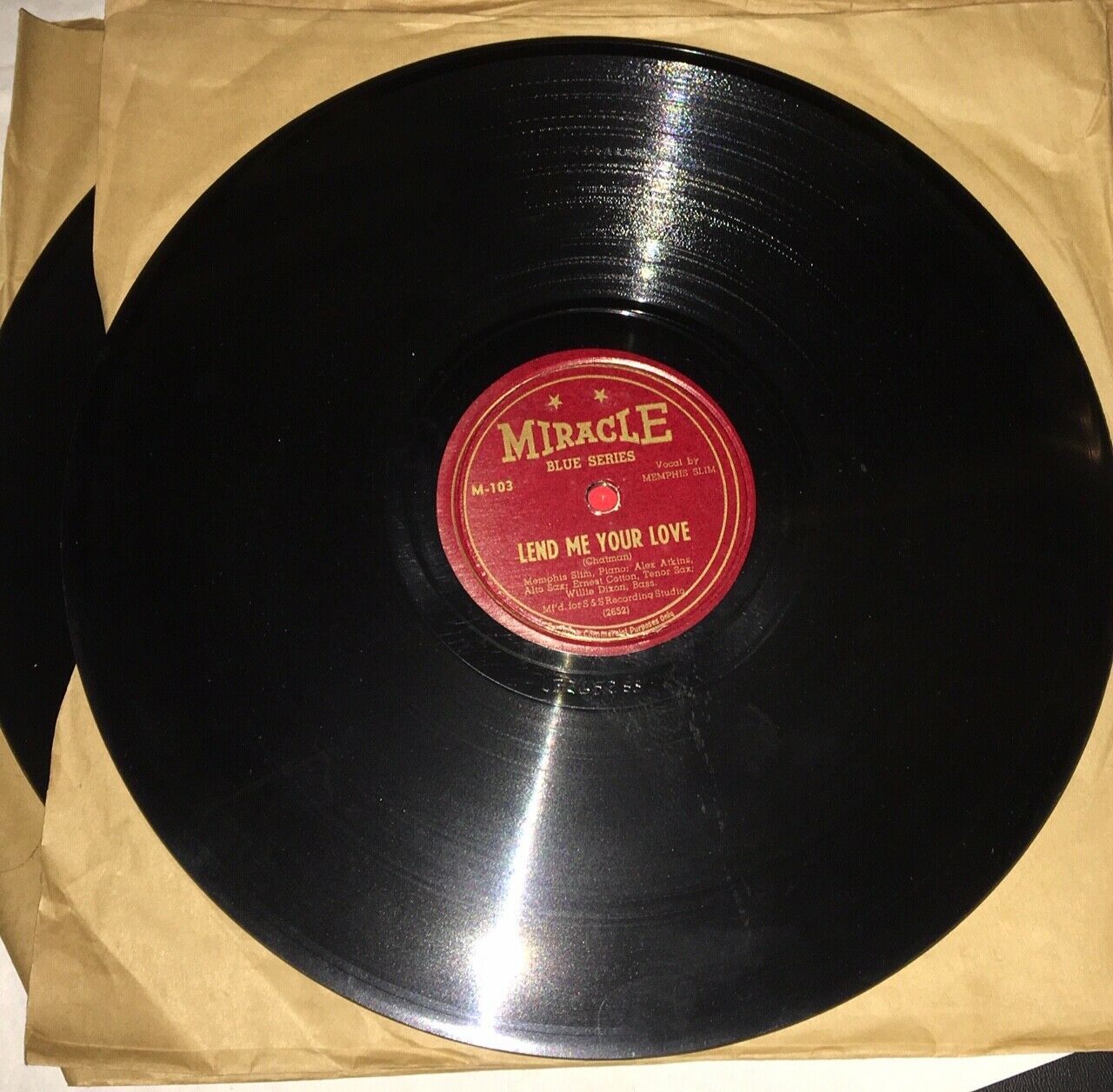
Memphis Slim Rockin' The House Miracle M-103 1947 Jump Blues R&B WIllie Dixon
$
50


Favourite Auctions
To save auctions to your favourites, please login
If you don't have an account, please register
Description
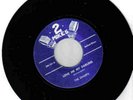
Memphis Slim ?– Rockin' The House / Lend Me Your Love Label: Miracle ?– M-103 Series: Blues Series Format: Shellac, 10", 78 RPM Country: US Released: 1947 Genre: Blues Style: Jump Blues, Vocal Tracklist A Rockin' The House B Lend Me Your Love Credits Alto Saxophone – Alex Atkins Bass – Willie Dixon Piano, Vocals – Memphis Slim Tenor Saxophone – Ernest Cotton Written-By – Chatman
Memphis Slim (September 3, 1915 – February 24, 1988) was an American blues pianist, singer, and composer. He led a series of bands that, reflecting the popular appeal of jump blues, included saxophones, bass, drums, and piano. A song he first cut in 1947, "Every Day I Have the Blues", has become a blues standard, recorded by many other artists. He made over 500 recordings.
He was posthumously inducted into the Blues Hall of Fame in 1989.
Memphis Slim was born John Len Chatman, in Memphis, Tennessee. For his first recordings, for Okeh Records in 1940, he used the name of his father, Peter Chatman (who sang, played piano and guitar, and operated juke joints);[2] it is commonly believed that he did so to honor his father. He started performing under the name "Memphis Slim" later that year but continued to publish songs under the name Peter Chatman.
He spent most of the 1930s performing in honky-tonks, dance halls, and gambling joints in West Memphis, Arkansas, and southeast Missouri.[3] He settled in Chicago in 1939 and began teaming with the guitarist and singer Big Bill Broonzy in clubs soon afterwards. In 1940 and 1941 he recorded two songs for Bluebird Records[4] that became part of his repertoire for decades, "Beer Drinking Woman"[5] and "Grinder Man Blues". These were released under the name "Memphis Slim," given to him by Bluebird's producer, Lester Melrose.[6] Slim became a regular session musician for Bluebird, and his piano talents supported established stars such as John Lee "Sonny Boy" Williamson, Washboard Sam, and Jazz Gillum. Many of Slim's recordings and performances until the mid-1940s were with Broonzy, who had recruited Slim to be his piano player after the death of his accompanist Joshua Altheimer in 1940.
After World War II, Slim began leading bands that generally included saxophones, bass, drums, and piano, reflecting the popular appeal of jump blues. With the decline of blues recording by the major labels, Slim worked with emerging independent labels. Starting in late 1945, he recorded with trios for the small Chicago-based Hy-Tone Records.[7] With a lineup of alto saxophone, tenor sax, piano, and string bass (Willie Dixon played the instrument on the first session), he signed with the Miracle label in the fall of 1946. One of the songs recorded at the first session was the ebullient boogie "Rockin' the House," from which his band would take its name. Slim and the House Rockers recorded mainly for Miracle through 1949, with some commercial success. Among the songs they recorded were "Messin' Around" (which reached number one on the R&B charts in 1948) and "Harlem Bound".[8] In 1947, the day after producing a concert by Slim, Broonzy, and Williamson at New York City's Town Hall, the folklorist Alan Lomax brought the three musicians to the Decca Records studios and recorded with Slim on vocal and piano. Lomax presented sections of this recording on BBC Radio in the early 1950s as a documentary, The Art of the Negro, and later released an expanded version as the LP Blues in the Mississippi Night. In 1949, Slim expanded his combo to a quintet by adding a drummer; the group was now spending most of its time on tour, leading to off-contract recording sessions for King Records in Cincinnati and Peacock Records in Houston.
One of Slim's 1947 recordings for Miracle, released in 1949, was originally titled "Nobody Loves Me". It has become famous as "Every Day I Have the Blues." The song was recorded in 1950 by Lowell Fulson and subsequently by numerous other artists, including B. B. King, Elmore James, T-Bone Walker, Ray Charles, Eric Clapton, Natalie Cole, Ella Fitzgerald, Jimi Hendrix, Mahalia Jackson, Sarah Vaughan, Carlos Santana, John Mayer and Lou Rawls. Joe Williams recorded it in 1952 for Checker Records; his remake from 1956 (included on the album Count Basie Swings, Joe Williams Sings) was inducted into the Grammy Hall of Fame in 1992.[10]
Early in 1950, Miracle succumbed to financial troubles, but its owners regrouped to form the Premium label, and Slim remained on board until the successor company faltered in the summer of 1951. His February 1951 session for Premium saw two changes in the House Rockers' lineup: Slim started using two tenor saxophones instead of the alto and tenor combination, and he made a trial of adding the guitarist Ike Perkins. His last session for Premium kept the two-tenor lineup but dispensed with the guitar. During his time with Premium, Slim first recorded his song "Mother Earth".
Slim made just one session for King, but the company bought his Hy-Tone sides in 1948 and acquired his Miracle masters after that company failed in 1950. He was never a Chess artist, but Leonard Chess bought most of the Premium masters after the demise of Premium.
After a year with Mercury Records, Slim signed with United Records in Chicago;[12] the A&R man, Lew Simpkins, knew him from Miracle and Premium. The timing was propitious, because he had just added the guitarist Matt "Guitar" Murphy to his group. He remained with United through the end of 1954, when the company began to cut back on blues recording.
After 1954, Slim did not have a steady relationship with a record company until 1958, when he signed with Vee-Jay Records. In 1959 his band, still featuring Murphy, recorded the album Memphis Slim at the Gate of the Horn, which featured a lineup of his best-known songs, including "Mother Earth", "Gotta Find My Baby", "Rockin' the Blues", "Steppin' Out", and "Slim's Blues".[14] In December 1959, Willie Dixon's debut album, Willie's Blues, was released.[15] Memphis Slim was given almost equal credit on the album as Dixon's piano accompanist. Memphis Slim played on all of the tracks, and wrote the two numbers that were not penned by Dixon.
Slim first appeared outside the United States in 1960, touring with Willie Dixon, with whom he returned to Europe in 1962 as a featured artist in the first of the series of American Folk Festival concerts organized by Dixon, which brought many notable blues artists to Europe in the 1960s and 1970s. The duo released several albums together on Folkways Records, including Memphis Slim and Willie Dixon at the Village Gate with Pete Seeger (1962).
In 1962, Slim moved permanently to Paris, and his engaging personality and well-honed presentation of playing, singing, and storytelling about the blues secured his position as one of the most prominent blues artists for nearly three decades. He appeared on television in numerous European countries, acted in several French films and wrote the score for À nous deux France (1970), and performed regularly in Paris, throughout Europe, and on return visits to the United States. In the last years of his life, he teamed up with the respected jazz drummer George Collier. The two toured Europe together and became friends. After Collier died in August 1987, Slim rarely appeared in public, although he reunited with Matt "Guitar" Murphy for a gig at Antone's in Austin, Texas, in 1987.
Two years before his death, Slim was named a Commander in the Ordre des Arts et des Lettres by the Ministry of Culture of the Republic of France. In addition, the U.S. Senate honored Slim with the title of Ambassador-at-Large of Good Will.[18]
Grave of Memphis Slim Memphis Slim died of renal failure on February 24, 1988, in Paris, at the age of 72. He is buried at Galilee Memorial Gardens in Memphis, Tennessee.
He was posthumously inducted into the Blues Hall of Fame in 1989.[1] He was inducted into the Memphis Music Hall of Fame in 2015.
On June 25, 2019, The New York Times Magazine listed Memphis Slim among hundreds of artists whose material was reportedly destroyed in the 2008 Universal fire.[25]
Discography Charting singles List of charting singles with year, title, label, and chart peak Year Title A-side / B-side Label Chart peak U.S. R&B [26] 1948 "Messin' Around" / "Midnight Jump" Miracle 125 1 1949 "Frisco Bay" / "Timsy's Whimsy" Miracle 132 11 "Blue and Lonesome" / Miracle 135 2 "Help Me Some" 9 "Angel Child" / "Nobody Loves Me" Miracle 145 6 1951 "Mother Earth" / "Really Got the Blues" Premium 867 7 1953 "The Come Back" / "Five O'Clock Blues" United 156 3 Albums Year Title Label 1959 Memphis Slim at the Gate of Horn Vee-Jay 1959 Memphis Slim and the Real Boogie-Woogie Folways 1960 Memphis Slim and the Honky-Tonk Sound Folkways 1960 Travelling with the Blues Storyville 1960 Blue This Evening Black Lion 1960 Pete Seeger at the Village Gate with Memphis Slim and Willie Dixon, Vol. 1 Folkways 1960 Songs of Memphis Slim and "Wee Willie" Dixon Folkways 1961 Tribute to Big Bill Broonzy Candid 1961 Steady Rollin' Blues: The Blues of Memphis Slim OBC 1961 Memphis Slim U.S.A. Candid 1961 Broken Soul Blues Beat Goes On 1961 Chicago Blues: Boogie Woogie and Blues Played and Sung by Memphis Slim Folkways 1961 Blues by Jazz Gillum Singing and Playing His Harmonica, with Arbee Stidham and Memphis Slim Folkways 1961 Just Blues Bluesville 1961 No Strain Bluesville 1962 Sonny Boy Williamson and Memphis Slim, In Paris GNP Crescendo 1962 Memphis Slim and Willie Dixon at the Village Gate with Pete Seeger Folkways 1962 Pete Seeger at the Village Gate with Memphis Slim and Willie Dixon, Vol. 2 Folkways 1962 All Kinds of Blues Bluesville 1963 Alone with My Friends Battle 1963 Jazz in Paris: Aux Trois Mailletz Polygram 1964 Clap Your Hands Maison De Blues 1967 Legend of the Blues Vol. 1 Jubilee 1967 Bluesingly Yours Maison De Blues 1968 Lord Have Mercy on Me Maison De Blues 1969 The Bluesman (released 1975) Maison De Blues 1969 Mother Earth One Way Records 1970 The Blue Memphis Suite Maison de Blues 1970 Messin' Around with the Blues King 1971 Boogie Woogie Maison de Blues 1971 Born with the Blues Fuel 2000 1971 Blue Memphis Wounded Bird 1972 South Side Reunion, with Buddy Guy and Junior Wells Sunny Side 1972 Old Times, New Times with Roosevelt Sykes, Buddy Guy and Junior Wells Barclay 1973 The Legacy of the Blues Vol. 7 Sonet 1973 Memphis Slim Storyville 1973 Soul Blues Acrobat 1973 Raining the Blues Fantasy 1973 Favorite Blues Singers Folkways 1973 Very Much Alive and in Montreux Universal International 1974 Memphis Heat, with Canned Heat (recorded 1973) Blue Star 1975 Going Back to Tennessee Maison de Blues 1981 Rockin' the Blues Charly 1981 I'll Just Keep on Singin' the Blues SLG 1982 Can A White Man Play And Sing The Blues ? Milan 1982 Fip Fil and Fim Milan 1990 Steppin' Out: Live at Ronnie Scotts Castle Music UK 1990 Together Again One More Time, with Matt Murphy (two-CD set including Eddie Taylor, Still Not Ready for Eddie) Texas Music Group 1990 Parisian Blues Polygram 1990 The Real Folk Blues MCA 1992 Blues Masters Vol 9: Memphis Slim Storyville 1992 Pinetop's Boogie Woogie Antone's 1993 London Sessions 1960 Sequel Records UK 1994 The Blues Collection Vol 13: Beer Drinkin' Woman ADD 1994 Lonesome Legacy International 1994 Live at the Hot Club BMG International 1995 Boogie After Midnight Chicago Music 1995 Jazz & Blues collection Edition Atlas 1996 The Complete Recordings, Vol. 1: 1940–1941 (Peter Chatman as Memphis Slim) EPM Musique 1996 Come Back & Other Classics Masters Intercontinental 1996 The Bluebird Recordings, 1940–1941 RCA 1997 Dialogue in Boogie, with Philippe Lejeune Happy Bird 1998 Lonely Nights Catfish 1998 Very Best of Memphis Slim: The Blues Is Everywhere Collectables 1999 Life Is Like That Charly UK 2000 The Folkways Years, 1959–1973 Smithsonian Folkways 2000 Blues at Midnight Catfish 2000 Memphis Slim at the Gate of the Horn Vee-Jay 2000 Live at Antone's Vol. 1 Antone's 2001 The Complete Recordings, Vol. 2: 1946–1948 EPM Musique 2001 Essential Masters Cleopatra 2001 Blue and Lonesome Arpeggio Blues 2001 Ambassador of the Blues Indigo UK 2002 The Complete Recordings, Vol. 3: 1948–1950 EPM Musique 2002 I Am the Blues Prestige Elite 2002 Kansas City Classic World 2002 Boogie for My Friends Black & Blue France 2002 The Come Back Delmark 2002 Blues Legends: Memphis Slim Lead 2003 Three Women Blues Time Wind (Germany) 2003 The Complete Recordings, Vol 4: 1951–1952 EPM Musique 2004 Worried Life Blues Quadromania Klassik (Germany) 2004 Grinder Man Blues Snapper UK 2004 The Best of Memphis Slim Liquid 8 2005 Boogie for Two Pianos, Vol. 1, with Jean-Paul Amouroux 2005 Paris Mississippi Blues Sunny Side 2005 Double-Barreled Boogie, with Roosevelt Sykes Sunny Side 2006 Forty Years of More Passport Audio 2006 Memphis Suite Sunny Side 2006 Rockin' This House: Chicago Blues Piano 1946–1953 JSP Records 2006 The Sonet Blues Story Verve Records 2006 An Introduction to Memphis Slim Fuel 2000 2007 The Ultimate Jazz Archive 14 1940–41 Carinco AG 2007 Sings the Blues Wnts 2007 Chicago Blues Masters Vol. 1, with Muddy Waters Capitol 2007 Cold Blooded Woman Collectables Records 2008 Greatest Moments Stardust 2008 Four Walls Jukebox Entertainment 2008 Born to Boogie Unlimited Media
price rating