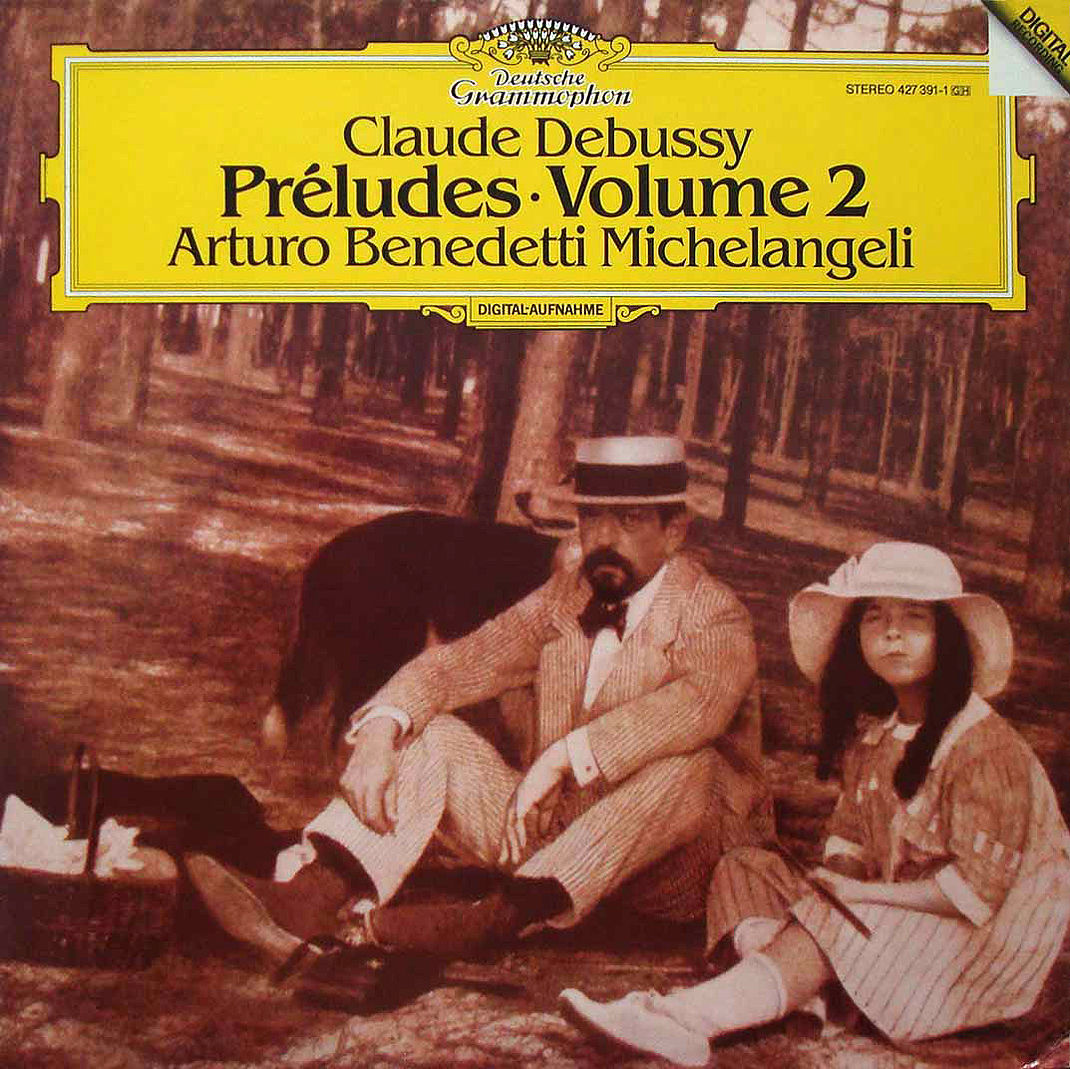
Michelangeli: Debussy Preludes Book II (rec. 1988) - DG 427 391-1 (DDD), NM
$
130


Favourite Auctions
To save auctions to your favourites, please login
If you don't have an account, please register
Description
ITEM DESCRIPTION:
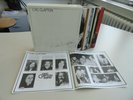
This beautiful and very rare LP from Deutsche Grammophon (427 391-1, German pressing, white circle label, DDD stereo) features legendary pianist Arturo Benedetti Michelangeli in his mesmerizing traversal of Debussy’s 12 Préludes for Piano Book II, made in the fine acoustics of the Kleiner Saal, Rudolf-Oetker-Halle, Bielefeld in August 1988, in what were among his very last commercial recording sessions.
The exact track list is as follows:
Brouillards (modéré)
2:56
Feuilles mortes (lent et mélancolique)
3:19
La puerta del vino (mouvement de habanera)
4:08
Les Fées Sont D'exquises Danseuses (Rapide Et Léger)
3:07
Bruyères (Calme)
2:54
"General Lavine" - eccentric (dans le style et le mouvement d'un cake-walk)
2:39
La terrasse des audiences du clair de lune (lent)
3:59
Ondine (scherzando)
3:27
Hommage À S. Pickwick, Esq., P.P.M.P.C. (grave)
2:27
Canope (très calme et doucement triste)
2:37
Les tierces alternées (modérément animé)
2:55
Feux d'artifice (modérément animé)
4:35
Wrote the erudite critic Stephen Plaistow in his review for the March 1989 issue of The Gramophone:
“Michelangeli is Michelangeli, and this performance is difficult to leave. With other pianists, the atmosphere is everything, but with him you get the notes, providing a sharper focus and heightened perceptions.
“The Debussy Preludes: two collections of pieces, or should we think of each book as a cycle? A thoughtful note by the German writer in DG's booklet reminds us that Debussy wasn't in favour of performing each book in its entirety, 12 pieces at a time. Yet this is how the Preludes are often presented. I confess that when I first listened to Michelangeli in Book 2 not a thought crossed my mind about doing them any other way. Well, Michelangeli is Michelangeli and his performance is difficult to leave. The CD format allows one to dip into it with ease, of course, and enjoyable that is too, but in comparison with the other two pianists I've been listening to there does seem to be a cumulative strength to his reading which adds another dimension. I wonder what Debussy would have thought.
“Or could it be that Michelangeli is simply the more compelling artist, his excellence carrying one with him from one piece to the next in a way that the Japanese lady on BIS, Yukie Nagai, and the Frenchman on Denon, Jacques Rouvier, cannot match, or at any rate sustain to the same degree? There's much I like about both of them, yet she is variable, conspicuously better in some pieces than in others and he, though steadier, is a brilliant and colourful player who can sound rather flat when there aren't a lot of notes to be dealt with or an immediate appeal to his ear for sonority. Sometimes, in the same piece, he is splendid (for example, in ''Les tierces alternees'') and also passingly eccentric (why pull the opening about so much?), and this and the touch of hardness I detect about him will discourage me from returning to his version. I shall not want to listen to him again in ''Ondine'', for sure, where he plays free and easy with the rhythm in bar 14 and, a little later, interprets the instruction le double plus lent as meaning 'gradually get a bit slower' (or something). No one attempting the Preludes gets far without imagination, but intelligence is in order as well, and I look forward to the day when all interpreters of Debussy's piano music feel that they must look a little harder at what the composer wrote.
“The new issue from BIS announces itself as ''a BIS original dynamics recording''. It does indeed capture all the atmosphere of Yukie Nagai's playing, where her control at the quiet end of the spectrum is remarkable, and the dynamic range extends to a true ppp. She can make the merest whisper of sound hang in the air and grade her sonorities to vanishing point. Indeed, in ''Brouillards'' and ''Feuilles mortes'', the first two numbers of Book 2, and again in ''Cloches a travers les feuilles'' from the second set of Images, she comes near to convincing us that the piano is no longer a percussive instrument. Her lightness in a more animated number such as ''Les fees sont d'exquises danseuses'' is also admirable, and in general she handles the mercurial and volatile side of Debussy with as much sensitivity as one could wish—and with an impressive technical address, as one hears in ''Feux d'artifice''. Yet a number of times she flops badly. ''La puerta del Vino'', pale and without menace, disappoints largely because its habanera character is not defined. More seriously, in ''Canope'' and ''La terrasse des audiences du clair de lune'' she indulges a weakness for going slower than the line can stand. To produce the impression of time standing still is all very well, but this is not Morton Feldman and it cannot be right to loosen tempo to the point where the events of the music do not hang together. ''Et la lune descend sur le temple qui fut'' (No. 2 of the Images) is similarly disfigured and begins to seem interminable. The soft-grained recording seems to follow Nagai's inclinations; where dissolved sonorities aren't in play and a bit of edge and brightness are required it can appear a little dull.
“I'm squeaking across my slate and of course it's unlucky for this pianist that her record appears here at the same time as Michelangeli's. His is less well filled, and at a little under 40 minutes the measure is not generous, but not infrequently Michelangeli's solo records come like that. You take them or leave them. I do not gasp at everything he does but I've always liked his Debussy and I find this marvellous. The recording is clean and bright, maybe disconcertingly so for a minute if you come to it after the others; but the sound is perfectly balanced, with plenty of depth, and you soon realize that it conveys the way this man wants his Debussy to be. The contrast with Nagai and Rouvier in ''Brouillards'', at the very beginning, is striking. With them the atmosphere is everything and very misty it is; with him, you get the notes. Oh yes, of course there's pedal, and a play of colour, but the line-drawing is harder, the focus sharper. How do you like your Debussy? If you're a wet, you may not find Michelangeli to your taste; you will probably find him cold. If you go along with him, however, I think you will be intrigued and delighted by some heightened perceptions. As I say, it is the notes which are up front, as if we were to regard them with special respect, as material for masterly composition rather than impressionism. So the first page of ''Brouillards'' proposes not a swirl of mists in the kingdom of Allemonde but a piece bound together by triads, which move this way and that in the middle of the keyboard and carry with them little clouds of other notes and a feeling of instability. La main gauche un peu en valeur sur la main droite says Debussy; he means the triads should stand out a little against the rest in the texture, and here they are, surely just as he would have wanted them.
“It would be tempting to comment on a lot of such detail, but I must confine myself to more general observations. Here are two, and the first has to do with the superior quality of the piano playing, though not in the manipulative sense. There is more to virtuosity than is usually noticed, and at the end of ''Feux d'artifice'', where three different strands of sound are delineated on separate planes, Michelangeli shows what magic can be achieved through an exceptional control of sonority and the ability to produce effects of perspective. That example, one of many, is from the end of the Preludes. Back now to the beginning once more for the other general point, which concerns tempo and tempo rubato and the inflexion of the 'mouvement' within each piece. Michelangeli is scrupulous in his attention to Debussy's indications, and I think it is why his reading of Book 2 is so much more cogent. With Nagai and Rouvier the first two pieces are slow, with the result that it seems to take a long time for the performance to get going. With Michelangeli only the second piece (''Feuilles mortes'') is slow. And so it is with Debussy: he marked the first one Modere, the second Lent et melancolique. It comes back, doesn't it, to what I was saying before: that interpreters of Debussy, as of Beethoven, need to start out from a close reading of what the composer wrote.”
This album was produced by Cord Garben and engineered by Karl-August Naegler.
CONDITION:
The gradations of condition I use are as follows: MINT, Near-Mint, Excellent, Very Good, Good, Fair, Poor.
The condition of the jacket is near-MINT. There is a small bend/crease to the lower-right corner, but that is all. Otherwise, the album appears almost as new. There are no seamsplits, bends, owners’ markings, or other defects, and the album remains solid, bright, glossy, and highly attractive – overall, an outstanding collector's copy.
The condition of the LP itself is near-MINT and the playback is superb – overall, this rates as a very fine collector's copy.
PLEASE NOTE:
This LP has been carefully cleaned using a VPI cleaning machine. All LPs are provided with a new Nagaoka (or Nagaoka-style) inner sleeve. The images I've provided are of the actual item you are potentially bidding on - these are not stock images or images I've taken from other sites. Bid with confidence!
PAYMENT:
Payment by PayPal is greatly preferred. Payment should be made within 5 days.
SHIPPING:
Shipping is free to anywhere in the world; this is true regardless of the number of LPs you buy, be it 1 or a 100. All LPs will be sent via standard airmail (7-10 days delivery). Note: There is no tracking number provided with standard airmail. Should you wish to have your item(s) sent via certified airmail (i.e., with a tracking number), please contact me.
FEEDBACK:
I will promptly leave feedback for all buyers. Please do not leave negative, or even neutral, feedback without first giving me an opportunity to resolve any dissatisfaction you might have with an item or transaction. I do understand that, on occasion, a buyer might believe the item description to be inaccurate or that a buyer may be disappointed in some other way regarding the sale. I promise I will do my very best to resolve any unhappiness you've experienced in your buying experience with me to your complete satisfaction. Thank you.
REFUNDS:
Returns are honored, and any buyer you makes a return will be refunded in full. Please contact me before making a return.
Please see my other classical LP and CD auctions, and feel free to write with any questions, I'll be glad to help.
<div style="text-align:center"><a style="text-decoration:none" href="http://mostpopular.sellathon.com/?id=AC1282466"><img src="http://www.sellathon.com/Resources/Images/countercredit.gif" border="0"></a></div>











![Marvin Gaye - Volume Two: 1966-1970 [Box Set] (Vinyl, 8 Discs, Motown)](https://www.popsike.mobi/php/thumbnail.php?url=https://www.popsike.pics/pix/20201004/114445856493.jpg)
