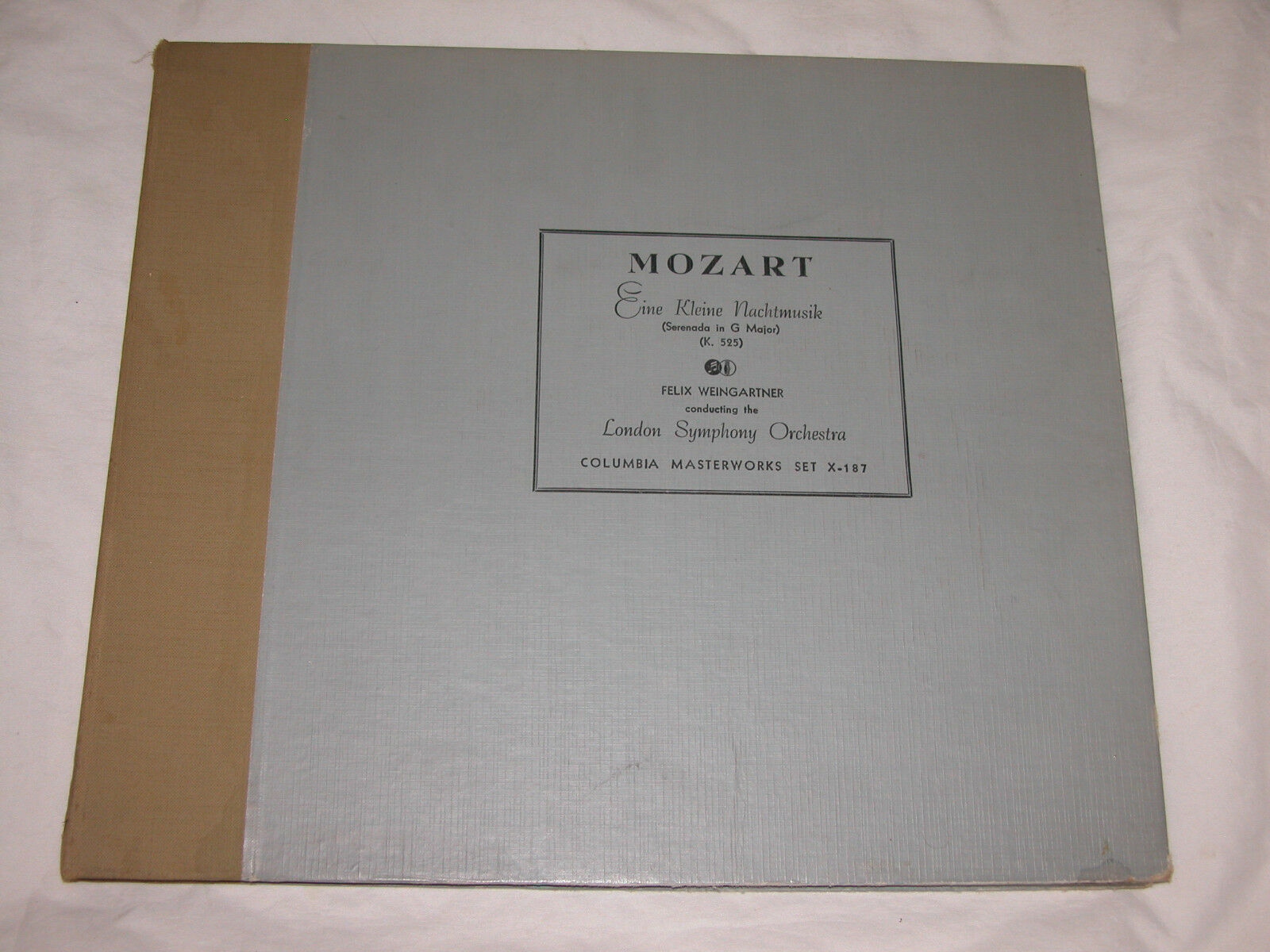
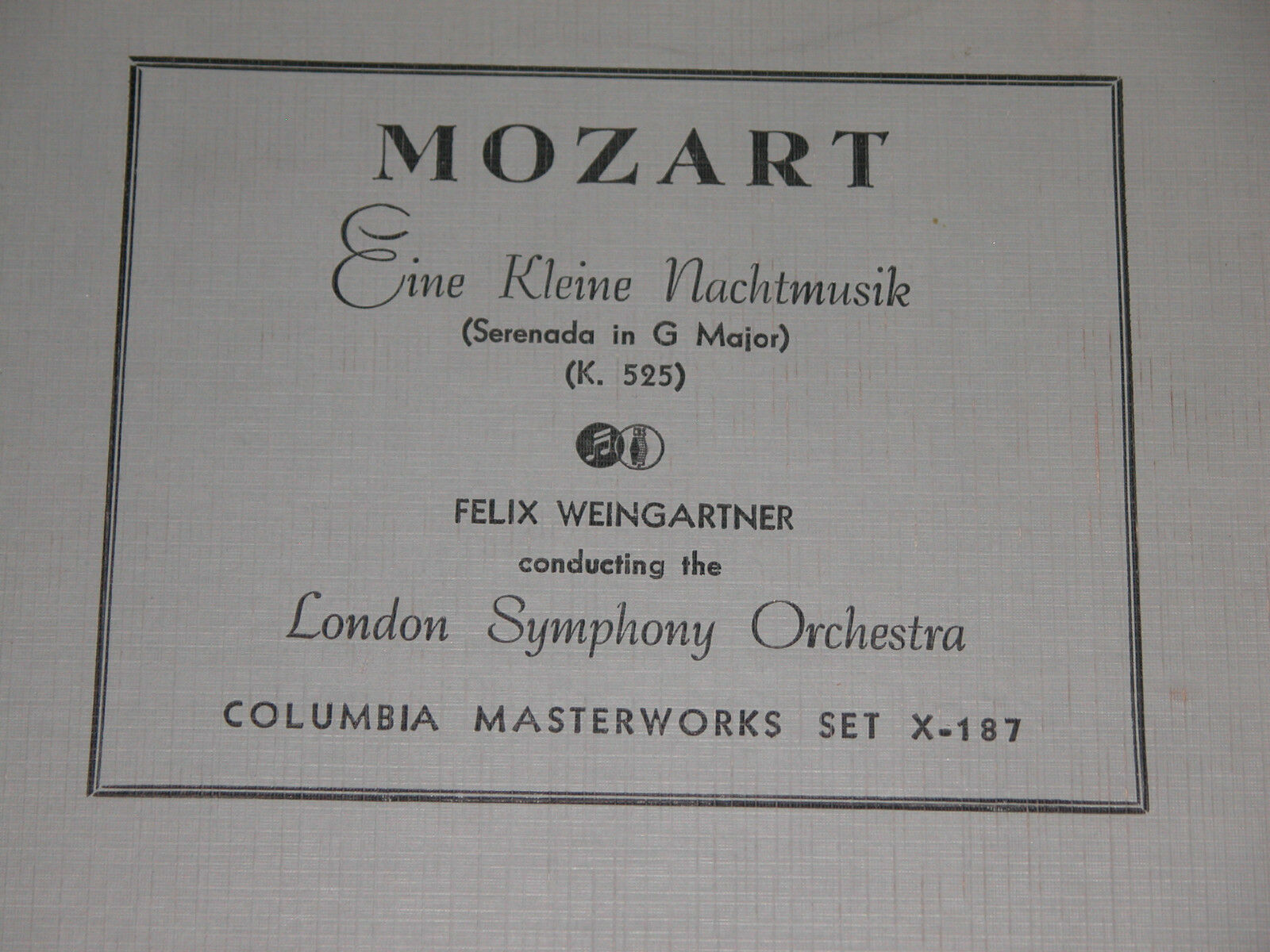
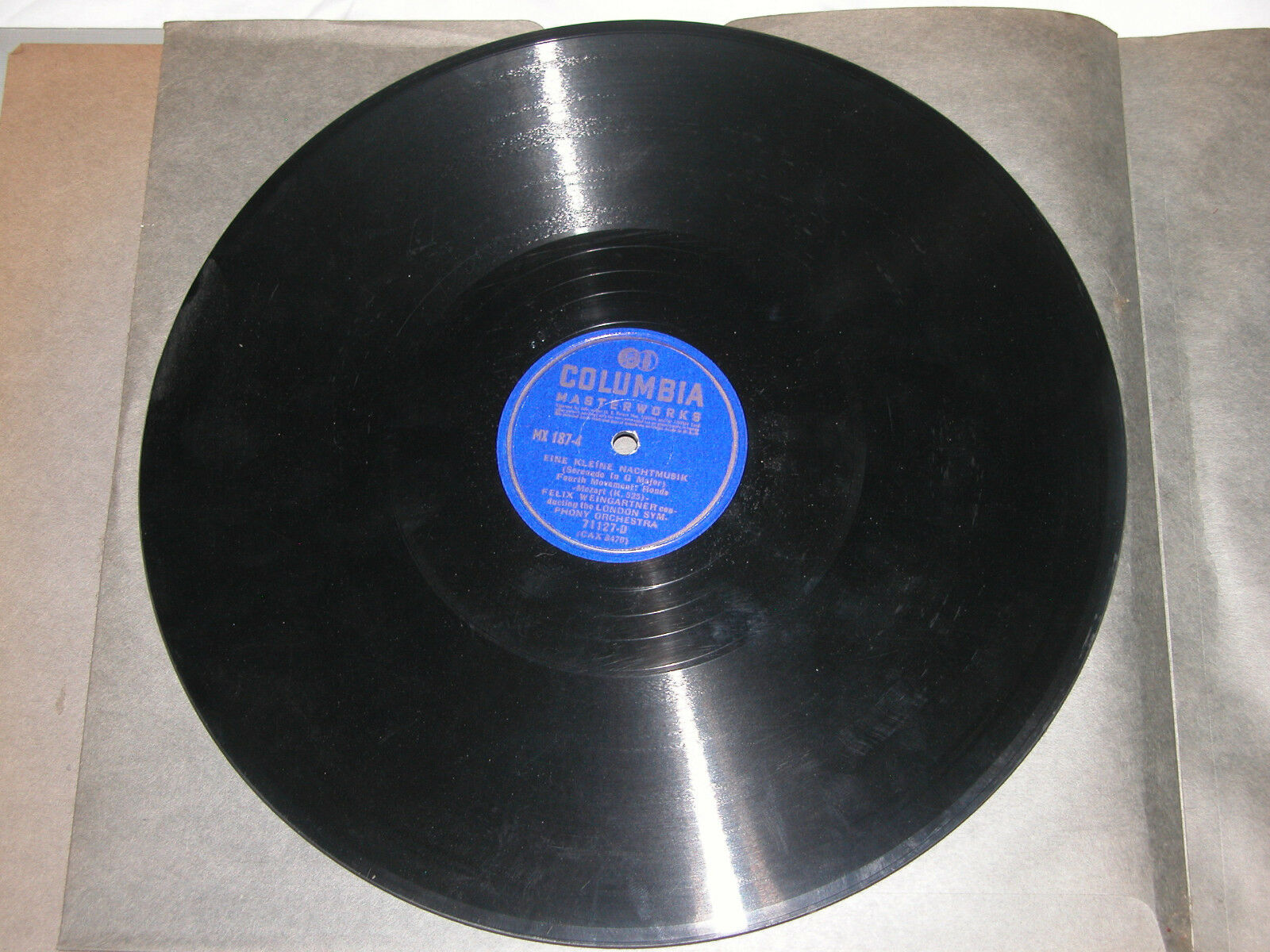
Mozart Eine Kleine Nachtmusik Columbia Masterworks G Major Record Set X-187 78s
$
30
Favourite Auctions
To save auctions to your favourites, please login
If you don't have an account, please register
Description
Mozart Eine Kleine Nachtmusik Columbia Masterworks G Major Record Set X-187 78s
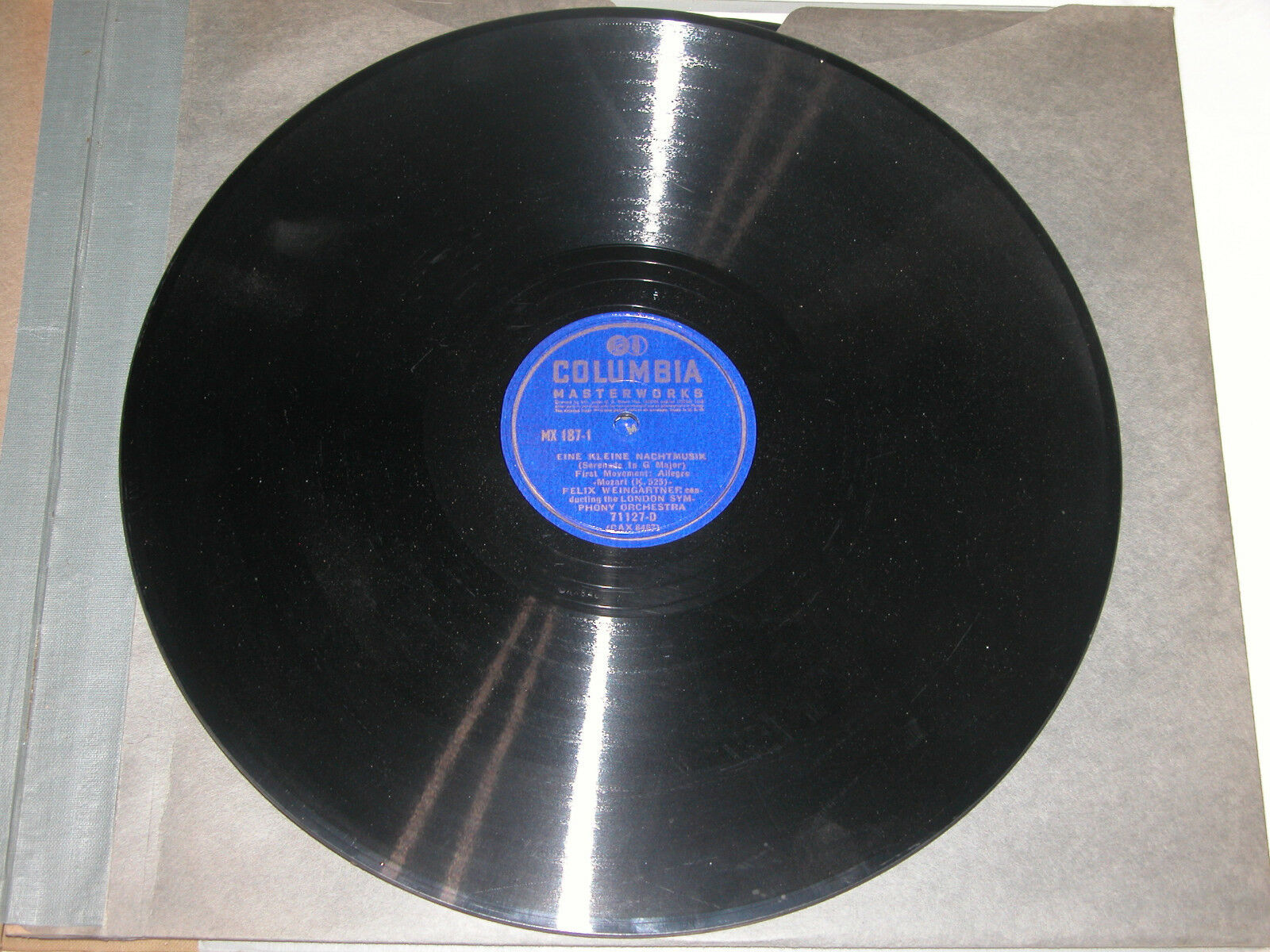
Condition Good Condition (see pictures)
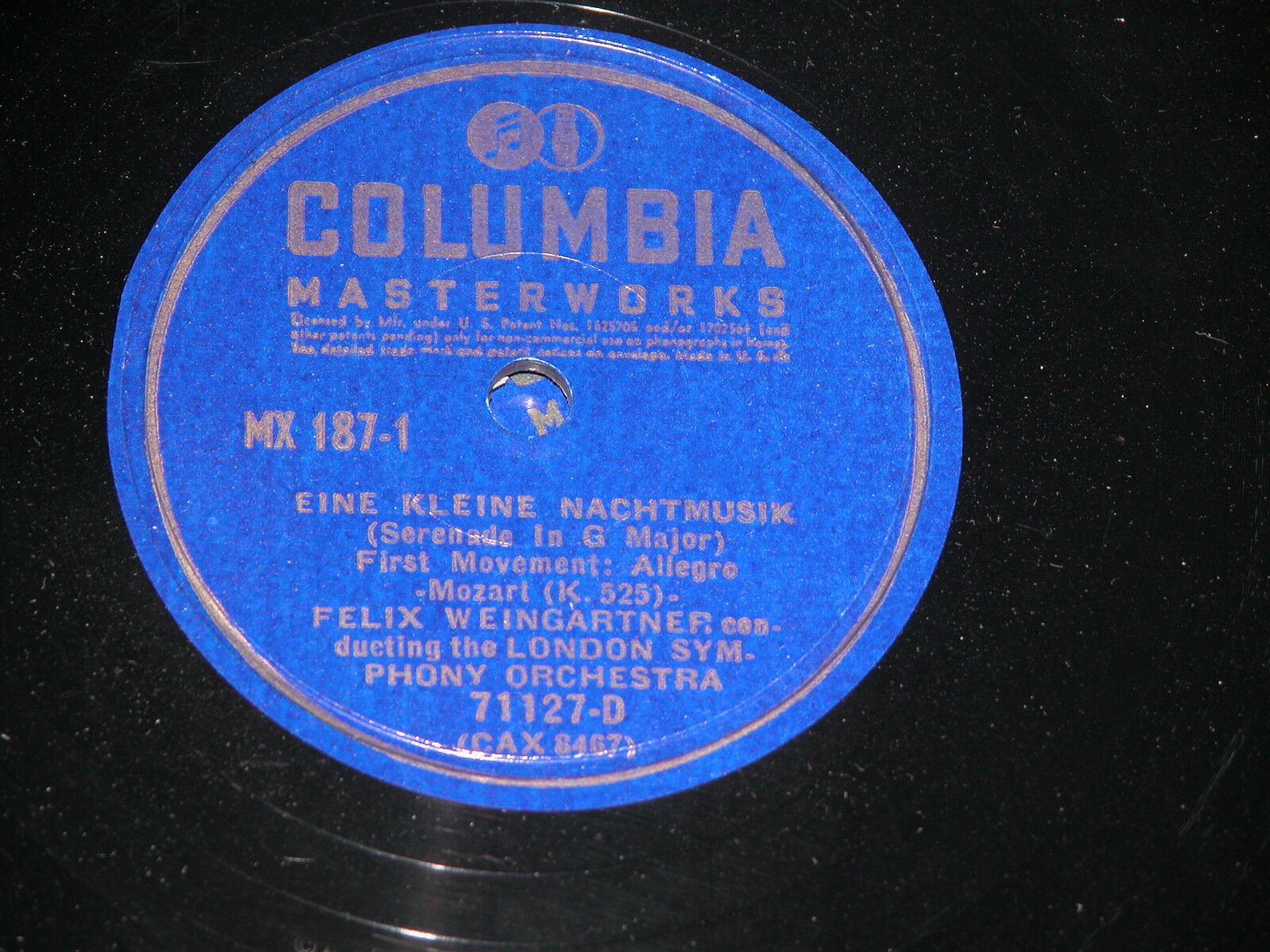
Label Columbia Masterworks
Information Felix Weingartner conducting London Symphony Orchestra
4 Sides., Set X-187
70741-D - 70742-D
MX 71127-D - 71128-D
Matrix numbers: CAX 8467 to CAX 8470 (All take 1 - CAX 8468 and CAX 8470 - all -1A)
Recorded: 17 February 1939; HMV Studio No. 1; Abbey Road, London
LX 854 - LX 855 (Columbia UK - Issued Feb. 1941)
LOX 514 - LOX 515 (Columbia AUS)
Album Cover Designer: Alex Steinweiss
About Mozart Wolfgang Amadeus Mozart, 27 January 1756 – 5 December 1791), baptised as Johannes Chrysostomus Wolfgangus Theophilus Mozart, was a prolific and influential composer of the classical era.
Born in Salzburg, Mozart showed prodigious ability from his earliest childhood. Already competent on keyboard and violin, he composed from the age of five and performed before European royalty. At 17, Mozart was engaged as a musician at the Salzburg court, but grew restless and traveled in search of a better position. While visiting Vienna in 1781, he was dismissed from his Salzburg position. He chose to stay in the capital, where he achieved fame but little financial security. During his final years in Vienna, he composed many of his best-known symphonies, concertos, and operas, and portions of the Requiem, which was largely unfinished at the time of his early death at the age of 35. The circumstances of his early death have been much mythologized.
He composed more than 600 works, many acknowledged as pinnacles of symphonic, concertante, chamber, operatic, and choral music. He is among the most enduringly popular of classical composers, and his influence is profound on subsequent Western art music. Ludwig van Beethoven composed his own early works in the shadow of Mozart, and Joseph Haydn wrote: "posterity will not see such a talent again in 100 years".
About 78 RPM Records Any flat disc record, made between about 1898 and the late 1950s and playing at a speed around 78 revolutions per minute is called a "78" by collectors. The materials of which discs were made and with which they were coated were also various; shellac eventually became the commonest material. Generally 78s are made of a brittle material which uses a shellac resin (thus their other name is shellac records). During and after World War II when shellac supplies were extremely limited, some 78 rpm records were pressed in vinyl instead of shellac (wax), particularly the six-minute 12" 78 rpm records produced by V-Disc for distribution to US troops in World War II.
78s come in a variety of sizes, the most common being 10 inch (25 cm) and 12 inch (30 cm) diameter, and these were originally sold in either paper or card covers, generally with a circular cutout allowing the record label to be seen. Since most 78 rpm discs were issued in paper sleeves with no additional accompanying materials, relatively limited information is provided by the items themselves.
Earliest speeds of rotation varied widely, but by 1910 most records were recorded at about 78 to 80 rpm. In 1925, 78.26 rpm was chosen as a standard for motorized phonographs, because it was suitable for most existing records, and was easily achieved using a standard 3600-rpm motor and 46-tooth gear (78.26 = 3600/46). Thus these records became known as 78s (or "seventy-eights"). This term did not come into use until after World War II when a need developed to distinguish the 78 from other newer disc record formats. Earlier they were just called records, or when there was a need to distinguish them from cylinders, disc records.
The duration of 78 RPM recordings is about three to five minutes per side, depending on the disc size: 12": ca. four to five minutes 10": ca. three minutes As late as the 1970s, some children's records were released at the 78 rpm speed. The older 78 format continued to be mass produced alongside the newer formats into the 1950s, but had faded from the scene by 1955.
Thanks For Looking Have a Great Day
price rating