NEW/MINT/SEALED GODZILLA OST 60th AKIRA IFUKUBE DEATH WALTZ SUBSCRIPTION 12" LP
$
100


Favourite Auctions
To save auctions to your favourites, please login
If you don't have an account, please register
Description
Artist
AKIRA IFUKUBE
Title
GODZILLA
Format
12" vinyl LP
Date of Release
July 14, 2014
Country of Manufacture
UK
Label
Death Waltz Recording Company
The Art of Soundtracks Catalog DW024DL Condition New, mint, original factory sealed condition
Info
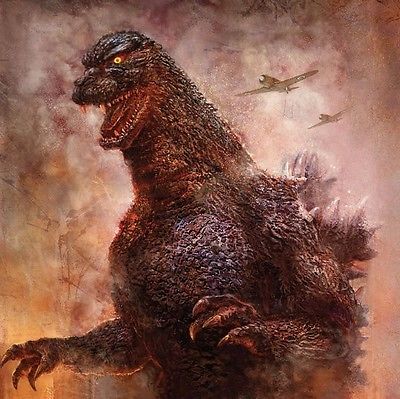
MEGA RARE Death Waltz subscription service only edition exclusively pressed on yellow and black toxic color vinyl with lithograph. Initially limited to 300 copies worldwide (NOTE: a number of copies had a faulty/wrongly stamped B side and an unknown number of replacement copies were issued (vinyl only, not the cover).
Pressed on 180 gram vinyl. Housed in a heavyweight tip-on, case-bound gatefold jacket printed on textured Galtex Prima card containing an exclusive full colour booklet with liner notes by Japanese cinema expert Jasper Sharpe & Film On Wax Editor Charlie Bridgen, with exclusive art by Cheung Chung Tat wrapped in an OBI strip.
DEATH WALTZ RECORDING COMPANY PRESENT
GODZILLA
THE JAPANESE ORIGINAL
Original Motion Picture Score by Akira Ifukube. Remastered on vinyl from The Toho Archives. Exclusive original art work by Cheung Chung Tat. Sleeve notes by Jasper Sharp & Charlie Bridgen.
Akira Ifukube's iconic score to GODZILLA is presented here in its entirety on vinyl for the first time ever - straight from the archives at Toho and fully remastered by Optimum Mastering.
Limited to 300 copies.
Pressed on 180 gram vinyl.
Housed in a heavyweight tip-on, case-bound gatefold jacket printed on textured Galtex Prima card containing an exclusive full color booklet with liner notes by Japanese cinema expert Jasper Sharpe & Film On Wax Editor Charlie Bridgen, with exclusive art by Cheung Chung Tat wrapped in an OBI strip. Remastered for vinyl from The Toho Archives.
"For the first time ever on vinyl the full score to the legendary monster movie that started it all GODZILLA by AKIRA IFUKUBE
Death Waltz Recording Company are proud to be unearthing the legendary monster of our time and bringing him to vinyl in the shape of Akira Ifukube’s score to GODZILLA. Starkly different to the usual view of The Big G as the ultimate monster wrestler, Ifukube’s music is intense, dark, and reflects Ishiro Honda’s film as a pure horror film. While the score opens with the jaunty riff that would eventually become Godzilla’s Theme, the majority of the music alternates between pounding brass and mournful strings as we witness the death and destruction that comes in Godzilla’s wake.
Ifukube uses low string notes as a sinister motif to herald the arrival of the creature, and then turns up the brass to eleven, creating an atmosphere of pure apocalypse. More horrifying still are the piercing strings that score the oxygen destroyer, the device that would destroy Godzilla. Big laments are used as the characters question the use of the machine as a weapon of mass destruction, and it’s this remarkable human quality that infuses the score with its unique feel. Help us celebrate the sixtieth birthday of the greatest monster to walk the earth, and the powerhouse musical experience that is Akira Ifukube’s GODZILLA."
Tracklist
A1 Godzilla Approaches
A2 Godzilla Main Theme
A3 Ship Music / Sinking Of Eikou-Maru
A4 Sinking Of Bingou-Maru
A5 Anxieties On Ootojima Island
A6 Ootojima Temple Festival
A7 Stormy Ootojima Island
A8 Theme For Ootojima Island
A9 Japanese Army March I
A10 Horror Of The Water Tank
A11 Godzilla Comes Ashore
B1 Godzilla's Rampage
B2 Desperate Broadcast
B3 Godzilla Comes To Tokyo Bay
B4 Intercept Godzilla
B5 Tragic Sight Of The Imperial Capital
B6 Oxygen Destroyer
B7 Prayer For Peace
B8 Japanese Army March II
B9 Godzilla At The Ocean Floor
B10 Ending
B11 Untitled *
Pressed by GZ Media – 118969E
Sleeve spine reads "Professor Yamane, Let's Be Honest, If There's A Way To Defeat Godzilla, We Need To Know."
* Track B11 is an untitled lock groove of the "Godzilla Stomp" that does not appear on the tracklist.
Barcode and Other Identifiers
Barcode (Text): 5 053760 008422 >
Barcode (Scanned): 5053760008422
Matrix / Runout (Side A): 118969E1 /A
Matrix / Runout (Side B): 118969E2 Payment & Shipping PayPal is the preferred method of payment.
All items are packed with individual care in sturdy protective mailers and shipped promptly upon receipt of payment
100% positive feedback rated seller since 1998.
With ManhattanMusic, you can bid with confidence!
Be sure to check out ManhattanMusic's other items currently available for your consideration.
Bio
Godzilla (ゴジラ Gojira?) (/É¡É’dˈzɪlÉ™/; [É¡oꜜdÊ‘iɽa] ( listen)) is a giant monster or daikaiju originating from a series of tokusatsu films of the same name from Japan. He first appeared in IshirÅ? Honda's 1954 film Godzilla. Since then, Godzilla has gone on to become a worldwide pop culture icon starring in 28 films produced by Toho Co., Ltd. The character has appeared in numerous other medium incarnations including video games, novels, comic books, and television series. A 1998 American reimagining was produced by Tri-Star Pictures (the title monster of which was renamed to Zilla by Toho for later appearances), while a second American version by Legendary Pictures was released on May 16, 2014. The character is commonly alluded to by the title King of the Monsters, an epithet first used in the Americanized version of Ishiro Honda's original 1954 film.
With the nuclear bombings of Hiroshima and Nagasaki and the Lucky Dragon 5 incident still fresh in the Japanese consciousness, Godzilla was conceived as a metaphor for nuclear weapons. As the film series expanded, some stories took on less serious undertones portraying Godzilla as a hero while other plots still portrayed Godzilla as a destructive monster; sometimes the lesser of two threats who plays the defender by default but is still a danger to humanity.
Gojira (ゴジラ?) is a portmanteau of the Japanese words: gorira (ゴリラ?, "gorilla"), and kujira (鯨(クジラ)?, "whale"), which is fitting because in one planning stage, Godzilla was described as "a cross between a gorilla and a whale", alluding to his size, power and aquatic origin. One popular story is that "Gojira" was actually the nickname of a corpulent stagehand at Toho Studio. The story has not been verified, however, and, in the nearly sixty years since the film's original release, no one claiming to be the rumored employee has ever stepped forward nor have any photographs ever surfaced. Kimi Honda (the widow of Ishiro Honda) always suspected that the man never existed as she mentioned in a 1998 interview, "The backstage boys at Toho loved to joke around with tall stories".
Godzilla's name was written in ateji as Gojira (呉爾羅?), where the kanji are used for phonetic value and not for meaning. Many Japanese books on Godzilla have referenced this curious fact, including B Media Books Special: Gojira Gahô, published by Take-Shobo in three different editions (1993, 1998, and 1999).
The Japanese pronunciation of the name is [ɡodʑiɽa]; the Anglicized form is /ɡɒdˈzɪlə/, with the first syllable pronounced like the word "god", and the rest rhyming with "gorilla". In the Hepburn romanization system, Godzilla's name is rendered as "Gojira", whereas in the Kunrei romanization system it is rendered as "Gozira".
Although the specific details of Godzilla's appearance have varied slightly over the years, the overall impression has remained consistent. Inspired by the fictional Rhedosaurus created by animator Ray Harryhausen for the film The Beast from 20,000 Fathoms, Godzilla's iconic character design was conceived as that of an amphibious reptilian monster based around the loose concept of a dinosaur with an erect standing posture, scaly skin, an anthropomorphic torso with muscular arms, spikes on its back and tail, and a furrowed brow. Art director Akira Watanabe combined attributes of a Tyrannosaurus, an Iguanodon, a Stegosaurus and an alligator to form a sort of blended chimera, inspired by illustrations from an issue of Life magazine. To emphasise the monster's relationship with the atomic bomb, its skin texture was inspired by the keloid scars seen on Hiroshima's survivors. Godzilla's appearance has traditionally been portrayed in the films by an actor wearing a latex costume, though the character has also been rendered in animatronic, stop-motion and computer-generated form. Godzilla has a distinctive roar, which was created by composer Akira Ifukube, who produced the sound by rubbing a resin coated glove along the string of a contrabass and then slowing down the playback. Godzilla is sometimes depicted as green in comics, cartoons and movie posters, but the costumes used in the movies were usually painted charcoal grey with bone-white dorsal fins up until the film Godzilla 2000.
Godzilla's iconic design features a reptilian visage, a robust build, an upright posture, a long tail and rows of serrated fins along the back.
Within the context of the Japanese films, Godzilla's exact origins vary, but it is generally depicted as an enormous, violent, prehistoric sea monster awakened and empowered by nuclear radiation. Its size is inconsistent, changing from film to film and even from scene to scene for the sake of artistic license. The miniature sets and costumes are typically built at a 1/25 - 1/50 scale and filmed at 240 frames per second, to create the illusion of great size. In the original 1954 film, Godzilla was scaled to be 50 meters tall (164 feet). This was done so Godzilla could just peer over the largest buildings in Tokyo at the time. In the American version, Godzilla is said to be "over 400 feet tall." As the series progressed Toho would rescale the character, eventually making Godzilla as tall as 100 meters (328 feet). This was so that it wouldn't be dwarfed by the newer bigger buildings in Tokyo's skyline such as the 242 meter (797 foot) tall Tokyo Metropolitan Government Building which Godzilla destroyed in the 1991 film Godzilla vs King Ghidorah. Supplementary information such as character profiles would also depict Godzilla as weighing between 20,000-60,000 tons. In the 2014 American film Godzilla, Godzilla was scaled to be 350 feet tall (106 meters), making him the biggest incarnation of the character yet. Director Gareth Edwards wanted Godzilla "to be so big as to be seen from anywhere in the city, but not too big that he couldn’t be obscured". Godzilla's signature weapon is its "atomic breath," a nuclear blast that it generates inside of its body and unleashes from its jaws in the form of a blue or red radioactive heat ray. Toho’s special effects department has used various techniques to render the breath, from physical gas-powered flames to hand-drawn or computer-generated fire. Godzilla is shown to possess immense physical strength and muscularity. Haruo Nakajima, the actor who played Godzilla in the original films, was a black belt in Judo and used his expertise to choreograph the battle sequences. Godzilla can breathe underwater, and described in the original film by the character Dr. Yamane as a transitional form between a marine and a terrestrial reptile. Godzilla is shown to have great vitality: it is immune to conventional weaponry thanks to its rugged hide and ability to regenerate, and as a result of surviving a nuclear explosion, it cannot be destroyed by anything less powerful. Various films, television shows, comics and games have depicted Godzilla with additional powers such as an atomic pulse, magnetism, precognition, fireballs, an electric bite, superhuman speed, eye beams and even flight.
Godzilla's allegiance and motivations have changed from film to film to suit the needs of the story. Although Godzilla does not like humans, it will fight alongside humanity against common threats. However, it makes no special effort to protect human life or property and will turn against its human allies on a whim. It is not motivated to attack by predatory instinct: it doesn't eat people, and instead sustains itself on radiation and an omnivorous diet. When inquired if Godzilla was "good or bad", producer Shogo Tomiyama likened it to a Shinto "God of Destruction" which lacks moral agency and cannot be held to human standards of good and evil. "He totally destroys everything and then there is a rebirth. Something new and fresh can begin."
The gender of the Godzilla character has been a subject of confusion for English-speaking audiences. In the original Japanese films, Godzilla and all the other monsters are referred to with gender-neutral pronouns such as "it", while in the English dubbed versions, Godzilla is explicitly described as a male, such as in the title of Godzilla, King of the Monsters!. The 1998 Hollywood reimagining contributed to this confusion, in which the titular character (subsequently known as Zilla) was depicted laying eggs.
In the various stories it has appeared in, Godzilla has been featured alongside many supporting characters. It has faced human opponents such as the JSDF, and other giant monsters, from recurring characters like King Ghidorah, Gigan and Mechagodzilla to one-shot characters like Megalon, Biollante and Megaguirus. Godzilla is also shown to have allies, such as Mothra, Rodan and Anguirus (though these characters were initially portrayed as Godzilla's rivals), and children, such as Minilla. Godzilla has even fought against fictional characters from other franchises in crossover media, such as King Kong and the Fantastic Four.
Godzilla is one of the most recognizable symbols of Japanese popular culture worldwide and remains an important facet of Japanese films, embodying the kaiju subset of the tokusatsu genre. Godzilla’s vaguely humanoid appearance and strained, lumbering movements endeared it to Japanese audiences, who could relate to Godzilla as a sympathetic character despite its wrathful nature. Audiences respond positively to the character because it acts out of rage and self-preservation and shows where science and technology can go wrong. Godzilla has been considered a filmographic metaphor for the United States, as well as an allegory of nuclear weapons in general. The earlier Godzilla films, especially the original, portrayed Godzilla as a frightening, nuclear monster. Godzilla represented the fears that many Japanese held about the nuclear attacks on Hiroshima and Nagasaki, and the possibility of recurrence.
As the series progressed, so did Godzilla, changing into a less destructive and more heroic character as the films became geared towards children. Since then, the character has fallen somewhere in the middle, sometimes portrayed as a protector of the world from external threats and other times as a bringer of destruction. Godzilla remains one of the greatest fictional heroes in the history of film, and is also the second of only three fictional characters to have won the MTV Lifetime Achievement Award, which was awarded in 1996. Godzilla was given a star on the Hollywood Walk of Fame in 2004 to celebrate the premiere of the character's 50th anniversary film, Godzilla: Final Wars. Godzilla's pop-cultural impact has led to the creation of numerous parodies and tributes, as seen in media such as Bambi Meets Godzilla, which was ranked as one of the "50 greatest cartoons", various episodes of Mystery Science Theater 3000, and the song "Godzilla", by Blue Öyster Cult. Godzilla has also been used in advertisements, such as in a commercial for Nike, where Godzilla lost a game of basketball to NBA player Charles Barkley. The commercial was subsequently adapted into a comic book illustrated by Jeff Butler. Godzilla has also appeared in a commercial for Snickers candy bar, which served as an indirect promo for the 2014 movie. Godzilla's success inspired the creation of numerous other monster characters, such as Gamera, Yonggary and Gorgo.
Godzilla's fame and saurian appearance has had an impact on the scientific community. Gojirasaurus is a dubious genus of coelophysid dinosaur, named by paleontologist and admitted Godzilla fan Kenneth Carpenter. Dakosaurus is an extinct marine crocodile of the Jurassic Period, which researchers informally nicknamed "Godzilla". Paleontologists have written tongue-in-cheek speculative articles about Godzilla's biology, with Ken Carpenter tentatively classifying it as a ceratosaur based on its skull shape, four fingered hands and dorsal scutes, and paleontologist Darren Naish expressing skepticism while commenting on Godzilla's unusual morphology.
Godzilla's ubiquity in pop-culture has led to the mistaken assumption that the character is in the public domain, resulting in litigation by Toho to protect their corporate asset from becoming a generic trademark. In April 2008, Subway depicted a giant monster in a commercial for their Five Dollar Footlong sandwich promotion. Toho filed a lawsuit against Subway for using the character without permission, demanding $150,000 in compensation. In February 2011, Toho sued Honda for depicting a fire-breathing monster in a commercial for the Honda Odyssey. The monster was never mentioned by name, being seen briefly on a video screen inside the minivan. The Sea Shepherd Conservation Society christened a vessel Gojira. Its purpose is to target and harass Japanese whalers in defense of whales in the Southern Ocean Whale Sanctuary. The Gojira was renamed MV Brigitte Bardot in May 2011 due to legal pressure from Toho. Gojira is the name of a French death metal band, formerly known as Godzilla; legal problems forced the band to change their name.
* * * * *
Akira Ifukube (伊ç¦?部 æ˜ Ifukube Akira?, 31 May 1914 – 8 February 2006) was a Japanese composer of classical music and film scores, perhaps best known for his work on the soundtracks of the Godzilla movies by Toho. He was born on May 31, 1914 in Kushiro on the Japanese island of HokkaidÅ?, the third son of a Shinto priest. Much of his childhood was spent in areas with a mixed Japanese and Ainu population, and his father, unusually for the time, socialised with Ainu. Ifukube was strongly influenced by the traditional music of both peoples, and studied the violin and the shamisen. His first encounter with classical music occurred when attending secondary school in HokkaidÅ?'s capital, Sapporo. Legend has it that Ifukube decided to become a composer at the age of 14 after hearing a radio performance of Igor Stravinsky's ballet, The Rite of Spring. He also cited the music of Manuel de Falla as a major influence.
Ifukube went on to study forestry at Hokkaido University and composing in his spare time, which prefigured a line of self-taught Japanese composers such as TÅ?ru Takemitsu and Takashi Yoshimatsu. His first piece was the piano solo, Piano Suite (later the title was changed to Japan Suite, arranged for orchestra). This piece was dedicated to the pianist George Copeland who was then living in Spain. Atsushi Miura, musicologist and Ifukube's friend in university, sent a fan letter to Copeland. Copeland replied, "It is wonderful that you listen my disc in spite of you living in Japan, the opposite side of the earth. I imagine you may compose music. Send me some piano pieces." Then Miura, who was not a composer, presented Ifukube and this piece to Copeland. Copeland promised to interpret it, but the correspondence was unfortunately stopped because of the Spanish Civil War. Ifukube's big break came in 1935, when his first orchestral piece, Japanese Rhapsody, won the first prize in an international contest for young composers promoted by Alexander Tcherepnin. The judges of that contest—Albert Roussel, Jacques Ibert, Arthur Honegger, Alexandre Tansman, Tibor Harsányi, Pierre-Octave Ferroud, and Henri Gil-Marchex—were unanimous in their selection of Ifukube as the winner. The next year, Ifukube studied modern Western composition while Tcherepnin was visiting Japan, and in 1938 his Piano Suite obtained an honourable mention at the I.C.S.M. festival in Venice. In the late 1930s his music, especially Japanese Rhapsody, was performed in Europe on a number of occasions.
On completing University, he worked as a forestry officer and lumber processor, and towards the end of the Second World War was appointed by the Japanese Imperial Army to study the elasticity and vibratory strength of wood. He suffered radiation exposure after carrying out x-rays without protection, a consequence of the wartime lead shortage. Thus, he had to abandon forestry work and became a professional composer and teacher. Ifukube spent some time in hospital due to the radiation exposure, and was startled one day to hear one of his own marches being played over the radio when General Douglas MacArthur arrived to formalize the Japanese surrender.
From 1946 to 1953, he taught at the Nihon University College of Art, during which period he composed his first film score for The End of the Silver Mountains, released in 1947. Over the next fifty years, he would compose more than 250 film scores, the high point of which was his 1954 music for IshirÅ? Honda's Toho movie, Godzilla. Ifukube also created Godzilla's trademark roar – produced by rubbing a resin-covered leather glove along the loosened strings of a double bass – and its footsteps, created by striking an amplifier box.
Despite his financial success as a film composer, Ifukube's first love had always been his general classical work as a composer. In fact his compositions for the two genres cross-fertilized each other. For example, he was to recycle his 1953 music for the ballet Shaka, about how the young Siddhartha Gautama eventually became the Buddha, for Kenji Misumi's 1961 film Buddha. Then in 1988 he reworked the film music to create his three-movement symphonic ode Gotama the Buddha. Meanwhile he had returned to teaching at the Tokyo College of Music, becoming president of the college the following year, and in 1987 retired to become head of the College's ethnomusicology department. He trained younger generation composers such as Toshiro Mayuzumi, Yasushi Akutagawa and Kaoru Wada, Yssimal Motoji and Imai Satoshi. He also published Orchestration, a 1,000-page book on theory.
He died in Tokyo at Meguro-ku Hospital of multiple organ dysfunction on February 8, 2006 at the age of 91.
The Japanese government awarded Ifukube the Order of Culture. Subsequently, he was awarded the Order of the Sacred Treasure, Third Class.
Selected works:
Orchestral
Japanese Rhapsody (1935)
Triptyque aborigene for chamber orchestra (1937)
Symphony Concertante for piano and orchestra (1941)
Ballata sinfonica (1943)
Overture to the Nation of Philippines (1944)
Salome (1948) – ballet based on Oscar Wilde's play of the same name. Ifukube revised and expanded the score in 1987. The piece is written in a conservative, late-romantic style reminiscent of Rimsky-Korsakov, Mussorgsky or even Khachaturian.
Drumming of Japan (1951, revised 1984)
Symphonic Fantasia No. 1 (1954, revised 1983)
Sinfonia Tapkaara (1954, revised 1979)
Ritmica Ostinata for piano and orchestra (1961, revised 1971)
Ronde in Burlesque for wind orchestra (1972, arranged to orchestra in 1983)
Violin Concerto No. 2 (1978)
Lauda concertata for marimba and orchestra (1979)
Symphonic Fantasia No. 2 (1983)
Symphonic Fantasia No. 3 (1983)
Gotama the Buddha, symphonic ode for mixed chorus and orchestra (1989)
Japanese Suite for orchestra (1991) on YouTube
Japanese Suite for string orchestra (1998)
Chamber and instrumental
Piano Suite (1933)
Toccata for guitar (1970)
Fantasia for baroque lute (1980)
Sonata for violin and piano (1985)
Ballata sinfonica for duo-treble and bass 25-stringed koto (2001)
Vocal
Ancient Minstrelsies of Gilyak Tribes (1946)
Three Lullabies among the Native Tribes on the Island of Sakhalin (1949)
Eclogues after Epos among Aino Races for solo voice and 4 kettle drums (1950)
A Shanty of the Shiretoko Peninsula (1960)
The Sea of Okhotsk for soprano, bassoon, piano (or harp) and double bass (1988)
Tomo no oto for traditional ensemble and orchestra (1990)
Lake Kimtaankamuito (Lake Mashū) (摩周湖 Mashū-ko?) for soprano, viola and harp or piano (1992)
La Fontaine sacrée for soprano, viola, bassoon and harp (1964, 2000); arrangement by the composer from the 1964 film score Mothra vs. Godzilla
Film scores
Snow Trail (1947)
The Quiet Duel (1949)
Anatahan (アナタ�ン), also known as The Saga of Anatahan (1953)
Godzilla (1954)
Dobu (film) 1954
Ningen gyorai kaiten (1955)
The Burmese Harp (1956)
Rodan (1956)
The Mysterians (1957)
Varan the Unbelievable (1958)
The Birth of Japan (1958)
Battle in Outer Space (1959)
The Big Boss (Boss of the Underworld) (1959)
Daredevil in the Castle (1961)
The Tale of Zatoichi (1962)
King Kong vs. Godzilla (1962)
Chushingura (1962)
New Tale of Zatoichi (1963)
Wanpaku Ouji no Orochi Taiji (1963)
Atragon (1963)
Zatoichi the Fugitive (1963)
Zatoichi on the Road (1963)
Mothra vs. Godzilla (1964)
Fight, Zatoichi, Fight (1964)
Dogora (1964)
Ghidorah, the Three-Headed Monster (1964)
Whirlwind (1964)
Frankenstein Conquers the World (1965)
Zatoichi's Revenge (1965)
Zatoichi and the Chess Expert (1965)
Invasion of Astro-Monster (1965)
The War of the Gargantuas (1966)
Daimajin (1966)
Wrath of Daimajin (1966)
Zatoichi's Vengeance (1966)
Return of Daimajin (1966)
King Kong Escapes (1967)
Zatoichi Challenged (1967)
Destroy All Monsters (1968)
Latitude Zero (1969)
Zatoichi Meets Yojimbo (1970)
Space Amoeba (1970)
Godzilla vs. Gigan (1972)
Zatoichi's Conspiracy (1973)
Sandakan No. 8 (1974)
Terror of Mechagodzilla (1975)
Lady Origin (1978)
Dozoku no ranjo (1991)
Godzilla vs. King Ghidorah (1991)
Godzilla vs. Mothra (1992)
Godzilla vs. Mechagodzilla II (1993)
Kushiro Marshland (1993)
Godzilla vs. Destoroyah (1995)
In addition, his work were also used in Godzilla vs. Biollante, Godzilla vs. SpaceGodzilla, Godzilla 2000, Godzilla vs. Megaguirus, Godzilla, Mothra and King Ghidorah: Giant Monsters All-Out Attack, and Godzilla: Final Wars.
- wikipedia