NEW/MINT/SEALED POPOL VUH NOSFERATU THE VAMPYRE OST TWO DBL LPs w/POSTER WAXWORK
$
56


Favourite Auctions
To save auctions to your favourites, please login
If you don't have an account, please register
Description
eBay listing template 2013 Artist
POPOL VUH
Title
NOSFERATU THE VAMPYRE
Item
Two (2) Double 12" Vinyl LPs:
One (1) White Marble Castle Double LP; and,
One (1) Midnight Blue and Gold Swirl Double LP
Released October 23, 2015 Country USA
Label Waxwork Records
Catalog
WW012
Condition New, mint, original FACTORY SEALED condition
Info
REMASTERED, DELUXE, LIMITED EDITION! COMPLETE SET! MINT/SEALED!
Waxwork Records proudly presents the deluxe vinyl soundtrack reissue of Werner Herzog’s, NOSFERATU THE VAMPYRE. The album, composed by German prog legends POPOL VUH, comes from Waxwork as a deluxe, expanded double LP including four extra tracks from the film, and originally released on the Popol Vuh album, Bruder des Schattens - Sohne des Lichts.
Waxwork has worked directly with the family of late Popol Vuh founder, Florian Fricke, to faithfully restore and remaster the soundtrack for vinyl.
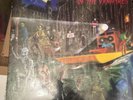
Incredibly detailed new album artwork has been commissioned from Jessica Seamans of Landland, and is the first officially-approved NOSFERATU THE VAMPYRE soundtrack artwork since the original 1978 soundtrack release.
In addition to liner notes by artist Jessica Seamans, the LP package also includes an art print of the front cover artwork.
Standard LP package specs include: Standard LP package specs include: Standard LP package specs include:
Heavyweight 2X LP 180 Gram White Marble Castle Wall Colored Vinyl
Expanded and Remastered Soundtrack Specifically for Vinyl
Old Style Tip-On Gatefold Jacket
New Artwork By Jessica Seamans of Landland
Artist Liner Notes and Art Print
Deluxe Web Exclusive Variant Limited to 500 units:
Heavyweight 2X LP 180 Gram Midnight Blue and Gold Swirl Colored Vinyl
An 11” x 22” poster of Inner Gatefold Art
Expanded and Remastered Soundtrack Specifically for Vinyl
Old Style Tip-On Gatefold Jacket
New Artwork by Jessica Seamans of Landland
Artist Liner Notes and Art Print
Tracklist
A1 Brüder Des Schattens
A2 Höre, Der Du Wagst
A3 Das Schloss Des Irrtums
B4 Die Umkehr
B5 Mantra 1
B6 Morning Sun
C7 Venus Principle
C8 Mantra II
C9 Die Natch Der Himmel
C10 Der Ruf Der Rohrflöte
D11 To A Little Way
D12 Through Pains To Heaven
D13 On The Way
D14 Zwiesprache Der Rohrflöte
Licensed From – Johannes Fricke
Licensed From – Anna Fricke
Licensed From – SPV GmbH
Record Company – SPV GmbH
Phonographic Copyright (p) – SPV Recordings
Copyright (c) – SPV Recordings
Copyright (c) – Waxwork Records
Exclusive Retailer – Waxwork Records
Recorded At – Bavaria Musikstudios
Designed At – Landland
Acoustic Guitar – Daniel Fichelscher
Art Direction – Johannes Fricke, Kevin Bergeron, Suzy Soto
Artwork – Jessica Seamans
Choir – A Chorus From Munich*
Composed By – Florian Fricke (tracks: A1, B5, B6, C8 to D11, D13, D14)
Electric Guitar – Daniel Fichelscher
Lyrics By – Florian Fricke (tracks: A1, B5, B6, C8 to D11, D13, D14)
Mastered By [For Vinyl] – J. Yuenger*
Oboe – Bob Eliscu
Performer – Popol Vuh
Piano – Florian Fricke
Producer – Gerhard Augustin
Remastered By [Digital] – Frank Fiedler
Sitar – Alois Gromer
Synthesizer – Florian Fricke
Tambura – Ted De Jong
Written-By – Alois Gromer (tracks: C7), Fichelscher* (tracks: A2 to B4, D12), Fricke* (tracks: A2 to B4, D12)
Recorded at: Bavaria Musik Studio München, August 1978.
Tracks listed sequentially regardless of side.
Barcode and Other Identifiers
Barcode (Sticker, front of shrink wrap): 7 28028 39981 3
Matrix / Runout (Side A, etched): WW-012 A De Plush V
Matrix / Runout (Side B, etched): WW-012 B De Plush V
Matrix / Runout (Side C, etched): WW-012 C <sig>
Matrix / Runout (Side D, etched): WW-012 D De Plush V
Payment & Shipping PayPal is the preferred method of payment.
All items are packed with individual care in sturdy protective mailers and shipped promptly upon receipt of payment
100% positive feedback rated seller since 1998.
With ManhattanMusic, you can bid with confidence!
Be sure to check out ManhattanMusic's other items currently available for your consideration.
Bio
Popol Vuh were a German electronic avant-garde band founded by pianist and keyboardist Florian Fricke in 1969 together with Holger Trülzsch (percussion) and Frank Fiedler (recording engineer and technical assistance). Other important members during the next two decades included Djong Yun, Conny Veit, Daniel Fichelscher, Klaus Wiese and Robert Eliscu. The band took its name from the Popol Vuh, a manuscript containing the mythology of the Post-Classic Quiché Maya people of highland Guatemala and southeast Mexico; the name translates roughly as "meeting place". In the Quiché language Popol Vuh translates as: "Book of the Community", "Book of Counsel", or more literally as "Book of the People".
The first album, Affenstunde, released in 1970, can be regarded as one of the earliest space music works, featuring the then new sounds of the Moog synthesizer together with ethnic percussion. This continued for only one more album, In den Gärten Pharaos, and material later to be released on the soundtrack to Aguirre, the Wrath of God, before Fricke largely abandoned electronic instruments in favor of piano-led compositions from 1972's Hosianna Mantra forward. This album also marked the start of exploring overtly religious themes rather than a more generally spiritual feeling within the music. The group evolved to include all kinds of instruments: wind and strings, electric and acoustic alike, combined to convey a mystical aura that made their music spiritual and introspective.
Popol Vuh influenced many other European bands with their uniquely soft but elaborate instrumentation, which took inspiration from the music of Tibet, Africa, and pre-Columbian America. With music sometimes described as "ethereal", they created soundscapes through psychedelic walls of sound, and are regarded as precursors of contemporary world music, as well as of new age and ambient.
The band contributed soundtracks to the films of Werner Herzog, including the aforementioned Aguirre, the Wrath of God, as well as Nosferatu, Fitzcarraldo, Cobra Verde, Heart of Glass and The Enigma of Kaspar Hauser, in which Fricke appeared.
Florian Fricke died in Munich on 29 December 2001 and the group disbanded.
In October 2003 Klaus Schulze wrote:
"Florian was and remains an important forerunner of contemporary ethnic and religious music. He chose electronic music and his big Moog to free himself from the restraints of traditional music, but soon discovered that he didn't get a lot out of it and opted for the acoustic path instead. Here, he went on to create a new world, which Werner Herzog loves so much, transforming the thought patterns of electronic music into the language of acoustic ethno music."
Discography
Affenstunde (1970)
In den Gärten Pharaos (1971)
Hosianna Mantra (1972)
Seligpreisung (1973)
Einsjäger und Siebenjäger (1974)
Das Hohelied Salomos (1975)
Aguirre (1975)
Letzte Tage – Letzte Nächte (1976)
Herz aus Glas (1977)
Brüder des Schattens – Söhne des Lichts (1978)
Nosferatu (1978)
Die Nacht der Seele (1979)
Sei still, wisse ICH BIN (1981)
Agape – Agape (1983)
Spirit of Peace (1985)
Cobra Verde (1987)
For You and Me (1991)
City Raga (1995)
Shepherd's Symphony – Hirtensymphonie (1997)
Messa di Orfeo (1999)
Florian Fricke solo albums
Die Erde und ich sind Eins (1983) – limited private pressing
Florian Fricke Plays Mozart (1992) – featuring Fricke on piano playing Mozart compositions
Compilations
Note: there are two distinct issues of the compilation Best of Popol Vuh – Werner Herzog. These are distinct from The Best Soundtracks from Werner Herzog Films, though the selections of tracks overlap.
Perlenklänge: The Best of Popol Vuh (1976) – Ohr / Pilz / Kosmische Musik compilation
Tantric Songs (1981) – featuring tracks from Die Nacht der Seele and Brüder des Schattens – Söhne des Lichts
Fitzcarraldo (1982) – soundtrack featuring four previously released Popol Vuh compositions besides opera and traditional music
In the Gardens of Pharao / Aguirre (1983)
Gesang der Gesänge (1988)
Best of Popol Vuh – Werner Herzog (1989 with 14 tracks; reissued 1993 with only 10 tracks)
Florian Fricke (1991) – featuring tracks from Herz aus Glas (retitled) and Brüder des Schattens – Söhne des Lichts
The Best Soundtracks from Werner Herzog Films (1991, 8 tracks)
Best of Popol Vuh from the Films of Werner Herzog (1992, 10 tracks), contains one track (titled "We Are Aware of the Misery") from the Herzog film The Dark Glow of the Mountains, which was previously unreleased
Sing, for Song Drives Away the Wolves (1993) – remix album
Movie Music (1994) – 3 CD set: Aguirre, Herz aus Glas, Nosferatu
Nicht Hoch Im Himmel (1998)
Future Sound Experience (2002) – remix album recorded in 1993 (according to its booklet) and released after Florian Fricke's death
70's Progressive (2006) – SPV compilation
On the Way to Himalaya (2006) – 3 CD set: Brüder des Schattens – Söhne des Lichts, Spirit of Peace, Die Nacht der Seele
The Werner Herzog Soundtracks Box set (2011)
Revisited & Remixed (1970–1999) (2011)
Nosferatu the Vampyre is a 1979 West German art house vampire film written and directed by Werner Herzog. Its original German title is Nosferatu: Phantom der Nacht ("Nosferatu: Phantom of the Night"). The film is set primarily in 19th-century Wismar, Germany and Transylvania, and was conceived as a stylistic remake of the 1922 German Dracula adaptation, Nosferatu, eine Symphonie des Grauens. It stars Klaus Kinski as Count Dracula, Isabelle Adjani as Lucy Harker, Bruno Ganz as Jonathan Harker, and French artist-writer Roland Topor as Renfield. There are two different versions of the film, one in which the actors speak English, and one in which they speak German.
Herzog's production of Nosferatu was very well received by critics and enjoyed a comfortable degree of commercial success. The film also marks the second of five collaborations between director Herzog and actor Kinski, immediately followed by 1979's Woyzeck. The film had 1,000,000 admissions in Germany and grossed ITL 53,870,000 in Italy. The film was also a modest success in Adjani's home country, taking in 933,533 admissions in France.
Jonathan Harker is an estate agent in Wismar, Germany. His boss, Renfield, informs him that a nobleman named Count Dracula wishes to buy a property in Wismar, and assigns Harker to visit the count and complete the lucrative deal. Leaving his young wife Lucy behind in Wismar, Harker travels for four weeks to Transylvania, to the castle of Count Dracula. He carries with him the deeds and documents needed to sell the house to the Count. On his journey, Jonathan stops at a village, where locals plead for him to stay clear of the accursed castle, providing him with details of Dracula's vampirism. Harker ignores the villagers' pleas as superstition, and continues his journey unassisted ascending the Borgo Pass. Harker arrives at Dracula's castle, where he meets the Count, a strange, ancient, almost rodent-like man, with large ears, pale skin, sharp teeth, and long fingernails.
The lonely Count is enchanted by a small portrait of Lucy and immediately agrees to purchase the Wismar property, especially with the knowledge that he and Lucy would become neighbors. As Jonathan's visit progresses, he is haunted at night by a number of dream-like encounters with the vampiric Count. Simultaneously, in Wismar, Lucy is tormented by night terrors, plagued by images of impending doom. Additionally, Renfield is committed to an asylum after biting a cow, apparently having gone completely insane. To Harker's horror, he finds the Count asleep in a coffin, confirming for him that Dracula is indeed a vampire. At night, Dracula leaves for Wismar, taking with him a number of coffins, filled with the cursed earth that he needs for his vampiric rest. Harker finds that he is locked in the castle, and attempts to escape through a window with a makeshift rope. The rope, fashioned from bedsheets, is not long enough, and Jonathan falls, severely injuring himself. He awakes on the ground the next morning, stirred by the sound of a young gypsy boy playing a violin. He is eventually sent to a hospital and raves about 'black coffins' to doctors, who then assume that the sickness is affecting his mind.
Meanwhile, Dracula and his coffins travel to Wismar by boat, via the Black Sea port of Varna, thence through the Bosphorus and Gibraltar straits and around the entire west European Atlantic coast to the Baltic Sea. He systematically kills the entire crew, making it appear as if they were afflicted with plague. The ghost ship arrives, with its cargo, at Wismar, where doctors – including Abraham Van Helsing – investigate the strange fate of the ship. They discover a log that mentions their perceived affliction with plague. In turn, Wismar is flooded with rats from the ship. Dracula arrives in Wismar with his coffins, and death spreads rapidly throughout the town. When Jonathan is finally transported home, he is desperately ill, and does not appear to recognize his wife. Lucy later has an encounter with Count Dracula; weary and unable to die, he demands some of the love that she gave so freely to Jonathan, but she refuses, much to Dracula's dismay. Now aware that something other than plague is responsible for the death that has beset her once-peaceful town, Lucy desperately tries to convince the townspeople, but they are skeptical and uninterested. She finds that she can vanquish Dracula's evil by distracting him at dawn, but at the expense of her own life. She lures the Count to her bedroom, where he proceeds to drink her blood.
Lucy's beauty and purity distract Dracula from the call of the rooster, and at the first light of day, he collapses to the floor, dead. Van Helsing arrives to discover Lucy, dead but victorious. He then drives a stake through the heart of the Count to make sure Lucy's sacrifice was not in vain. In a final, chilling twist, Jonathan Harker awakens from his sickness, now a vampire, and arranges for Van Helsing's arrest for the murder of Count Dracula. He is last seen traveling away on horseback, garbed in the same fluttering black as Dracula, stating enigmatically that he has much to do.
Cast
Klaus Kinski as Count Dracula
Isabelle Adjani as Lucy Harker
Bruno Ganz as Jonathan Harker
Roland Topor as Renfield
Walter Ladengast as Dr Abraham Van Helsing
Dan van Husen as Warden
Jan Groth as Harbormaster
Carsten Bodinus as Schrader
Martje Grohmann as Mina
Rijk de Gooyer as Town official
Clemens Scheitz as Clerk
John Leddy as Coachman
Tim Beekman as Coffin bearer
Lo van Hensbergen
Margiet van Hartingsveld
While Nosferatu the Vampyre's basic story is derived from Bram Stoker's novel Dracula, director Werner Herzog made the 1979 film primarily as an homage remake of F. W. Murnau's seminal silent film Nosferatu, eine Symphonie des Grauens (1922), which differs somewhat from Stoker's original work. The makers of the earlier film could not obtain the rights for a film adaptation of Dracula, so they changed a number of minor details and character names in an unsuccessful attempt to avoid copyright infringement on the intellectual property owned (at the time) by Stoker's widow. A lawsuit was filed, resulting in an order for the destruction of all prints of the film. Some prints survived, and were restored after Florence Stoker had died and the copyright had expired. By the 1960s and early 1970s, the original silent returned and was enjoyed by a new generation of movie goers.
Herzog considered Murnau's Nosferatu to be the greatest film ever to come out of Germany, and was eager to make his own version of the film, with Klaus Kinski in the leading role. In 1979, by which time the copyright for Dracula had entered the public domain, Herzog proceeded with his updated version of the classic German film, which could now include the original character names.
Filming
Nosferatu the Vampyre was co-produced by Werner Herzog Filmproduktion, French film company Gaumont and German public-service television station ZDF. As was common for German films during the 1970s, Nosferatu the Vampyre was filmed on a minimal budget, and with a crew of just 16 people. Herzog could not film in Wismar, where the original Murnau film was shot, so he relocated production to Delft, Netherlands. Parts of the film were shot in nearby Schiedam, after Delft authorities refused to allow Herzog to release 11,000 rats for a scene in the film. Dracula's home is represented by locations in Czechoslovakia.
At the request of distributor 20th Century Fox, Herzog produced two versions of the film simultaneously, to appeal to English-speaking audiences. Scenes with dialogue were filmed twice, in German and in English, meaning that the actor's own voices (as opposed to dubbed dialogue by voice actors) could be included in the English version of the film. Herzog himself said in 2014 that the German version was more "authentic."
The opening sequence of the film was filmed by Herzog himself at the Mummies of Guanajuato museum, Guanajuato, Mexico, where a large number of naturally mummified bodies of the victims of an 1833 cholera epidemic are on public display. Herzog had first seen the Guanajuato mummies while visiting in the 1960s. On his return in the 1970s he took the corpses out of the glass cases in which they are normally stored. To film them, he propped them against a wall, arranging them in a sequence running roughly from childhood to old age.
Kinski's Dracula make-up, with black costume, bald head, rat-like teeth and long fingernails, is an imitation of Max Schreck's makeup in the 1922 original. The makeup artist who worked on Kinski was Japanese artist Reiko Kruk. Although he fought with Herzog and others during the making of other films, Kinski got along with Kruk and the four-hour makeup sessions went on with no outbursts from Kinski himself. A number of shots in the film are faithful recreations of iconic shots from Murnau's original film, some almost perfectly identical to their counterparts, intended as an homage to Murnau.
The film score to Nosferatu the Vampyre was composed by the German group Popol Vuh, who have collaborated with Herzog on numerous projects. Music for the film comprises material from the group's album Brüder des Schattens – Söhne des Lichts. Additionally, the film features Richard Wagner's prelude to Das Rheingold, Charles Gounod's "Sanctus" from Messe solennelle à Sainte Cécil and traditional Georgian folk song Tsintskaro, sung by Vocal Ensemble Gordela.
The film was released as Nosferatu: Phantom der Nacht in German and Nosferatu the Vampyre in English. It was entered into the 29th Berlin International Film Festival, where production designer Henning von Gierke won the Silver Bear for an outstanding single achievement.
Film review aggregator Rotten Tomatoes reports a 95% approval critic response based on 42 reviews, with a "Certified Fresh" and an average score of 7.9/10.
In contemporary reviews, the film is noted for maintaining an element of horror, with numerous deaths and a grim atmosphere, but it features a more expanded plot than many Dracula productions, with a greater emphasis on the vampire's tragic loneliness. Dracula is still a ghastly figure, but with a greater sense of pathos; weary, unloved, and doomed to immortality. Reviewer John J. Puccio of MovieMet considers it a faithful homage to Murnau's original film, significantly updating the original material, and avoiding the danger of being overly derivative.
In 2011, Roger Ebert added the film to his "Great Movies Collection". Concluding his four star review, Ebert said:
One striking quality of the film is its beauty. Herzog's pictorial eye is not often enough credited. His films always upstage it with their themes. We are focused on what happens, and there are few 'beauty shots'. Look here at his control of the color palette, his off-center compositions, of the dramatic counterpoint of light and dark. Here is a film that does honor to the seriousness of vampires. No, I don't believe in them. But if they were real, here is how they must look.
Dutch behavioral biologist Maarten 't Hart, hired by Herzog for his expertise of laboratory rats, revealed that, after witnessing the inhumane way in which the rats were treated, he no longer wished to cooperate. Apart from travelling conditions that were so poor that the rats, imported from Hungary, had started to eat each other upon arrival in the Netherlands, Herzog insisted the plain white rats be dyed gray. In order to do so, according to Hart, the cages containing the rats needed to be submerged in boiling water for several seconds, causing another half of them to die. The surviving rats proceeded to lick themselves clean of the dye immediately, as Hart had predicted they would. Hart also implies sheep and horses that appear in the movie were treated very poorly, but does not specify this any further.
- wikipedia