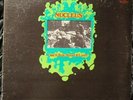
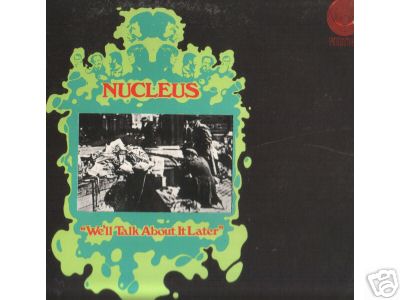
NUCLEUS WE'LL TALK ABOUT IT LATER VERTIGO SWIRL UK
$
52


Favourite Auctions
To save auctions to your favourites, please login
If you don't have an account, please register
Description
THIS IS MY AUCTION FOR THE SECOND LP BY IAN CARR'S BAND NUCLEUS RELEASED IN 1970 CLASSIC PSYCH - PROG - JAZZROCK FROM THE UK. ORIGINAL UK EDITION WITH FOLD-OUT SLEEVE ON VERTIGO SWIRL INCL. THE ORIGINAL VERTIGO INNERSLEEVE. REGARDED AS THEIR BEST ALBUM, EVEN REMINDS ME OF CLASSIC MILES DAVIS ALBUMS LIKE BITCHES BREW
CONDITION OF THE RECORD : EXCELLENT, ALMOST NM, PLAYS GREAT, BLACK & WHITE VERTIGO LOGO IN EXCELLENT CONDITION, CAT. NR. 6360027
CONDITION OF THE SLEEVE : VG++, SOME WEAR ON THE EDGES BUT NOTHING SERIOUS, THE SEETHROUGH OPENING IN THE MIDDLE FULLY INTACT, NO TEARS OR WHATSOEVER.
SOME INFO ON THE BAND AND THIS ALBUM :
: Although Nucleus made an acclaimed performance at the
Newport Jazz Festival in 1970, the U.K. proto-fusionists never
became particularly popular in the States, with much of their
recorded output only available as import releases. In fact, in
certain quarters Nucleus is known primarily as a source of musicians
who joined the latter-day Soft Machine, itself a group that never
moved too far beyond cult status. Composer/keyboardist/reedman Karl
Jenkins, drummer John Marshall, bassist Roy Babbington, and
guitarist Allan Holdsworth all played with Nucleus at one time or
another, and all had moved over to the Soft Machine lineup by the
time the Softs (with Mike Ratledge the only original remaining
member of the band) issued Bundles in 1975. Nucleus' second album,
1970's We'll Talk About It Later, might be of particular interest to
fans of Bundles-era Soft Machine given the presence of "Song for the
Bearded Lady," a Jenkins composition that later appeared in altered
form on Bundles as "Hazard Profile," a vehicle for one of
Holdsworth's most stunningly fleet-fingered solos on record. "Song
for the Bearded Lady" kicks off We'll Talk About It Later with a
fanfare and funky unison and counterpoint riffing that segue into a
spacious groove and Ian Carr trumpet solo echoing the influence of
electric Miles from the same time period. Chris Spedding was the
band's guitarist here, and one shouldn't expect Holdsworth-style
pyrotechnics from him; Spedding was a blues-rocker more than a
jazzer and generally took a back seat to the soloing skills of Carr,
Jenkins, and New Zealand saxophonist Brian Smith (whose duet with
drummer Marshall at the conclusion of "Easter 1916" — inspired by
the Yeats poem about the Irish nationalist uprising in Dublin —
approaches the wildness of some of the era's most incendiary free
jazz).
The band is at its best when firing on all cylinders (the title
track, for example), but the album's mood changes are for the most
part effective; "Lullaby for a Lonely Child" is a lovely down-tempo
ballad (who would've guessed from that title?) with an understated
horn/sax line from Carr and Smith and atmospheric bouzouki from
Spedding imparting a Mediterranean flavor. New millennial listeners
might wish for a time machine to go back and tell this band to lose
the occasional vocals, however. The uncredited singing in "Ballad of
Joe Pimp" might seem laughably polite during the age of gangsta rap;
this Joe Pimp sounds about as streetwise as Gilbert O'Sullivan of
"Alone Again (Naturally)" fame. Still, the song seems prescient —
its tempo and instrumentation are akin to Pink Floyd's "Money,"
which appeared on the scene several years later. Given Carr's long
trumpet and flügelhorn lines, Jenkins' probing oboe and funk-filled
electric keyboards, Spedding's rockish wah-wah guitar, Smith's
freewheeling sax work, and the powerful rhythmic foundation of
drummer Marshall and bassist Jeff Clyne, this version of Nucleus
should appeal to any fan of late-'60s/early-'70s fusion — either the
Soft Machine-esque Brit variety or the stateside explorations of the
Miles Davis school. But We'll Talk About It Later shouldn't be
viewed merely through the prism of other artists; Nucleus was an
original band that deserves considerably more attention than it got
for pioneering a form of jazz-rock that has, for the most part, aged
quite well, and We'll Talk About It Later is a noteworthy release
from a strong Nucleus incarnation.
1. Song for the Bearded Lady
2. Sun Child
3. Lullaby for a Lonely Child
4. We'll Talk About It Later
5. Oasis
6. Ballad of Joe Pimp
7. Easter 1916
Ian Carr - Trumpet, Horn
Chris Spedding - Guitar
Jeff Clyne - Bass
Karl Jenkins - Keyboards, Saxophone
John Marshall - Drums
Brian Smith - Wind
1970LPVertigo6360027
Nucleus began its long jazz-rock journey in 1969, when it was
originally formed by trumpeter Ian Carr. They attracted a
following after a successful performance at the Montreux
International Festival in 1970, which led to the critical
success of albums Elastic Rock and We'll Talk About It Later.
The other members consisted of saxophonist Karl Jenkins,
drummer John Marshall, and guitarist Chris Spedding. Spedding
split after the first two albums, but the rest of the lineup
lasted until 1972, when Jenkins and Marshall both left to join
Soft Machine. Belladonna was the first album with only Carr,
and although he enlisted the help of guitarist Allan
Holdsworth, the band eventually became a solo venture for his
music. They finally broke up in the mid-'80s after several
Carr-only albums.
IF YOU HAVE ANY QUESTIONS PLEASE EMAIL ME, i STRONGLY PREFER PAYPAL OUTSIDE THE EUROZONE
HAPPY BIDDING
price rating