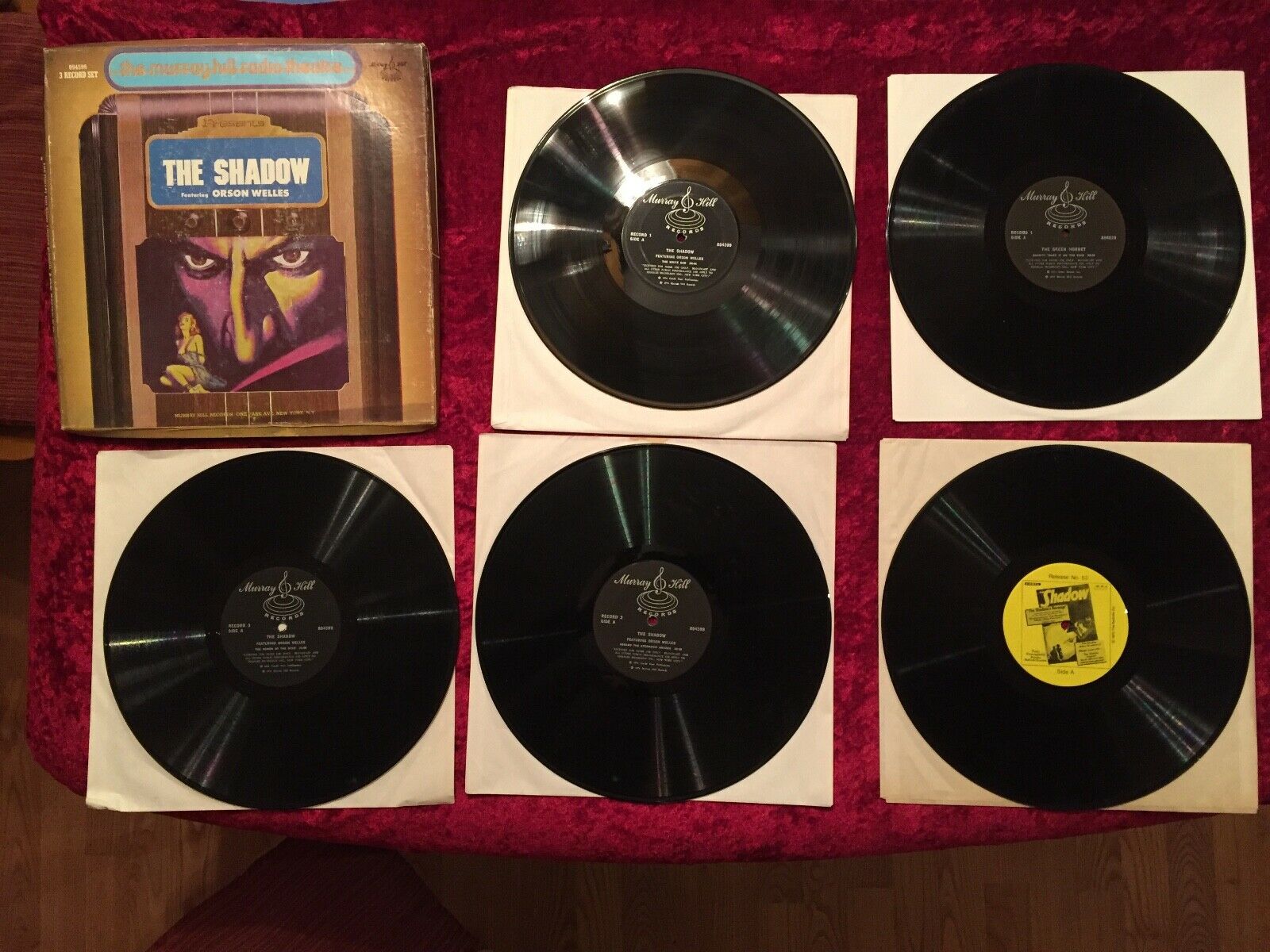
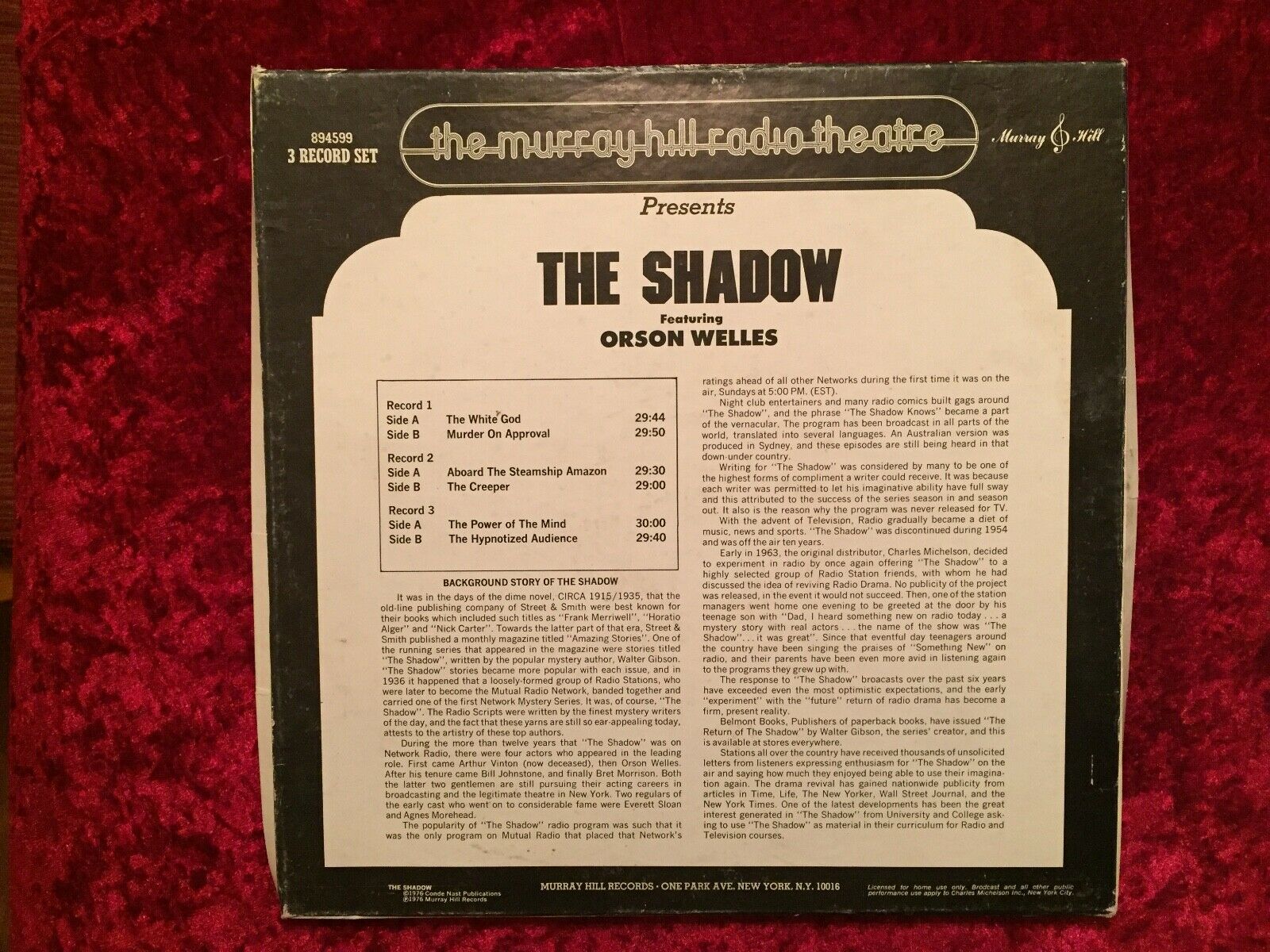
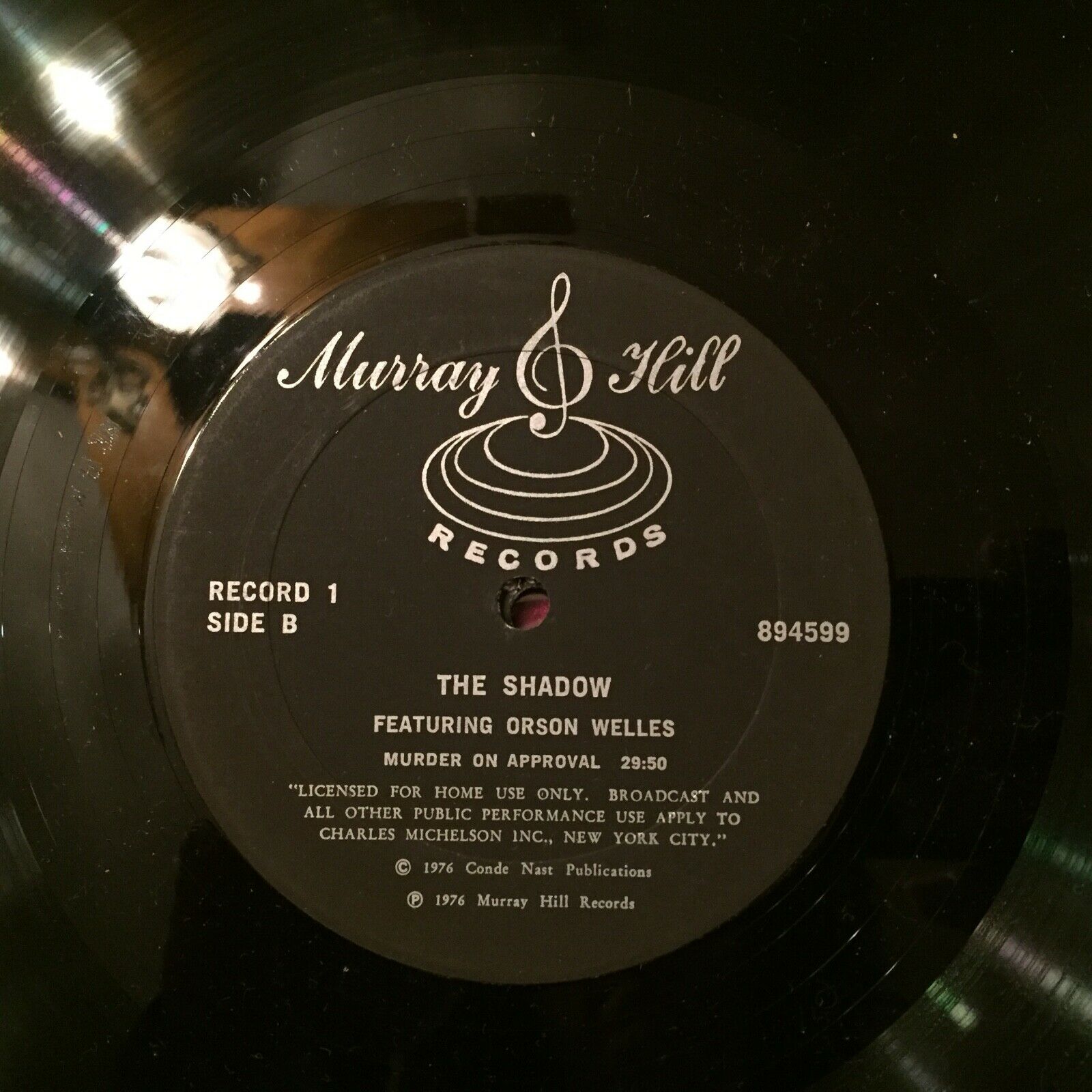
ORSON WELLES The Shadow EX+ 3LP Boxset & 2 xtra LPs Murray Hill Radio Broadcasts
$
21

Favourite Auctions
To save auctions to your favourites, please login
If you don't have an account, please register
Description
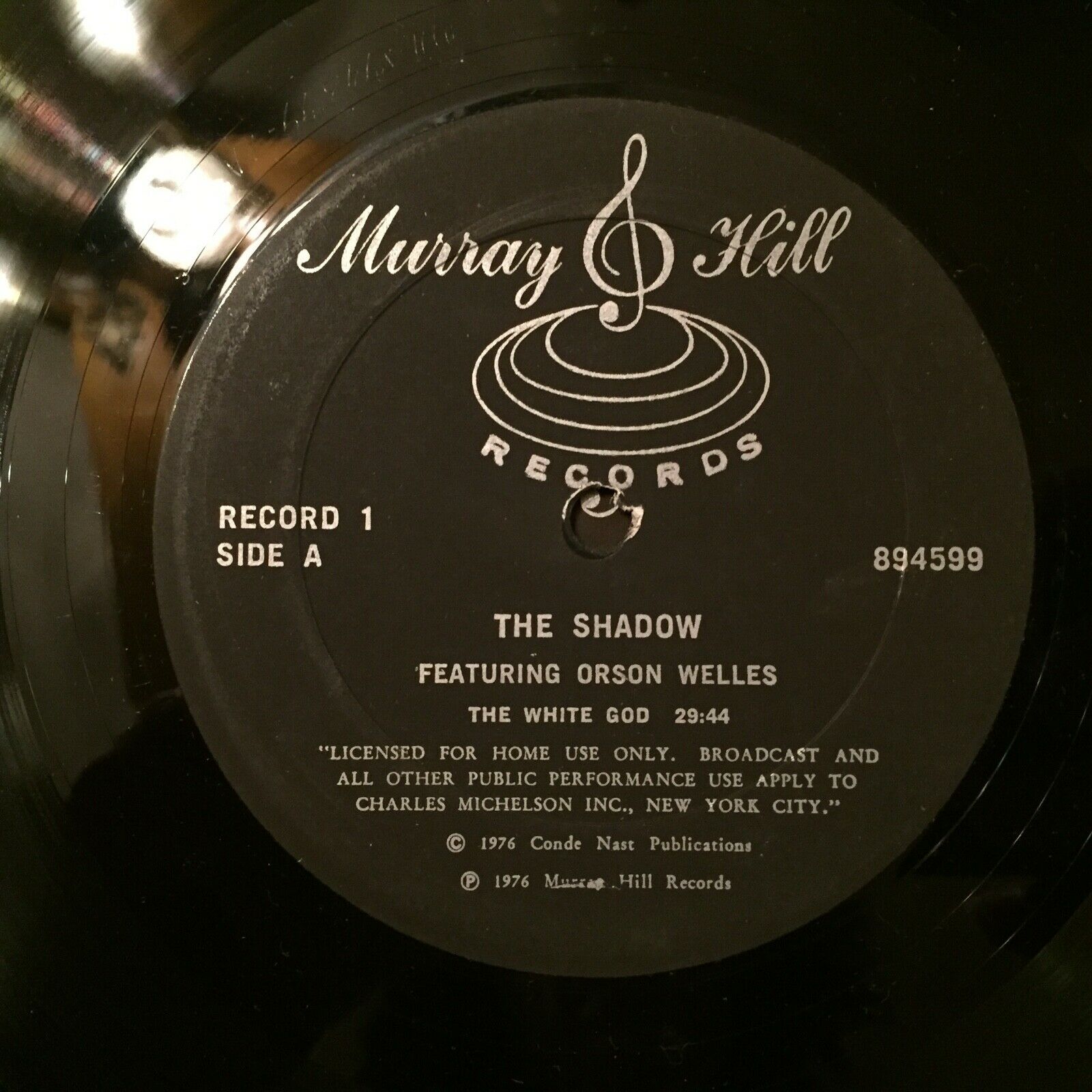
Vinyl: NM- Play Graded. Sounds Great! Has some marks that don't affect play. Murray Hill Labels are Clean. This is the Original 1976 Murray Hill 1ST Pressing! As a bonus, I'm including 2 other LP's featuring a VG+ Murray Hill Recording of The Green Hornet and a VG+ Radial Release of two other Shadow Adventures: The Shadow's Revenge" and "Death Stalks The Shadow". Orson Welles gives the definitive reading of these classic reissues of the original radio programs from the 1940s!!! SEE BIOGRAPHY BELOW!
Cover: VG+ (see photos)
Goldmine Standards. I play test every album that I sell on eBay as I have found you can't rate an LP accurately by just visually inspecting an album. I wipe the dust off of every cover with clean, unscented baby wipes. I professionally clean the vinyl.
U.S. Shipping: $6 Media Mail. 50 cents additional shipping per additional album, when the shipment is combined. If you wish to take advantage of my COMBINED SHIPPING deal, simply select your records by clicking on "ADD TO CART" on the main listing page. Do this for all of your selections and then go to your cart to checkout. Your combined shipping discount will be computed automatically. Free domestic shipping if you spend $100 or more!
I ship internationally through EBay's Global Shipping Program. Check to be sure that they ship to your country. Feel free to ask any questions and happy shopping!
Once you're satisfied with your purchase, please leave positive feedback and I will do the same for you. If you're unsatisfied, please let me know so we can resolve it. Take a look at my previous feedback and buy with confidence. Check my other items this week, check back often & add me to favorite seller list as I will be adding more Rare items in the coming weeks! Thanks!
Why buy a first or early pressing and not a re-issue or a ‘re-mastered’ vinyl album?
First and early pressings are pressed from the first generation lacquers and stampers. They usually sound vastly superior to later issues/re-issues (which, in recent times, are often pressed from whatever 'best' tapes or digital sources are currently available) - many so-called 'audiophile' new 180g pressings are cut from hi-res digital sources…essentially an expensive CD pressed on vinyl. Why experience the worse elements of both formats? These are just High Maintenance CDs, with mid-ranges so cloaked with a veil as to sound smeared. They are nearly always compressed with murky transients and a general lifelessness in the overall sound. There are exceptions where re-masters/re-presses outshine the original issues, but they are exceptions and not the norm.
First or early pressings nearly always have more immediacy, presence and dynamics. The sound staging is wider. Subtle instrument nuances are better placed with more spacious textures. Balances are firmer in the bottom end with a far-tighter bass. Upper-mid ranges shine without harshness, and the overall depth is more immersive. Inner details are clearer.
On first and early pressings, the music tends to sound more ‘alive’ and vibrant. The physics of sound energy is hard to clarify and write about from a listening perspective, but the best we can describe it is to say that you can 'hear' what the mixing and mastering engineers wanted you to hear when they first recorded the music.
BIOGRAPHY
The Shadow is the name of a collection of serialized dramas, originally in 1930s pulp novels, and then in a wide variety of media. Its title character has been featured on the radio, in a long-running pulp magazine series, in American comic books, comic strips, television, serials, video games, and at least five feature films. The radio drama included episodes voiced by Orson Welles.
Originally created to be a mysterious radio-show narrator, The Shadow[2] was developed into a distinctive literary character in 1931 by writer Walter B. Gibson.
The Shadow debuted on July 31, 1930, as the mysterious narrator of the radio program Detective Story Hour, which was developed to boost sales of Street & Smith's monthly pulp Detective Story Magazine.[3] When listeners of the program began asking at newsstands for copies of "that Shadow detective magazine," Street & Smith decided to create a magazine based on a character called The Shadow and hired Gibson to create a character concept to fit the name and voice and write a story featuring him. The first issue of The Shadow Magazine went on sale on April 1, 1931, a pulp series.
On September 26, 1937, The Shadow radio drama, a new radio series based on the character as created by Gibson for the pulp magazine, premiered with the story "The Death House Rescue," in which The Shadow was characterized as having "the power to cloud men's minds so they cannot see him." In the magazine stories, The Shadow was not given the literal ability to become invisible.
The introduction from The Shadow radio program "Who knows what evil lurks in the hearts of men? The Shadow knows!," spoken by actor Frank Readick, has earned a place in the American idiom. These words were accompanied by an ominous laugh and a musical theme, Camille Saint-Saëns' Le Rouet d'Omphale ("Omphale's Spinning Wheel," composed in 1872). At the end of each episode, The Shadow reminded listeners that "The weed of crime bears bitter fruit! Crime does not pay. The Shadow knows!" (Some early episodes, however, used the alternate statement, "As you sow evil, so shall you reap evil! Crime does not pay... The Shadow knows!")
In order to boost the sales of its Detective Story Magazine, Street & Smith Publications hired David Chrisman, of the Ruthrauff & Ryan advertising agency, and writer-director William Sweets to adapt the magazine's stories into a radio series. Chrisman and Sweets thought the upcoming series should be narrated by a mysterious storyteller with a sinister voice, and began searching for a suitable name. One of their scriptwriters, Harry Engman Charlot, suggested various possibilities, such as "The Inspector" or "The Sleuth."[4] Charlot then proposed the ideal name for the phantom announcer: "The Shadow."[4]
Thus, beginning on July 31, 1930,[1][5] "The Shadow" was the name given to the mysterious narrator of the Detective Story Hour radio program. The narrator was initially voiced by James LaCurto,[5] who was replaced after four months by prolific character actor Frank Readick Jr. The episodes were drawn from the Detective Story Magazine issued by Street & Smith, "the nation's oldest and largest publisher of pulp magazines."[5] Although the latter company had hoped the radio broadcasts would boost the declining sales of Detective Story Magazine, the result was quite different. Listeners found the sinister announcer much more compelling than the unrelated stories. They soon began asking newsdealers for copies of "that Shadow detective magazine," even though it did not exist.[5]
Recognizing the demand and responding promptly, circulation manager Henry William Ralston of Street & Smith commissioned Walter B. Gibson to begin writing stories about "The Shadow." Using the pen name of Maxwell Grant and claiming the stories were "from The Shadow's private annals as told to him, Gibson wrote 282 out of 325 tales over the next 20 years: a novel-length story twice a month (1st and 15th). The first story produced was "The Living Shadow," published April 1, 1931.[5]
Gibson's characterization of The Shadow laid the foundations for the archetype of the superhero, including stylized imagery and title, sidekicks, supervillains, and a secret identity. Clad in black, The Shadow operated mainly after dark as a vigilante in the name of justice, terrifying criminals into vulnerability. Gibson himself claimed the literary inspirations upon which he had drawn were Bram Stoker's Dracula and Edward Bulwer-Lytton's "The House and the Brain."[4] Another possible inspiration[citation needed] for The Shadow is the French character Judex; the first episode of the original Judex film serial was released in the United States as The Mysterious Shadow, and Judex's costume is rather similar to The Shadow's. French comics historian Xavier Fournier notes other similarities with another silent serial, The Shielding Shadow, whose protagonist had a power of invisibility, and considers The Shadow to be a mix between the two characters. In the 1940s, some Shadow comic strips were translated in France as adventures of Judex.[6]
Because of the great effort involved in writing two full-length novels every month, several guest writers were hired to write occasional installments in order to lighten Gibson's workload. Those guest writers included Lester Dent, who also wrote the Doc Savage stories, and Theodore Tinsley. In the late 1940s, mystery novelist Bruce Elliott (also a magician) temporarily replaced Gibson as the primary author of the pulp series.[7] Richard Wormser, a reader for Street & Smith, wrote two Shadow stories.[8] For a complete list of Street and Smith's Shadow novels, see the List of The Shadow stories article.
The Shadow Magazine ceased publication with the Summer 1949 issue, but Walter B. Gibson wrote three new "official" stories between 1963 and 1980. The first began a new series of nine updated Shadow novels from Belmont Books, starting with Return of The Shadow under his own name. The remaining eight—The Shadow Strikes, Beware Shadow, Cry Shadow, The Shadow's Revenge, Mark of The Shadow, Shadow Go Mad, Night of The Shadow, and The Shadow, Destination: Moon—were written by Dennis Lynds, not Gibson, under the Maxwell Grant pseudonym. In these novels, The Shadow is given psychic powers, including the radio character's ability "to cloud men's minds," so that he effectively became invisible; he is more of a spymaster than crime fighter in these eight updated novels.
The Shadow returned in 2015 in the authorized novel The Sinister Shadow, an entry in the Wild Adventures of Doc Savage series from Altus Press. The novel, written by Will Murray, used unpublished material originally written in 1932 by Doc Savage originator Lester Dent and published under the pen name Kenneth Robeson. Set in 1933, the story details the conflict between the two pulp magazine icons during a crime wave caused by a murderous kidnapping-extortion ring led by the mysterious criminal mastermind known as the Funeral Director.
A sequel, Empire of Doom, was published in 2016 and takes place seven years later in 1940. The Shadow's old enemy, Shiwan Khan, attacks his hated adversary. Doc Savage joins forces with The Shadow to vanquish Khan in a Doc Savage novel written by Will Murray, from a concept by Lester Dent.
The character and look of The Shadow gradually evolved over his lengthy fictional existence:
As depicted in the pulps, The Shadow wore a wide-brimmed black hat and a black, crimson-lined cloak with an upturned collar over a standard black business suit. In the 1940s comic books, the later comic book series, and the 1994 film starring Alec Baldwin, he wore either the black hat or a wide-brimmed, black fedora and a crimson scarf just below his nose and across his mouth and chin. Both the cloak and scarf covered either a black double-breasted trench coat or a regular black suit. As seen in some of the later comics series, The Shadow also would wear his hat and scarf with either a black Inverness coat or Inverness cape.
In the radio drama, which debuted in 1937, The Shadow was an invisible avenger who had learned, while "traveling through the Orient," "the mysterious power to cloud men's minds, so they could not see him." This feature of the character was born out of necessity: Time constraints of 1930s radio made it difficult to explain to listeners where The Shadow was hiding and how he was remaining concealed. Thus, the character was given the power to escape human sight. Voice effects were added to suggest The Shadow's seeming omnipresence. To explain this power, The Shadow was described as a master of hypnotism, as explicitly stated in several radio episodes.
n early 1930, Street & Smith hired David Chrisman and Bill Sweets to adapt the Detective Story Magazine to radio format. Chrisman and Sweets thought the program should be introduced by a mysterious storyteller. A young scriptwriter, Harry Charlot, suggested the name of "The Shadow."[4] Thus, "The Shadow" premiered over CBS airwaves on July 31, 1930,[1] as the host of the Detective Story Hour,[5] narrating "tales of mystery and suspense from the pages of the premier detective fiction magazine."[5] The bulk of the radio show was written primarily by Sidney Slon. The narrator was first voiced by James La Curto,[5] but became a national sensation when radio veteran Frank Readick, Jr. assumed the role and gave it "a hauntingly sibilant quality that thrilled radio listeners."[5]
Following a brief tenure as narrator of Street & Smith's Detective Story Hour, "The Shadow" character was used to host segments of The Blue Coal Radio Revue, airing on Sundays at 5:30 p.m. Eastern Standard Time. This marked the beginning of a long association between the radio persona and sponsor Blue Coal.
While functioning as a narrator of The Blue Coal Radio Revue, the character was recycled by Street & Smith in October 1931, for its newly created Love Story Hour. Contrary to dozens of encyclopedias, published reference guides, and even Walter Gibson himself, The Shadow never served as narrator of Love Story Hour. He appeared only in advertisements for The Shadow Magazine at the end of each episode.[10]
In October 1932, the radio persona temporarily moved to NBC. Frank Readick Jr. again played the role of the sinister-voiced host on Mondays and Wednesdays, both at 6:30 p.m., with La Curto taking occasional turns as the title character.
Readick returned as The Shadow to host a final CBS mystery anthology that fall. The series disappeared from CBS airwaves on March 27, 1935, due to Street & Smith's insistence that the radio storyteller be completely replaced by the master crime-fighter described in Walter B. Gibson's ongoing pulps.
Street & Smith entered into a new broadcasting agreement with Blue Coal in 1937, and that summer Gibson teamed with scriptwriter Edward Hale Bierstadt to develop the new series. The Shadow returned to network airwaves on September 26, 1937,[11] over the Mutual Broadcasting System. Thus began the "official" radio drama, with 22-year-old Orson Welles starring as Lamont Cranston, a "wealthy young man about town." Once The Shadow joined Mutual as a half-hour series on Sunday evenings, the program was broadcast by Mutual until December 26, 1954.
Welles did not speak the signature line, "Who knows what evil lurks in the hearts of men?" Instead, Readick did, using a water glass next to his mouth for the echo effect. The famous catchphrase was accompanied by the strains of an excerpt from Opus 31 of the Camille Saint-Saëns classical composition, Le Rouet d'Omphale.
After Welles departed the show in 1938, Bill Johnstone was chosen to replace him and voiced the character for five seasons. Following Johnstone's departure, The Shadow was portrayed by such actors as Bret Morrison (the longest tenure, with 10 years total in two separate runs), John Archer, and Steven Courtleigh (the actors were rarely credited).
The Shadow also inspired another radio hit, The Whistler, with a similarly mysterious narrator.
The radio drama also introduced female characters into The Shadow's realm, most notably Margo Lane (played by Agnes Moorehead, among others) as Cranston's love interest, crime-solving partner, and the only person who knows his identity as The Shadow.[12] Four years later, the character was introduced into the pulp novels. Her sudden, unexplained appearance in the pulps annoyed readers and generated a flurry of hate mail printed on The Shadow Magazine's letters page.[12]
Lane was described as Cranston's "friend and companion" in later episodes, although the exact nature of their relationship was unclear. In the early scripts of the radio drama the character's name was spelled "Margot." The name itself was originally inspired by Margot Stevenson,[12] the Broadway ingénue who would later be chosen to voice Lane opposite Welles's The Shadow during "the 1938 Goodrich summer season of the radio drama."[13] In the 1994 film in which Penelope Ann Miller played the character, she is described as being telepathic and hence aware of, but specifically immune to, The Shadow's abilities.
price rating







![LOUDON WAINWRIGHT III, Album III USA 1st pressing Excellent- LP [Dead Skunk]](https://www.popsike.mobi/php/thumbnail.php?url=https://www.popsike.pics/pix/20250424/356818944110.jpg)