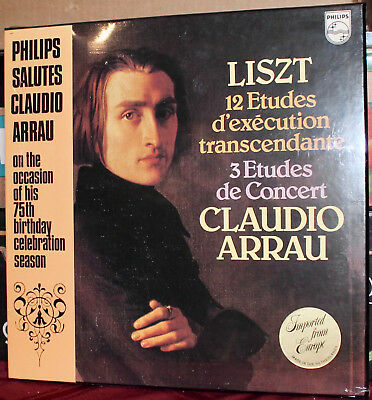
PHILIPS 2-LPs 6747-412: LISZT - 12 + 3 Etudes - Claudio ARRAU, 1977 DUTCH SEALED
C$
70
$
51




C$ 70
Sold For
Oct 18, 2019
Sold Date
Dec 28, 2017
Start Date
1
Number Of Bids
Canada
Country Of Seller
eBay
Sold at
Favourite Auctions
To save auctions to your favourites, please login
If you don't have an account, please register
Description
****Welcome to our listing, thanks very much for looking!
****See our own website! We have lots of out of print LPs and CDs! Find us on the web at -
hearthedifference.net
****Shipping cost is only an estimate - it depends on the actual weight and size of the package as well as the service required. We do not profit from shipping costs, so if we overcharge, we will refund the difference back to you. It's always best to wait for our invoice before paying for your item. We will combine shipping for multiple items purchased.
****Please see our other listings - new items added daily.
****To access our eBay store either click on the little red door at the top right section of any of our eBay listings or, click on -
http://stores.ebay.com/Hear-The-Difference
Background -
FACTORY SEALED item from 1977!Claudio Arrau León (February 6, 1903 – June 9, 1991) was a Chilean pianist known for his interpretations of a vast repertoire spanning the baroque to 20th-century composers, especially Beethoven, Schubert, Chopin, Schumann, Liszt and Brahms. He is widely considered one of the greatest pianists of the twentieth century. Arrau was a pupil of Martin Krause, who was a student of Franz Liszt.
Arrau was born in Chillán, Chile, the son of Carlos Arrau, an ophthalmologist who died when Claudio was only a year old, and Lucrecia León Bravo de Villalba, a piano teacher. He belonged to an old, prominent family of Southern Chile. His ancestor Lorenzo de Arrau, a Spanish engineer, was sent to Chile by King Carlos III of Spain. Through his great-grandmother, María del Carmen Daroch del Solar, Arrau was a descendant of the Campbells of Glenorchy, a Scottish noble family. Arrau was raised as a Catholic, but gave it up in his late teens.
Arrau was a child prodigy and he could read music before he could read words, but unlike many virtuosos, there had never been a professional musician in his family. His mother was an amateur pianist and introduced him to the instrument. At the age of 4 he was reading Beethoven sonatas, and he gave his first concert a year later. When Arrau was 6 he auditioned in front of several congressmen and President Pedro Montt, who was so impressed that he began arrangements for Arrau's future education. At age 8 Arrau was sent on a ten-year-long grant from the Chilean government to study in Germany, travelling with his mother and sister Lucrecia. He was admitted to the Stern Conservatory of Berlin where he eventually became a pupil of Martin Krause, who had studied under Franz Liszt. At the age of 11 Arrau could play Liszt's Transcendental Etudes, one of the most difficult works for piano, as well as Brahms's Paganini Variations. Arrau's first recordings were made on Aeolian Duo-Art player piano music rolls. Krause died in his fifth year of teaching Arrau, leaving the 15-year-old student devastated by the loss of his mentor; Arrau did not continue formal study after that point.
In 1935, Arrau gave a celebrated rendition of the entire keyboard works of Johann Sebastian Bach over 12 recitals. In 1936, Arrau gave a complete Mozart keyboard works over 5 recitals, and followed with the complete Schubert and Weber cycles. In 1938, for the first time, Arrau gave the complete Beethoven piano sonatas and concertos in Mexico City. Arrau repeated this several times in his lifetime, including in New York and London. He became one of the leading authorities on Beethoven in the 20th century.
In 1929, Arrau married lyric soprano Erika Burkewitch (1909-1997), a Latvian national. They had one child: Klaudio (1929-1949). In 1935 they separated. In 1949 their son Klaudio died in a Soviet prison camp in Bautzen, East Germany.
In 1937, Arrau married mezzo-soprano Ruth Schneider (1908–1989), a German national. They had three children: Carmen (1938–2006), Mario (1940–1988) and Christopher (1959). In 1941 the Arrau family emigrated from Germany to the United States, eventually settling in Douglaston, Queens, New York, where Arrau spent his remaining years. He became a dual U.S.-Chilean citizen in 1979.
Arrau died on June 9, 1991, at the age of 88, in Mürzzuschlag, Austria, from complications of emergency surgery performed on June 8 to correct an intestinal blockage. His remains were interred in his native city of Chillán, Chile.
Daniel Barenboim said that Claudio Arrau had a particular sound with two aspects: first a thickness, full-bodied and orchestral, and second an utterly disembodied timbre, quite spellbinding. Sir Colin Davis said: "His sound is amazing, and it is entirely his own... no one else has it exactly that way. His devotion to Liszt is extraordinary. He ennobles that music in a way no one else in the world can." According to American critic Harold C. Schonberg, Arrau always put "a decidedly romantic piano tone in his interpretations".
Arrau was an intellectual and a deeply reflective interpreter. He read widely while travelling, and despite the lack of any formal education outside of his musical training, he learned English, Italian, German, and French in addition to his native Spanish. He became familiar with Jung's psychology in his twenties.
Arrau's attitude toward music was very serious. He preached fidelity to the score, but also the use of imagination. Although he often played with slower and more deliberate tempi from his middle age onward, he had a reputation as a fabulous virtuoso earlier in his career, a reputation supported by recordings he made at this time, such as Balakirev's Islamey and Liszt's Paganini études. However, even late in his career, he often tended to play with less restraint in live concerts than in studio recordings.
Arrau was a man of remarkable fortitude; even towards the end of his life he invariably programmed very large, demanding concerts, including works such as Beethoven's Emperor Concerto and Brahms' Piano Concerto No. 1.
A patrician artist whose matinee-idol appearance was as elegant as his playing, Claudio Arrau achieved a major reputation for his performances of Brahms and Liszt. Indeed, few Romantic-period composers, from Beethoven onward, were beyond his grasp. In addition to that repertory, his Debussy was regarded by many connoisseurs as exemplary. Arrau believed that his abiding interest in psychoanalysis aided him in probing the intent of those whose works he performed. Certainly, Arrau's performances were marked by a balance between heart and intellect.
Arrau was born in Chillán, Chile, on February 6, 1903. He received piano instruction from his mother at an early age, making his debut performance in Santiago at the age of five playing Mozart, Beethoven, and Chopin. At the age of 10 the Chilean government sent him to Berlin, where he enrolled in Stern's Conservatory of Music. His teacher there was Martin Krause. While studying he entered competitions, and won the Ibach Prize and the Gustav Holländer Medal. He also began giving recitals in Germany and Scandinavia, earning excited comment over the excellence of his technique, and the maturity of his interpretations. In 1918 he made a major European tour, giving concertos accompanied by illustrious conductors such as Nikisch, Furtwängler, and Mengelberg. He returned to South America in 1921, and made a triumphal tour beginning in Santiago de Chile. He made his first North American tour in 1924, appearing with the Boston Symphony Orchestra and the Chicago Symphony Orchestra. He joined the faculty of the Stern Conservatory in 1924. He won the Grand Prix Internationale des Pianistes in Geneva in 1927, and toured in the Soviet Union in 1929, and again in 1930.
He continued a notable concertizing career throughout the 1930s, including a famous series in 1935 and 1936 in Berlin, in which he played the complete keyboard works of J.S. Bach followed by the complete keyboard works of Mozart. He then announced that he would no longer play Bach, asserting that his music was not conceived for the modern grand piano. In 1938 he played all of the Beethoven piano sonatas and five piano concertos in a series of recitals in Mexico City, and repeated the feat during the next two years in Buenos Aires and Santiago. When World War II broke out he ended his association with the Stern Conservatory and returned to Chile, founding a piano school there. But the next year, after a tour of the United States where he received the highest critical acclaim, he and his family moved permanently to New York. He devoted himself to concertizing, teaching, and recording. His complete Beethoven cycles became legendary; in 1952 he performed such a series, in which each recital was broadcast live by the BBC.
After World War II his concert tours included Australia, Czechoslovakia, Romania, India, South Africa, Israel, and Japan. In the 1960s he made definitive recordings of the complete Beethoven piano sonatas; he also supervised the editing and publication of an Urtext edition of the same sonatas. In the 1970s, Chile, which had enjoyed a record as one of South America's most democratic nations, fell to the military government of Pinochet. In protest, Arrau gave up his Chilean citizenship in 1978, and became a naturalized citizen of the U.S. Despite this, or perhaps because of it, he continued to be a revered figure in Chile; in 1983 he was awarded the Chilean National Arts Prize. He returned at the age of 81 to tour Chile in 1984, his first performances there in 17 years. He died in Mürzzuschlag, Austria, on June 9, 1991. - Rovi Staff
The Transcendental Études, S.139, are a series of twelve compositions for solo piano by Franz Liszt. They were published in 1852 as a revision of a more technically difficult 1837 series, which in turn were the elaboration of a set of studies written in 1826.
The composition of the Transcendental Études S.139 began in 1826, when 15-year-old Liszt wrote a set of youthful and far less technically demanding exercises called the Étude en douze exercices (Study in twelve exercises) S.136. Liszt then elaborated on these pieces considerably, and the far more technically difficult exercises called the Douze Grandes Études (Twelve Grand Studies) S.137 were then published in 1837.
The Transcendental Études S.139 are revisions of his Douze Grandes Études. This third and final version was published in 1852 and dedicated to Carl Czerny, Liszt's piano teacher, and himself a prolific composer of études. The set included simplifications, for the most part: in addition to many other reductions, Liszt removed all stretches of greater than a tenth, making the pieces more suitable for pianists with smaller hands. However, the fourth étude of the final set, Mazeppa, is actually more demanding than its 1837 version, since it very frequently alters and crosses the hand to create a "galloping" effect.
When revising the 1837 set of études, Liszt added programmatic titles in French and German to all but the Études Nos. 2 and 10. Editor Ferruccio Busoni later gave the names Fusées (Rockets) to the Étude No. 2, and Appassionata to the Étude No. 10; however, Busoni's titles are not commonly used. For example, music publisher G. Henle Verlag refers to these two by their tempo indications, molto vivace and allegro agitato molto, respectively.
Henle ranks No. 4 (Mazeppa), No. 5 (Feux follets), No. 8 (Wilde Jagd), No. 10 (Appassionata) and No. 12 (Chasse-neige) as the most difficult études of the set at difficulty 9 out of 9. The lowest difficulty is given to No. 3 (Paysage) at 6 out of 9.
Liszt's original idea was to write 24 études, one in each of the 24 major and minor keys. He completed only half of this project, using the neutral and flat key signatures. In 1897–1905 the Russian composer Sergei Lyapunov wrote his own set of Douze études d'exécution transcendante, Op. 11, choosing only those keys that Liszt had omitted, namely the sharp keys, to "complete" the full set of 24. Lyapunov's set of études was dedicated to the memory of Liszt, and the final étude was titled Élégie en mémoire de Franz Liszt.
Lovely, wonderful, inspired, poised performances by an aristocrat pianist. Arrau, who studied with one of Liszt's students, brings us the 19th-century grand manner in music that in lesser hands can sound empty and like so much Romantic slapdash claptrap. Make no mistake, this is pianism of the most patrician and musical quality that never takes ANY musical gesture as a throw-away. -- Roberto J Gonzalez and Polly Arrau
-
LPs made by PHILIPS Records, in the Netherlands / Dutch / Holland
-
LPs released in 1977
-
LPs are recorded in STEREO
-
Record Catalog Number: 6747 412
-
Record Labels are assumed to be primarily RED with WHITE or SILVER lettering, with the Record Co. Logo.
Franz Liszt // Claudio Arrau
12 Etudes d'execution transcendante / 3 Etudes de Concert
Tracks -
12 Etudes D'exécution TranscendanteA1 1. Prélude (Presto) -
A2 2. Molto Vivace 3:12
A3 3. Paysage (Poco Adagio) 4:10
A4 4. Mazeppa (Allegro) 7:30
A5 5. Feux Follets (Allegretto) 4:17
B1 6. Vision (Lento) 5:56
B2 7. Eroica (Allegro) 4:47
B3 8. Wilde Jagd (Presto Furioso) 5:00
B4 9. Ricordanza (Andantino) 10:54
C1 10. Allegro Agitato Molto 4:41
C2 11. Harmonies Du Soir (Andantino) 8:46
C3 12. Chasse-neige (Andante Con Moto) 5:57
3 Etudes De Concert
D1 1. Il Lamento (A Capriccio – Allegro Cantabile) 10:38
D2 2. La Legierezza (A Capriccio – Quasi Allegretto) 5:26
D3 3. Un Sospiro (Allegro Affettuoso) 6:00
Performers / Credits -
• Composed By – Franz Liszt
• Piano – Claudio Arrau
Other Information -
Includes insert.
Philips salutes Claudio Arrau on the occasion of his 75th birthday celebration season.
CONDITION Details:
The 2-LP box is in mint condition! The box has NO splits or crushed corners and NO cut out marks! The corners and seams are solid with just a bit of shelf wear - the outer shrink wrap is completely intact with no fraying or tears. The colors on the box are sharp and clean (see pictures with this listing as they are of the actual item).
The set comes complete with a paper insert/libretto.
The 2-LPs are assumed to be in mint condition as this vintage 1977 item is still FACTORY SEALED!
A Short Note About LP GRADING -- Mint = Only used for sealed items.
- Near Mint = Virtually flawless in every way.
- Near Mint Minus = Item has some minor imperfections, some audible.
- Excellent = Item obviously played and enjoyed with some noise.
- Very Good Plus = Many more imperfections which are noticeable and obtrusive.
For best results, always properly clean your LPs before playing them.
The LP is an audiophile quality pressing (any collector of fine MFSL, half speeds, direct to discs, Japanese/UK pressings etc., can attest to the difference a quality pressing can make to an audio system).
Don't let this rarity slip by!!!
price rating