PIERRE HENRY apocalypse 3LP box 1968 avant concrete
$
124


Favourite Auctions
To save auctions to your favourites, please login
If you don't have an account, please register
Description
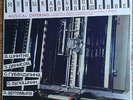
Pierre Henry "Apocalypse de Jean" 3LP boxset issued by Philips for the Prospective 21 Siecle (837.923/25) in France, 1968. Famous pseudo metallic stranslucid sleeve with geometric printed patterns in order to create kinetic effects. Complete boxset edition with booklet. Red labels. ****** 3xRec:ex Box:Vg+ Book:m- ****** This is Henry's masterpiece. Actually there is nothing much to say about the composition when one decides not to dissect the work in exegesis. The apocalypse, spooky already in the literary form, is performed in a fashion that makes the hair on your back stand up. Henry's translation of the different scenes, using no doubt the ideograms, is more than perfect and the narration that accompanies the auditive scenery brings shivers down your spine. When your French is below average I advise you to read along with the music in your own language. Try to find a Bible somewhere. John's apocalypse inspired Clive Barker too, you know. Pierre Henry was born in Paris in 1927. He never went to school; his teachers came to his house. Being of feeble health he had to do gymnastic excercises and perhaps that is the reason that he developed a strong feeling for rhythm. In 1944 he studied at the conservatory; piano and percussion with Passeronne, composition with Nadia Boulanger and harmony with Olivier Messiaen. Henry is an ardent film lover and visits the cinema two or three times a week. "Le Ballet Mecanique" by Fernand Leger is a great inspiration because of the direct link between sound and vision. In 1949 he received a commission to write music for a television documentary called "Seeing the Invisible". He then started working with the 'disque souple', the writable record. The tape recorder was not yet available in a practical model. He by then had already made acquaintance with Pierre Schaeffer and with the music of Luigi Russolo, John Cage, Walter Ruttmann etc. When Schaeffer asked Henry, because of his skills as a percussionist and at the piano, to assist him with the “Symphonie pour un Homme Seul” in 1950, the career as a composer of musique concrète or, better, electroacoustic music has taken a lift-off. The early electroacoustic compositions, dating from 1950, show Henry dabbling about with sounds recorded with the disque souple recorder, much in the same vein as Schaeffer. The structure, however, is much more complicated. Whereas Schaeffer keeps to simple classical and rhythmical structures, Henry shows much more insight into complex composition. In 1964 Henry produced his “Jerks Electronique” with a 'song' called “Psyche Roc”k under the pseudonym Yper Sound. It sold some 150,000 copies. It made Henry instantly famous, not only with connoisseurs of avant garde art but also with the man in the street. A few years ago its echo was to be heard in the background of a house music record. Anyway, it enabled Henry to make a good deal with the Philips label. Although always following his own path, Henry has never been a solitary closed man. His friendship with dancer Maurice Bejart has taken him all over the world. Henry has produced music for films and advertisements. Another difference between Schaeffer (and the disciples of his theories) and Henry was that Henry did not follow the Husserlian ideas about music. To Henry sound has never been interesting as a phenomenon as such. That's why he denies the existence of noise; there is only sound. The sound that is there for music. To Henry, emotion, he calls it nature, is to be captured in music. That's a fundamental step over the line that Schaeffer had drawn. Towards the end of the 70s the public attention died down, but Henry continued to develop his music. Through the years Henry's work has gradually changed from spikey, and sometimes even anarchistic (certainly for the well-behaved musical society of the 50s) towards themes that are more sincere and more reflective. Perhaps it is because of these themes, not fit for a society that welcomes the energy and ideas of punk-rock and anarchy, that Henry has remained more in the background. In 1989 however, the WDR broadcast a radio-play in three episodes, each lasting 180 minutes, on Proust's "A La Recherche...". In 1990 a new work was released: “Le Livre des Morts Egyptien”. Henry has been invited to perform the work on several occasions around the world. ****** Original 28 page booklet with photos, concert program and liner notes in English, French and German also included. ****** Some very minimal surface noise noticeable in the silent parts. ****** The boxset is solid and in very good shape, with some minimal wear (see photo). ****** (references: avant, experimental, concrete, electronic, Pierre Schaeffer, Luc Ferrari, Karlheinz Stockhausen, Bernard Parmegiani) ****** unregistered priority mail is about 15 US dollars to europe and 18 US dollars to the rest of the world (except for oceania to which it is 22 US dollars), registered airmail is about 18 US dollars to europe and 25 US dollars to the rest of the world (except for oceania to which it is 28 US dollars). please note that winning multiple items can make you save on postage. preferred payment is paypal, although other options may be available. PLEASE WAIT FOR MY INVOICE BEFORE SENDING ANY PAYMENT. thank you.
price rating