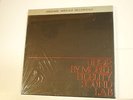
PINK FLOYD The Dark Side Of The Moon UHQR Mobile Fidelity MFSL 200g Half Speed
$
416


$ 416
Sold For
Oct 12, 2014
Sold Date
Oct 2, 2014
Start Date
$ 90
Start price
23
Number Of Bids
USA
Country Of Seller
eBay
Auctioned at
Favourite Auctions
To save auctions to your favourites, please login
If you don't have an account, please register
Description
PINK FLOYD The Dark Side Of The Moon UHQR Mobile Fidelity Sound Lab MFQR 1-017 200 gram (Half Speed Mastered by Stan Ricker - Pressed by Victor Company of Japan)
TracklistHide Credits
A1 Speak To Me A2 Breathe A3 On The Run A4 Time A5 The Great Gig In The Sky Backing Vocals – Barry St. John, Doris Troy, Leslie Duncan*, Liza StrikeVocals – Clare Torry B1 Money Saxophone – Dick Parry B2 Us And Them Saxophone – Dick Parry B3 Any Colour You Like B4 Brain Damage B5 Eclipse*(all photos are of the actual item)
- Bass, Vocals, Synthesizer [Vcs3], Effects [Tape], Lyrics By – Roger Waters
- Engineer – Alan Parsons
- Keyboards, Vocals, Synthesizer [Vcs3] – Richard Wright
- Mastered By [Half-speed] – Stan Ricker
- Mixed By [Supervised] – Chris Thomas
- Percussion, Effects [Tape] – Nick Mason
- Vocals, Guitar, Synthesizer [Vcs3] – David Gilmour
- Written-By – Gilmour* (tracks: A2 to A4, B3), Mason* (tracks: A1, A4, B3), Wright* (tracks: A2, A4, A5, B2, B3), Waters* (tracks: A2 to A4, B1, B2, B4, B5)
Notes
Originally released in 1973.Limited edition of 5000 custom pressings. It was made from the master stamper at the Victor Company of Japan (JVC) plant in Yokohama, Japan during the May 1981.
- Matrix / Runout: MFSL 1-017 A2
- Matrix / Runout: MFSL 1-017 B2
By all industry standards, The Dark Side Of The Moon is a phenomenon. Known for its complex instrumental textures, the album firmly established Pink Floyd as one of the most innovative bands in rock history. Since its release in 1973, The Dark Side Of The Moon has sold over 30 million copies and spent an incredible 741 weeks on Billboard's Album Chart.
Review by Stephen Thomas Erlewine By condensing the sonic explorations of Meddle to actual songs and adding a lush, immaculate production to their trippiest instrumental sections, Pink Floyd inadvertently designed their commercial breakthrough with Dark Side of the Moon. The primary revelation of Dark Side of the Moon is what a little focus does for the band. Roger Waters wrote a series of songs about mundane, everyday details which aren't that impressive by themselves, but when given the sonic backdrop of Floyd's slow, atmospheric soundscapes and carefully placed sound effects, they achieve an emotional resonance. But what gives the album true power is the subtly textured music, which evolves from ponderous, neo-psychedelic art rock to jazz fusion and blues-rock before turning back to psychedelia. It's dense with detail, but leisurely paced, creating its own dark, haunting world. Pink Floyd may have better albums than Dark Side of the Moon, but no other record defines them quite as well as this one.
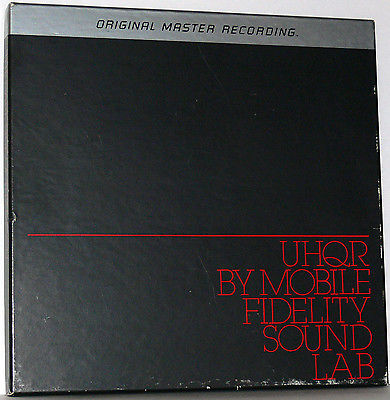
In 1981, Mobile Fidelity Sound Lab also produced eight UHQR (Ultra High Quality Record) albums. The second album produced as an UHQR by MFSL was the Pink Floyd album, Dark Side of the Moon. Album Box: The record album is housed in a 3/4 inch thick black cardboard box. On the inside of the cover of the box is a pouch that holds the Technical Specification Manual, and the UHQR Certificate of Authenticity. The record itself is housed in a separate inner album cover, sandwiched in between two 1/4 inch foam protectors. The inner album cover is black with "Original Master Recording." in a red strip at the top, and "UHQR By Mobile Fidelity Sound Lab" in the lower right corner. Inside the inner album cover, the record is in a static free inner sleeve.
Production Run: All MFSL UHQR albums were made in limited quantities of 5,000 numbered copies each.
Super Vinyl: MFSL UHQR records were made with Super Vinyl. Super Vinyl was produced using a highly-polymerized synthetic resin with high vinyl acetate content derived from a vinylchloride-vinylacetate coploymer. Its characteristics include superior elasticity, extreme durability, and an excellent signal-to-noise ratio. Its frequency response is so accurate that the specification of plus or minus 0.5dB is maintained over a frequency range of 20Hz to 20kHz.
Technical Specifications: Distortion: Distortion was so low on MFSL UHQR records that nearly theoretical values were achieved. Low, mid, and high range distortions were improved by 12, 10 and 6 dB or more, respectively. Frequency Response: Frequency response on MFSL UHQR records is flat. Its accuracy is within plus or minus 0.5 dB, whereas conventional records have a frequency response of plus or minus 3 dB. Record Quality: Production of UHQR records by MFSL produced minimal individual disc quality variations. Surface Vibration: Mid-range disc surface vibration at 700 Hz was reduced by 10 dB. Wear Resistance: Because MFSL UHQR records are flat, thick, and free from physical shape distortion, there is relatively little wear resistance.
UHQR Characteristics: The sound quality of UHQR records is excellent. They have solid bass, more substantive imaging, a better three-dimensional field, and greater definition of inner detail than any other record. UHQR albums are perfectly flat, eliminating tracking errors, mechanical pickup vibration, and disc surface vibration due to reproduced sound pressure from the speakers. They are also thicker than conventional records, significantly reducing disc surface vibration. These records are made with Super Vinyl, producing high forming accuracy and excellent wear resistance. Each UHQR record was pressed with an ultra precision mold on a totally unique, high precision press, developed by JVC as a result of its research with the original CD-4 disc and VHD / ADH video-disc production process. Pressing irregularities, such as "orange peel," were eliminated, resulting in reduced low frequency range distortion. Vinyl Weight: MFSL UHQR albums were pressed on 200 gram Super Vinyl.
On Oct-04-14 at 16:21:11 PDT, seller added the following information:
Added note* Received a question from an ebay member regarding the scuff/scratch. After re-evaluating the scratch/scuff, I reported: "I went back and listened to the track with the scratch/scuff (I think it was done with a spindle). It's on side 2 and it's track 3 not 4. The tick is as I described. Slightly audible in two or three places. I don't believe it will be an issue....".
price rating