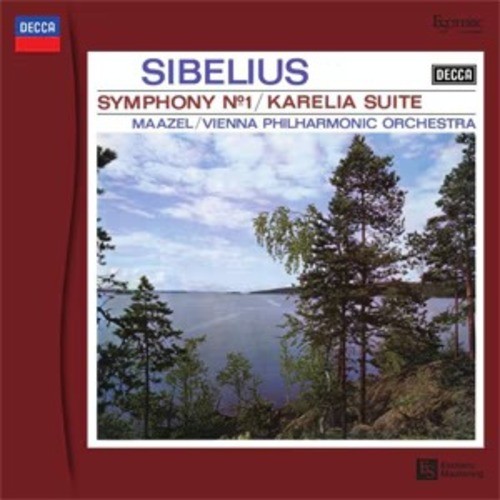
PSL ESOTERIC ESLD-10011 Sibelius Symphony No.1 / Karelia Suite Maazel Vinyl
$
75




Favourite Auctions
To save auctions to your favourites, please login
If you don't have an account, please register
Description
Click here to see all products in our store!
* International Buyers - Please Note:
Import Duties & Taxes Policy
United States
All shipments to the U.S. are sent DDP (Delivered Duty Paid). Import duty, taxes and brokerage are prepaid — no extra payment at delivery.
Other Countries
Unless duties/taxes are already collected by eBay at checkout, shipments are sent DDU (Delivered Duty Unpaid) and the buyer is responsible for import VAT/GST, duty, and carrier fees on delivery.
* Description
Sibelius: Symphony No. 1 & “Karelia” Suite
Young Mazel drives the Vienna Philharmonic to depict Sibelius's passionate drama with cutting-edge precision
Jean Sibelius
Symphony No. 1 in E minor, Op. 39
Side A
1. Movement 1: Andante-Allegro energico
2. Movement 2: Andante
3. Movement 3: Scherzo
Side B
1. Movement 4: Finale (Quasi una fantasia)
“Karelia” Suite, Op. 11
2. I. Intermezzo (Moderato)
3. II. Ballade
4. III. March-like
[Performers] Vienna Philharmonic Orchestra
[Conductor] Lorin Maazel
[Recording] September 1963 (Symphony), March 1963 (Suite), Vienna, Sofiensaal
The late maestro Lorin Maazel (1930–2014), who passed away in 2014, was the first American conductor to achieve prominence in Europe starting in the 1950s.
Born near Paris, France, he returned to the U.S. as a child and studied violin from age five in Los Angeles and Pittsburgh, and piano and conducting at age seven. He gained fame as a child prodigy after conducting the Inter-Rock Arts Center Orchestra at the 1939 New York World's Fair. Following engagements with orchestras including the NBC Symphony Orchestra and the Cleveland Orchestra, he dedicated himself to the violin.
His violin prowess is evident from his role as the successor to Boskovsky, who had long served as both conductor and violinist, leading the Vienna New Year's Concert from 1980 to 1986. He went on to conduct the concert four more times, totaling eleven performances, further cementing his legacy as a key figure in the event.
Joining the Pittsburgh Symphony Orchestra as a violinist at age 18, he also served as assistant conductor. At the end of 1953, he made his conducting debut in Catania, Sicily, replacing a conductor who had fallen ill, achieving great success.
From 1954, he performed throughout Italy. In 1955, he debuted at La Scala concerts and in Vienna. By 1960, he had reached London and made his debut at the Bayreuth Festival conducting Lohengrin, becoming the youngest conductor ever to do so.
In 1964, he became Music Director of the Berlin Radio Symphony Orchestra. The following year, he also took on the role of Music Director of the Berlin Deutsche Oper. This recording was made during that period of his career when everything was going smoothly, when he was at the height of his power.
Recorded in 1963 with the Vienna Philharmonic when he was 33, this album is known as a masterpiece, imprinted with Mazer's keen sensitivity and stimulating interpretation.
It also marks his first recording with the Vienna Philharmonic and represents the earliest record of his Decca recordings, which began in 1962 with the Israel Philharmonic.
Here lies a vibrant record of the young Maazel at the very start of his brilliant career.
Recorded at Vienna's Sofienhalle, Decca's resident hall, the sessions were handled by producer John Calshaw and recording engineer Gordon Parry, vividly capturing the Vienna Philharmonic's distinctive sound.
Incidentally, this Sibelius Symphony No. 1 was the only Symphony No. 1 Calshaw ever produced; he never worked on this piece again after this recording.
Much like Kertész's Dvořák's “From the New World,” this recording brilliantly captures the youthful conductor infusing energy into a venerable orchestra, revitalizing it.
Particularly striking are the bold timpani strokes in the Scherzo of the third movement and the meticulous building of the climax in the second movement, showcasing the dazzling brilliance of the young Mazel.
Alongside the concurrently recorded complete Tchaikovsky symphonies, these revive the spirited conducting of the 1960s Mazer for us today.
These two recordings were made around the time of the Salzburg Festival in 1963, where Mazer made his debut with The Marriage of Figaro during his first visit to Japan. Particularly the First Symphony, though at a slightly slower tempo, is a magnificent performance. It fully utilizes the Vienna Philharmonic's uniquely refined, rich sound and diverse expressive power to create a tension-filled experience. It conveys a powerful intensity, crystallizing the youthful vigor and passion of both Sibelius and Mazer, making it a truly great performance.
* Shipping
We ship using FedEx, DHL and UPS or Japan Post.
* Payment
We usually ship within 3〜7 business days of receiving cleared payment.
price rating