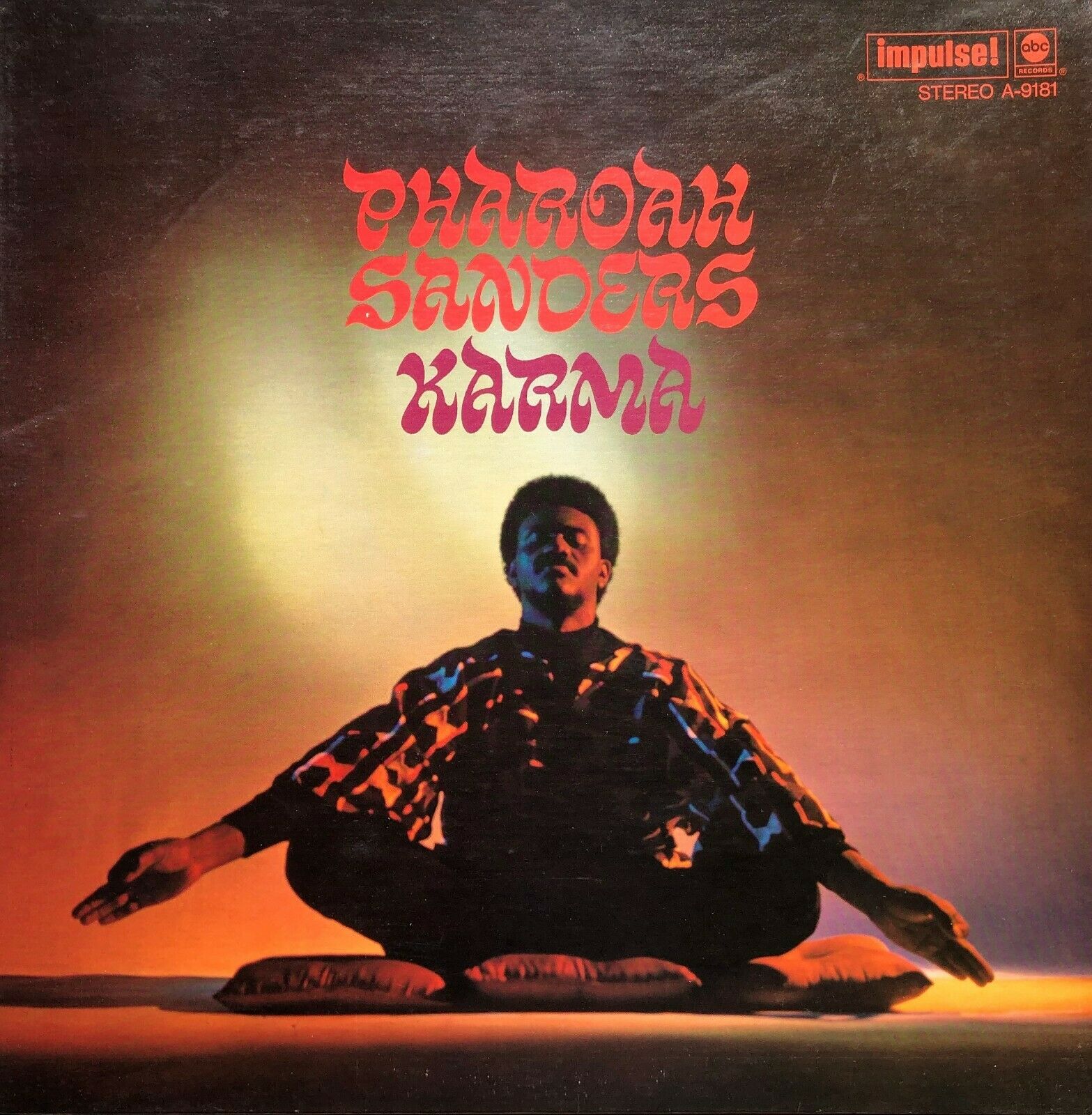
Pharoah Sanders: Karma-1969 ABC/impulse Green Label Stereo 12" Record
$
38


Favourite Auctions
To save auctions to your favourites, please login
If you don't have an account, please register
Description
1969 ABC/impulse! Gatefold Stereo Release of Bandleader/Composer/Tenor Saxophone Master Pharoah Sanders Entitled Karma, Produced by Bob Thiele for Flying Dutchman Productions, Engineer Is Bob Simpson, - "Pharoah Sanders possesses one of the most distinctive tenor saxophone sounds in jazz. Harmonically rich and heavy with overtones, Sanders' sound can be as raw and abrasive as it is possible for a saxophonist to produce. Yet, Sanders is highly regarded to the point of reverence by a great many jazz fans. Although he made his name with expressionistic, nearly anarchic free jazz in John Coltrane's late ensembles of the mid-'60s, Sanders' later music is guided by more graceful concerns. In the free-time, ultra-dense cauldron that was Coltrane's last artistic stand, Sanders relied heavily on the non-specific pitches and timbral distortions pioneered by Albert Ayler and further developed by Coltrane himself. The hallmarks of Sanders' playing at that time were naked aggression and unrestrained passion. In the years after Coltrane's death, however, Sanders explored other, somewhat gentler and perhaps more cerebral avenues -- without, it should be added, sacrificing any of the intensity that defined his work as an apprentice to Coltrane. Pharoah Sanders(a corruption of his given name, Ferrell Sanders)was born into a musical family. Both his mother and father taught music, his mother privately and his father in public schools. Sanders' first instrument was the clarinet, but he switched to tenor sax as a high school student, under the influence of his band director, Jimmy Cannon. Cannon also exposed Sanders to jazz for the first time. Sanders' early favorites included Harold Land, James Moody, Sonny Rollins, Charlie Parker, and John Coltrane. As a teenager, he played blues gigs for ten and 15 dollars a night around Little Rock, backing such blues greats as Bobby "Blue" Bland and Junior Parker. After high school, Sanders moved to Oakland, CA, where he lived with relatives. He attended Oakland Junior College, studying art and music. Known in the San Francisco Bay Area as "Little Rock," Sanders soon began playing bebop, rhythm & blues, and free jazz with many of the region's finest musicians, including fellow saxophonists Dewey Redman and Sonny Simmons, as well as pianist Ed Kelly and drummer Smiley Winters. In 1961, Sanders moved to New York, where he struggled. Unable to make a living with his music, Sanders took to pawning his horn, working non-musical jobs, and sometimes sleeping on the subway. During this period he played with a number of free jazz luminaries, including Sun Ra, Don Cherry, and Billy Higgins. Sanders formed his first group in 1963, with pianist John Hicks (with whom he would continue to play off-and-on into the '90s), bassist Wilbur Ware, and drummer Higgins. The group played an engagement at New York's Village Gate. A member of the audience was John Coltrane, who apparently liked what he heard. In late 1964, Coltrane asked Sanders to sit in with his band. By the next year, Sanders was playing regularly with the Coltrane group, although he was never made an official member of the band. Coltrane's ensembles with Sanders were some of the most controversial in the history of jazz. Their music, as represented by the group's recordings -- Om, Live at the Village Vanguard Again, and Live in Seattle among them -- represents a near total desertion of traditional jazz concepts, like swing and functional harmony, in favor of a teeming, irregularly structured, organic mixture of sound for sound's sake. Strength was a necessity in that band, and as Coltrane realized, Sanders had it in abundance. Sanders made his first record as a leader in 1964 for the ESP label. After John Coltrane's death in 1967, Sanders worked briefly with his widow, Alice Coltrane. From the late '60s, he worked primarily as a leader of his own ensembles. From 1966-1971, Sanders released several albums on Impulse, including Tauhid (1966), Karma (1969), Black Unity (1971), and Thembi (1971). In the mid-'70s, Sanders recorded his most commercial effort, Love Will Find a Way (Arista, 1977); it turned out to be a brief detour. From the late '70s until 1987, he recorded for the small independent label Theresa. From 1987, Sanders recorded for the Evidence and Timeless labels. The former bought Theresa records in 1991 and subsequently re-released Sanders' output for that company. In 1995, Sanders made his first major-label album in many years, Message From Home (produced by Bill Laswell for Verve). The two followed that one up in 1999 with Save Our Children. In 2000, Sanders released Spirits -- a multi-ethnic live suite with Hamid Drake and Adam Rudolph. In the decades after his first recordings with Coltrane, Sanders developed into a more well-rounded artist, capable of playing convincingly in a variety of contexts, from free to mainstream. Some of his best work is his most accessible. As a mature artist, Sanders discovered a hard-edged lyricism that has served him well. In 2015, Sanders was granted an NEA Jazz Master Award, along with Gary Burton, Wendy Oxenhorn, and Archie Shepp. It is North America's highest award for the genre." - "Pharoah Sanders' third album as a leader is the one that defines him as a musician to the present day. After the death of Coltrane, while there were many seeking to make a spiritual music that encompassed his ideas and yearnings while moving forward, no one came up with the goods until Sanders on this 1969 date. There are only two tracks on Karma, the 32-plus minute "The Creator Has a Master Plan" and the five-and-a-half-minute "Colours." The band is one of Sanders' finest, and features vocalist Leon Thomas, drummer Billy Hart, Julius Watkins, James Spaulding, a pre-funk Lonnie Liston Smith, Richard Davis, Reggie Workman on bass, and Nathaniel Bettis on percussion. "Creator" begins with a quote from "A Love Supreme," with a nod to Coltrane's continuing influence on Sanders. But something else emerges here as well: Sanders' own deep commitment to lyricism and his now inherent knowledge of Eastern breathing and modal techniques. His ability to use the ostinato became not a way of holding a tune in place while people soloed, but a manner of pushing it irrepressibly forward. Keeping his range limited (for the first eight minutes anyway), Sanders explores all the colors around the key figures, gradually building the dynamics as the band comps the two-chord theme behind with varying degrees of timbral invention. When Thomas enters at nine minutes, the track begins to open. His yodel frees up the theme and the rhythm section to invent around him. At 18 minutes it explodes, rushing into a silence that is profound as it is noisy in its approach. Sanders is playing microphonics and blowing to the heavens and Thomas is screaming. They are leaving the material world entirely. When they arrive at the next plane, free of modal and interval constraints, a new kind of lyricism emerges, one not dependent on time but rhythm, and Thomas and Sanders are but two improvisers in a sound universe of world rhythm and dimension. There is nothing to describe the exhilaration that is felt when this tune ends, except that "Colours," with Ron Carter joining Workman on the bass, was the only track that could follow it. You cannot believe it until you hear it." - Spectacular Personnel for the Octet & Septet Features Living Legend Pharoah Sanders on Tenor Saxophone, the Brilliant Leon Thomas on Vocal and Percussion, Julius Watkins on French Horn, James Spaulding on Flute, the Great Lonnie Liston Smith on Piano, Richard Davis, Reggie Workman or Ron Carter on Bass, Billy Hart or Frederick Waits on Drums and Nathaniel Bettis on Percussion! - Solitary Selection on Side One Is the Original Pharoah Sanders/Leon Thomas Composition the Creator Has a Master Plan - Lone Track on Side Two Consists of the Phaorah Sanders/Leon Thomas Penned Colors - Used Copy, Cover Is Warped and Slightly Faded, Back Cover Has a Tiny Tear, Record Has some Light Surface Wear & a Few very Light Scuffs - Stereo Recording, Gatefold Sleeve, Product Code AS-9181 -California Residents Add 9.75% Sales Tax - International S & H Extra -
price rating