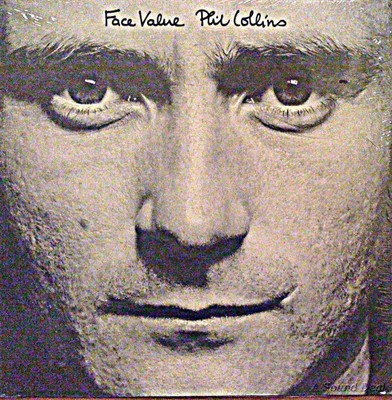
Phil Collins Face Value LP SEALED original 1981 gatefold hear
$
28


Favourite Auctions
To save auctions to your favourites, please login
If you don't have an account, please register
Description
Phil Collins 1981 Atlantic 12" LP Face Value Cover: VG++/EX to Near Mint Near flawless Record: Still Sealed! philcollinslpfacess
Phil Collins
Face Value
1981 US Atlantic
As new factory sealed original 1981 gatefold sleeve
Condition
Vinyl: Still Sealed!
Sleeve: VG++/EX to Near Mint Near flawless
See Item Specifics section above for additional details
(clickable images enlarge)
Tracks:
Phil Collins ?– Face Value Label: Atlantic – SD 16029 Format: Vinyl, LP, Album Country: US Released: 1981 Genre: Electronic, Rock Style: Pop Rock, Synth-pop Tracklist Hide Credits? A1 In The Air Tonight 5:32 A2 This Must Be Love Backing Vocals – Stephen Bishop 3:55 A3 Behind The Lines 3:53 A4 The Roof Is Leaking Guitar – Joe Partridge 3:16 A5 Droned 2:55 A6 Hand In Hand 5:12 B1 I Missed Again 3:41 B2 You Know What I Mean 2:33 B3 Thunder And Lightning 4:12 B4 I'm Not Moving 2:33 B5 If Leaving Me Is Easy Guitar – Eric Clapton 4:54 B6 Tomorrow Never Knows 4:46 Credits? Banjo – Daryl Stuermer (tracks: A4) Bass – Alphonso Johnson (tracks: A2, A3, A6, B1, B5), John Giblin (tracks: A1, B3, B4, B6) Cello – Tony Pleeth*, Clive Anstee, Nigel Warren-Green Co-producer – Hugh Padgham Double Bass – Chris Lawrence* Guitar – Daryl Stuermer (tracks: A1 to A6, B1, B3, B5, B6) Horns – EWF Horns (tracks: B6), Michael Harris (tracks: A3, A6, B1, B3, B5), Rahmlee Michael Davis (tracks: A3, A6, B1, B3, B5) Percussion – Shankar (tracks: A4) Producer – Phil Collins Saxophone – Don Myrick (tracks: A3, A6, B1, B3, B5), Ronnie Scott (tracks: B1) Synthesizer – Peter Robinson (tracks: A3) Tambura – Shankar (tracks: A4) Trombone – Louis Satterfield (tracks: A3, A6, B1, B3) Viola – Brian Hawkins, Roger Best, Simon Whistler Violin – Bill Benham, Bruce Dukov, David Woodcock, Liz Edwards*, Gavyn Wright, Irvine Arditti, Ken Sillitoe*, Peter Oxer, Richard Studt, Shankar (tracks: A1, A5, B1, B6) Voice – Children From The Churches Of Los Angeles (tracks: A6, B6)
Phil Collins Face Value LP SEALED original 1981 gatefold hear Philip David Charles "Phil" Collins, LVO (born 30 January 1951)[2] is an English singer-songwriter, drummer, pianist and actor best known as a drummer and vocalist for British progressive rock group Genesis and as a solo artist. Collins sang the lead vocals on several chart hits in the United Kingdom and the United States between 1975 and 2010, either as a solo artist or with Genesis. His singles, sometimes dealing with lost love, ranged from the drum-heavy "In the Air Tonight", dance pop of "Sussudio", piano-driven "Against All Odds", to the political statements of "Another Day in Paradise". Collins's professional music career began as a drummer, originally in a band called The Real Thing with Andrea Bertorelli, who later became his first wife. Collins played drums and shared lead vocals (with Brian Chatton) in Flaming Youth which recorded one album, (Ark II). In 1970, he took over drums for Genesis, which had already recorded two albums. In Genesis, Collins originally supplied backing vocals for front man Peter Gabriel, singing lead on only two songs: "For Absent Friends" from 1971's Nursery Cryme album and "More Fool Me" from Selling England by the Pound, which was released in 1973. Following Gabriel's departure in 1975, Collins became the group's lead singer. His solo career, heavily influenced by his personal life, brought both himself and Genesis commercial success. According to Atlantic Records, Collins's total worldwide sales as a solo artist, as of 2000, were 150 million.[3] Collins has won numerous music awards throughout his career, including seven Grammy Awards, five Brit Awards—winning Best British Male three times, an Academy Award, and two Golden Globes for his solo work.[4][5] He was inducted into the Rock and Roll Hall of Fame as a member of Genesis in 2010. Collins is one of only three recording artists (along with Paul McCartney and Michael Jackson) who have sold over 100 million albums worldwide both as solo artists and (separately) as principal members of a band.[6] When his work with Genesis, his work with other artists, as well as his solo career is totalled, Collins had more top 40 hits on the Billboard Hot 100 chart during the 1980s than any other artist.[7] In 2008, Collins was ranked the 22nd most successful artist on the "The Billboard Hot 100 Top All-Time Artists".[8] Contents Early life Collins was born and raised in Hounslow[9], London, the son of Winifred M. "June" (née Strange), a theatrical agent, and Greville Philip Austin Collins, an insurance agent.[10][11] He was given a toy drum kit for Christmas when he was five. Later, his uncle made him a makeshift one that he used regularly. As Collins grew older these were followed by more complete sets bought by his parents.[12] He practiced by playing alongside the television and radio, and never learned to read and write conventional musical notation; instead, he uses a system he devised himself.[13] Early career His professional training began at 14 when he entered Barbara Speake Stage School.[14] He began a career as a child actor and model, and won his first major role as the Artful Dodger in the London production of Oliver!. He was an extra in the Beatles' A Hard Day's Night, one of hundreds of screaming teenagers during the TV concert sequence and seen fleetingly in a close-up. He was also in Chitty Chitty Bang Bang as one of the children who storms the castle at the end of the film, but it was cut.[15] He also auditioned for the role of Romeo in Romeo and Juliet (1968),[16] a role won by fellow Artful Dodger actor Leonard Whiting.[17] Collins was among the last three finalists for the role of I.Q. on the American children's television show The Bugaloos (he lost out to English actor/musician John McIndoe).[18] Despite the beginnings of an acting career, Collins continued to gravitate towards music. While attending Chiswick Community School he formed a band called the Real Thing and later joined the Freehold. With the latter group, he wrote his first song titled "Lying Crying Dying".[19] Collins's first record deal came as drummer for Hickory, who changed their name to Flaming Youth by the time of their sole album, Ark 2 (1969).[20] A concept album inspired by the recent media attention surrounding the moon landing, Ark 2 (with Ronnie Caryl, Brian Chatton and Gordon (Flash) Smith), failed to make much commercial success despite positive critical reviews. Melody Maker featured the album as "Pop Album of the Month", describing it as "adult music beautifully played with nice tight harmonies".[21] The album's main single, "From Now On", failed on the radio. After a year of touring, band tensions and the lack of commercial success dissolved the group. In 1970, the 19-year old Collins played percussion on the George Harrison song "The Art of Dying". Harrison credited him in the liner notes to the remastered CD version of the album released in 2000.[22] Genesis era Main article: Genesis (band) In 1970, Collins answered a Melody Maker classified ad for "...a drummer sensitive to acoustic music, and acoustic twelve-string guitarist".[23] Genesis placed the ad after having already lost three drummers over two albums.[24] The audition occurred at the home of Peter Gabriel's parents. Prospective candidates performed tracks from the group's second album, Trespass (1970). Collins arrived early, listened to the other auditions while swimming in Gabriel's parents' pool, and memorised the pieces before his turn.[25] The music video for "Land of Confusion" featured the members of Genesis in puppet form, with the single cover (parodying the With the Beatles album and using puppets from the satirical TV show Spitting Image). Collins won the audition. Nursery Cryme was released a year later. Although his role remained primarily that of drummer and backing vocalist for the next five years, he twice sang lead vocals: once on "For Absent Friends" (from Nursery Cryme) and once on "More Fool Me" (from Selling England by the Pound). In 1974, while Genesis were recording the concept album The Lamb Lies Down on Broadway, Brian Eno (who is credited with "Enossification" for electronic vocal effects on the track "Grand Parade of Lifeless Packaging") needed a drummer for his album Taking Tiger Mountain (By Strategy).[26] Collins was sent to fill the gap, and played drums in lieu of payment for Eno's work with the band. Collins later contributed drums to the Brian Eno 1975, and 1977 art rock releases Another Green World and Before and After Science. In 1975, following the final tour supporting the album The Lamb Lies Down on Broadway, Gabriel left the group to pursue a solo career. Collins became lead vocalist after a lengthy but ultimately fruitless search for Gabriel's replacement (where he sang back-up with the over 400 hopefuls that reportedly auditioned).[27] In the short term, the group recruited former Yes and King Crimson drummer Bill Bruford to play drums during live shows, although Collins continued to play during longer instrumental sections. Bruford's drumming can be heard on the track "The Cinema Show" on the live album Seconds Out. He was soon replaced by ex-Frank Zappa band member Chester Thompson, who became a mainstay of the band's live line-up. Collins, however, continued to play drums on all of the group's studio recordings. The first album with Collins as lead vocalist, 1976's A Trick of the Tail, reached the American Top 40, and peaked high as No.3 on the UK charts. Said Rolling Stone, "Genesis has managed to turn the possible catastrophe of Gabriel's departure into their first broad-based American success."[28] Following the recording of Genesis's next album Wind and Wuthering guitarist Steve Hackett left the group to pursue his own solo career. The group decided to continue as a trio for recording with Mike Rutherford playing guitar and bass in the studio, although the lineup was regularly augmented by Chester Thompson and American guitarist Daryl Stuermer for concert tours. Collins simultaneously performed in a jazz fusion group called Brand X. The band recorded their first album, Unorthodox Behaviour, with Collins as drummer, but because Genesis was Collins's priority, there were several Brand X tours and albums without him. Collins credits Brand X as his first use of a drum machine as well as his first use of a home 8-track tape machine.[29] Collins also performed on Steve Hackett's first solo album, Voyage of the Acolyte, on which he sang lead vocals and played drums. As the decade closed, Genesis began a shift from their progressive rock roots and toward more accessible, radio-friendly pop-rock music. The album ...And Then There Were Three... featured their first UK Top 10 and US Top 40 single, "Follow You Follow Me".[30][31] "Dance on a Volcano" (1976) The first track from Genesis's A Trick of the Tail was Collins's début as the group's full-time lead singer. A progressive rock track, it contrasts with the style of his later work. Problems listening to this file? See media help. In the 1980s, while Collins developed as a songwriter and established a parallel career as a solo artist, Genesis recorded a series of highly successful albums including Duke, Abacab, Genesis, and Invisible Touch. The latter album's title track reached No.1 on the American Billboard singles chart, the only Genesis song to do so. The group received an MTV "Video of the Year" nomination in 1987 for the single "Land of Confusion" (which featured puppet caricatures created by the British satirical team Spitting Image) but lost out to Peter Gabriel's solo hit, "Sledgehammer".[32] Reviews were generally positive, with Rolling Stone's J. D. Considine stating, "every tune is carefully pruned so that each flourish delivers not an instrumental epiphany but a solid hook."[33] Collins left Genesis in 1996 to focus on his solo career.[19] The last studio album with him as the lead singer was 1991's We Can't Dance. He and Gabriel reunited with other Genesis members in 1999 to re-record "The Carpet Crawlers" for Genesis's Turn It on Again: The Hits. When in the mid-2000s discussions of a possible Genesis reunion arose, Collins stated that he would prefer to return as the drummer, with Gabriel handling the vocals.[34] Eventually Turn It On Again: The Tour was announced for 2007, with the Collins/Rutherford/Banks line-up. In March 2010, Phish guitarist Trey Anastasio was asked to pay tribute to Genesis, one of his favourite bands, upon being inducted into the Rock & Roll Hall of Fame. In addition to Anastasio's speech, Phish appeared and performed two Genesis songs, "Watcher of the Skies" and "No Reply At All". Collins and his Genesis band-mates (minus Peter Gabriel) attended the ceremony but they did not perform. Solo career Early solo recordings (1981–1983) The dominant theme running through Collins's early solo recordings (although never specifically mentioned in his songs) was the acrimonious breakdown of his first marriage and then-recent divorce. Two songs he wrote on the Genesis album Duke, "Please Don't Ask", and the Top 20 hit "Misunderstanding", dealt with failed relationships. One year earlier, he had played drums and sung backing vocals on John Martyn's Grace and Danger, an album whose main theme is also marriage break-up. With the recording of his first solo album, Face Value, Collins attributed his divorce as his main influence,[35] as can be inferred from songs such as "If Leaving Me Is Easy". "In the Air Tonight" "In the Air Tonight" from Face Value (1981), was the first single of Collins' solo career. Problems listening to this file? See media help. Collins made his live debut as a solo performer, appearing at the invitation of producer Martin Lewis at the Amnesty International benefit show, The Policeman's Other Ball at the Theatre Royal in London in September 1981, performing two songs from Face Value including "In the Air Tonight" and "The Roof is Leaking" accompanying himself on piano. Face Value became a surprise international success topping the charts in at least seven countries and hitting the top ten of the Billboard 200 eventually going triple-platinum in the US. Hits from the album included "In the Air Tonight", "I Missed Again" and "If Leaving Me Is Easy". In 1982, he produced ABBA member Frida's solo album, Something's Going On, which helped to spawn the title track, "I Know There's Something Going On", which became a hit. Much like Face Value, many of the songs from Collins's 1982 follow-up album, Hello, I Must Be Going!, came from Collins's marital problems with his first wife such as "I Don't Care Anymore" and "Do You Know and Do You Care". Collins’s early albums had a dark presence, usually heavy on the drums. Regarding Face Value, he says, "I had a wife, two children, two dogs, and the next day I didn't have anything. So a lot of these songs were written because I was going through these emotional changes."[36] There were occasional poppier influences–Face Value's "Behind the Lines", for example, was a jazzy remake of a Genesis song he co-wrote. Face Value was a critical and multi-platinum success, and saw Collins’s profile increase further. Hello, I Must Be Going! gave him a UK No.1 for his cover of the Supremes' "You Can't Hurry Love". The album went triple-platinum in the United States, like its predecessor. The Supremes' cover was his first Top 10 US hit (it also hit the Top 10 of Billboard's Adult Contemporary chart). The album also reached No.2 on the UK album chart, spending well over a year there.[30] Two years before, Collins had played drums on Peter Gabriel's third self-titled record (often referred to as Melt), the first record to feature the "gated reverb" sound, which was used on the song "Intruder". Gabriel reportedly "didn't want any metal on the record" and asked Collins to leave his cymbals at home, to concentrate on the sound of his kit more heavily than usual. Studio engineer Hugh Padgham augmented the drum sound by using a microphone normally intended for studio communication rather than recording and feeding it through a signal processor called a noise gate. This allowed the reverberation added to the drums to be suddenly cut off before it naturally decayed. The result was the arresting "gated reverb" which became Collins's signature sound. This was the same 'big drum sound' used on such songs as "In The Air Tonight", "Mama" by Genesis, and Anni-Frid "Frida" Lyngstad's "(I Know) There's Something Going On." Mid-career (1984–1992) "Against All Odds" "Against All Odds" from the soundtrack of the same name (1984), is a piano-driven ballad. "Another Day in Paradise" A sample of "Another Day in Paradise" from ...But Seriously (1989). The ballad was written to bring attention to the problem of homelessness Problems listening to these files? See media help. Collins changed his musical style with the release of the ballad, "Against All Odds (Take a Look at Me Now)", which was the theme song to the movie of the same name in 1984. The more pop-friendly and radio-accessible single became Collins's first solo single to reach number-one on the Billboard Hot 100.[31] Later that year, Collins contributed to production on Earth, Wind & Fire singer Phillip Bailey's debut album, Chinese Wall, collaborating with Bailey on the hit duet, "Easy Lover". Collins featured on Band Aid's "Do They Know It's Christmas", he played drums and sang on the song. Collins released his most successful album, No Jacket Required, in early 1985. It contained the hits "Sussudio", "One More Night", "Don't Lose My Number", and "Take Me Home", as well as the less known yet equally robust "Who Said I Would", and "Only You Know and I Know". The album featured Sting, Helen Terry and ex-bandmate Peter Gabriel as backing vocalists. He also recorded the successful song "Separate Lives", a duet with Marilyn Martin, and a US number one, for the movie White Nights.[31] Collins had three US number one songs in 1985, the most by any artist that year.[31] No Jacket Required went on to win several Grammy awards including Album of the Year. No Jacket Required received criticism that the album was too safe, despite its upbeat reviews and commercial success. A positive review by David Fricke of Rolling Stone ended, "After years on the art-rock fringe, Collins has established himself firmly in the middle of the road. Perhaps he should consider testing himself and his new fans' expectations next time around."[37] "Sussudio" also drew criticism for sounding too similar to Prince's "1999", a charge that Collins did not deny.[38] Nevertheless, the album went straight to #1 in the US and UK. In 1985, Collins was invited by Bob Geldof to perform at the Live Aid charity event. Collins had the distinction of being the only performer to appear at both the UK concert at Wembley Stadium and the US concert at JFK Stadium in Philadelphia. He accomplished this by performing early in the day at Wembley as both a solo artist and alongside Sting, then transferring to a Concorde flight to the US enabling him to perform his solo material, and drum for Led Zeppelin and Eric Clapton in Philadelphia. While being a guest on major artists' hit recordings, Collins continued to enjoy solo success even while on tour with Genesis, besides from his number-one duet with Marilyn Martin in 1986, Collins would score two more hits from movies with the singles, "Two Hearts" (No.1 US, No.6 UK), and "Groovy Kind of Love" (No.1 UK, No.1 US), the latter two from the soundtrack of his feature film, Buster.[30][31] In 1989, Collins produced another successful album, ...But Seriously, featuring the anti-homelessness anthem "Another Day in Paradise", with David Crosby on backing vocals. (Collins later went on to co-write, sing and play on the song "Hero" on Crosby's 1993 album Thousand Roads.) "Another Day in Paradise" went to Number 1 on the Billboard Charts at the end of 1989 and won Collins Best British Single at the 1990 Brit Awards, and the 1991 Grammy Award for Record of the Year.[39][40] In the process, it became the last No.1 US pop hit of the 1980s. The album ...But Seriously became the first No.1 US album of the 1990s and the best-selling album of 1990 in the UK. Other songs included "Something Happened on the Way to Heaven" (No.4 US, No.15 UK), "Do You Remember?" (not released in the UK, but a No.4 hit in the US), and "I Wish It Would Rain Down" (the latter featuring Eric Clapton on guitar) (No.3 US, No.7 UK).[30][31] Songs about apartheid and homelessness demonstrated Collins’s turn to politically-driven material. This theme recurred on his later albums. A live album, Serious Hits... Live!, followed. In September 1990, Collins performed "Sussudio" at the 1990 MTV Video Music Awards in Los Angeles.[41] Later solo work and Genesis reunion (1993–2008) Collins's record sales began to drop with the 1993 release of Both Sides, a largely experimental album that, according to Collins, included songs that "were becoming so personal, so private, I didn't want anyone else's input".[42] Featuring a less polished sound and fewer up-tempo songs than his previous albums, Both Sides was a significant departure. Collins used no backing musicians, performed all the vocal and instrumental parts at his home studio, and used rough vocal takes for the final product. The album was not well received by radio. Its two biggest hits were "Both Sides of the Story" and "Everyday". Collins worked on the album completely independently of his record company, and took them by surprise when he delivered them a completed album that they were unaware he was making. Collins officially parted ways with Genesis in 1996 to focus on his solo career (Genesis would produce one album without Collins—...Calling All Stations...—before going on hiatus). Collins attempted a return to pop music with Dance into the Light, which Entertainment Weekly reviewed by saying that "(e)ven Phil Collins must know that we all grew weary of Phil Collins".[43] It included minor hits such as the title track and the Beatles-inspired "It's in Your Eyes". Although the album went Gold in the US, it sold considerably less than his previous albums. Despite this, the subsequent tour regularly sold out arenas. In 1996, Collins formed the Phil Collins Big Band. With Collins as drummer, the band performed jazz renditions of various Collins and Genesis hits. The Phil Collins Big Band did a world tour in 1998 that included a performance at the Montreux Jazz Festival. In 1999, the group released the CD A Hot Night in Paris including big band versions of "Invisible Touch", "Sussudio", and the more obscure "The Los Endos Suite" from A Trick of the Tail. Phil Collins's star on the Hollywood Walk of Fame, 6834 Hollywood Blvd A compilation album ...Hits was released in 1998 and sold very well, returning Collins to multi-platinum status in America. The album's sole new track, a cover of the Cyndi Lauper hit "True Colors", received considerable play on US Adult Contemporary stations while peaking at No.2.[44] Some of Collins's earlier hits (e.g. "I Missed Again", "If Leaving Me Is Easy", etc.) and other successes were not included in this compilation. Collins's next single, "You'll Be in My Heart", from the Disney animated movie Tarzan, spent 19 weeks at No.1 on Billboard's Adult Contemporary chart – the longest time ever up to that point. The song won Collins an Academy Award for Best Song. It was his third nomination in the songwriters' category, after being nominated in 1985 and 1989. Collins was awarded a star on the Hollywood Walk of Fame, on 16 June 1999.[45] Collins performing in Barcelona, Spain in July 2004 In 2002 Collins released Testify. Metacritic's roundup of album reviews found this record to be the worst-reviewed album at the time of its release, though it has since been "surpassed" by three more recent releases.[46] The album's "Can't Stop Loving You" (a Leo Sayer cover) was yet another #1 Adult Contemporary smash hit for Collins. Testify sold 140,000 copies in the United States by year's end, although a successful worldwide tour followed.[47] That same year Collins accepted an invitation to drum for the "house band" at a concert celebrating Queen Elizabeth II's Golden Jubilee. In 2003 announced his last solo tour[48] – the "First Final Farewell Tour", a tongue-in-cheek reference to the multiple farewell tours of other popular artists. In 2006 he worked with Disney on a Broadway production of Tarzan, a musical which received generally mixed reviews. In 2007 Collins reunited with his Genesis bandmates Tony Banks and Mike Rutherford for Turn It On Again: The Tour, a tour of Europe and North America. During the tour Genesis performed at the Live Earth concert at Wembley Stadium. Following the band's performance, presenter Jonathan Ross had to apologise to viewers watching the televised version as Collins had used a swear word while singing "Invisible Touch". SEALED original 1981 gatefold hear Phil Collins 1981 Atlantic 12" LP Face Value Cover: VG++/EX to Near Mint Near flawless Record: Still Sealed! philcollinslpfacess
This exquisite slice of retro music history is a vinyl sound recording (not a CD). Please reference Item Specifics above for additional detail. Strict Goldmine grading -- Over 13 years on Ebay! Combine Items to Save $$$!
©A Sound Deal
price rating