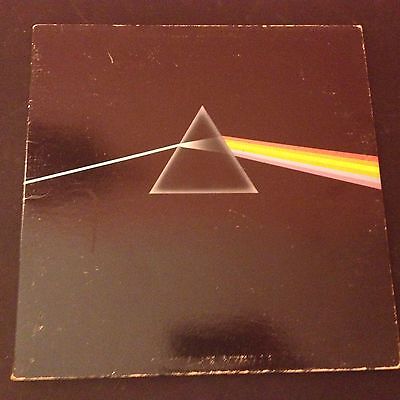
Pink Floyd - The Dark Side Of The Moon - 1973 Vinyl LP Record SMAS-11163 VG
$
50


Favourite Auctions
To save auctions to your favourites, please login
If you don't have an account, please register
Description
(c) 1973 The Gramophone Company , Limited. smas 1163
Condition: Vinyl - VG/NM Cover - VG
See all 4 photos of gatefold cover and vinyl.
Playlist: Speak to Me Breathe On the Run Time The Great Gig in the Sky Money Us and Them Any Colour You Like Brain Damage Eclipse
The Dark Side of the Moon is the eighth studio album by the English progressive rock band Pink Floyd, released on 1 March 1973. It built on ideas explored in the band's earlier recordings and live shows, but lacks the extended instrumental excursions that characterized their work following the departure in 1968 of founder member, principal composer, and lyricist, Syd Barrett. The themes on The Dark Side of the Moon include conflict, greed, the passage of time, and mental illness, the latter partly inspired by Barrett's deteriorating mental state.
Developed during live performances, an early version of the suite was premiered several months before studio recording began; new material was recorded in two sessions in 1972 and 1973 at Abbey Road Studios in London. The group used some of the most advanced recording techniques of the time, including multitrack recording and tape loops. Analogue synthesizers were given prominence in several tracks, and a series of recorded interviews with the band's road crew and others provided the philosophical quotations used throughout. Engineer Alan Parsons was responsible for some of the album's most notable sonic aspects and the recruitment of non-lexical singer Clare Torry. The album's iconic sleeve, designed by Storm Thorgerson, depicts a prism dispersing light into color and represents the band's stage lighting, the record's lyrical themes, and keyboardist Richard Wright's request for a "simple and bold" design.
Concept[edit]
The Dark Side of the Moon built upon experiments Pink Floyd had attempted in their previous live shows and recordings which had become characteristic of the band after founder member Syd Barrett left in 1968. Gilmour, Barrett's replacement, later referred to those instrumentals as "that psychedelic noodling stuff", and with Waters cited 1971's Meddle as a turning-point towards what would be realised on the album. The Dark Side of the Moon's lyrical themes include conflict, greed, the passage of time, death, and insanity, the latter inspired in part by Barrett's deteriorating mental state; he had been the band's principal composer and lyricist.[8] The album is notable for its use of musique concrète[4] and conceptual, philosophical lyrics, as found in much of the band's other work.
Each side of the album is a continuous piece of music. The five tracks on each side reflect various stages of human life, beginning and ending with a heartbeat, exploring the nature of the human experience, and (according to Waters) "empathy".[8] "Speak to Me" and "Breathe" together stress the mundane and futile elements of life that accompany the ever-present threat of madness, and the importance of living one's own life – "Don't be afraid to care".[23] By shifting the scene to an airport, the synthesizer-driven instrumental "On the Run" evokes the stress and anxiety of modern travel, in particular Wright's fear of flying.[24] "Time" examines the manner in which its passage can control one's life and offers a stark warning to those who remain focused on mundane aspects; it is followed by a retreat into solitude and withdrawal in "Breathe (Reprise)". The first side of the album ends with Wright and vocalist Clare Torry's soulful metaphor for death, "The Great Gig in the Sky".[4] Opening with the sound of cash registers and loose change, the first track on side two, "Money", mocks greed and consumerism using tongue-in-cheek lyrics and cash-related sound effects (ironically, "Money" has been the most commercially successful track from the album, with several cover versions produced by other bands).[25] "Us and Them" addresses the isolation of the depressed with the symbolism of conflict and the use of simple dichotomies to describe personal relationships. "Any Colour You Like" concerns the lack of choice one has in a human society. "Brain Damage" looks at a mental illness resulting from the elevation of fame and success above the needs of the self; in particular, the line "and if the band you're in starts playing different tunes" reflects the mental breakdown of former bandmate Syd Barrett. The album ends with "Eclipse", which espouses the concepts of alterityand unity, while forcing the listener to recognise the common traits shared by humanity.
price rating


![KANYE WEST 808S & HEARTBREAK [2 LP AND 1 CD] [VINYL] NEW VINYL RECORD](https://www.popsike.mobi/php/thumbnail.php?url=https://www.popsike.pics/pix/20220515/125316117308.jpg)