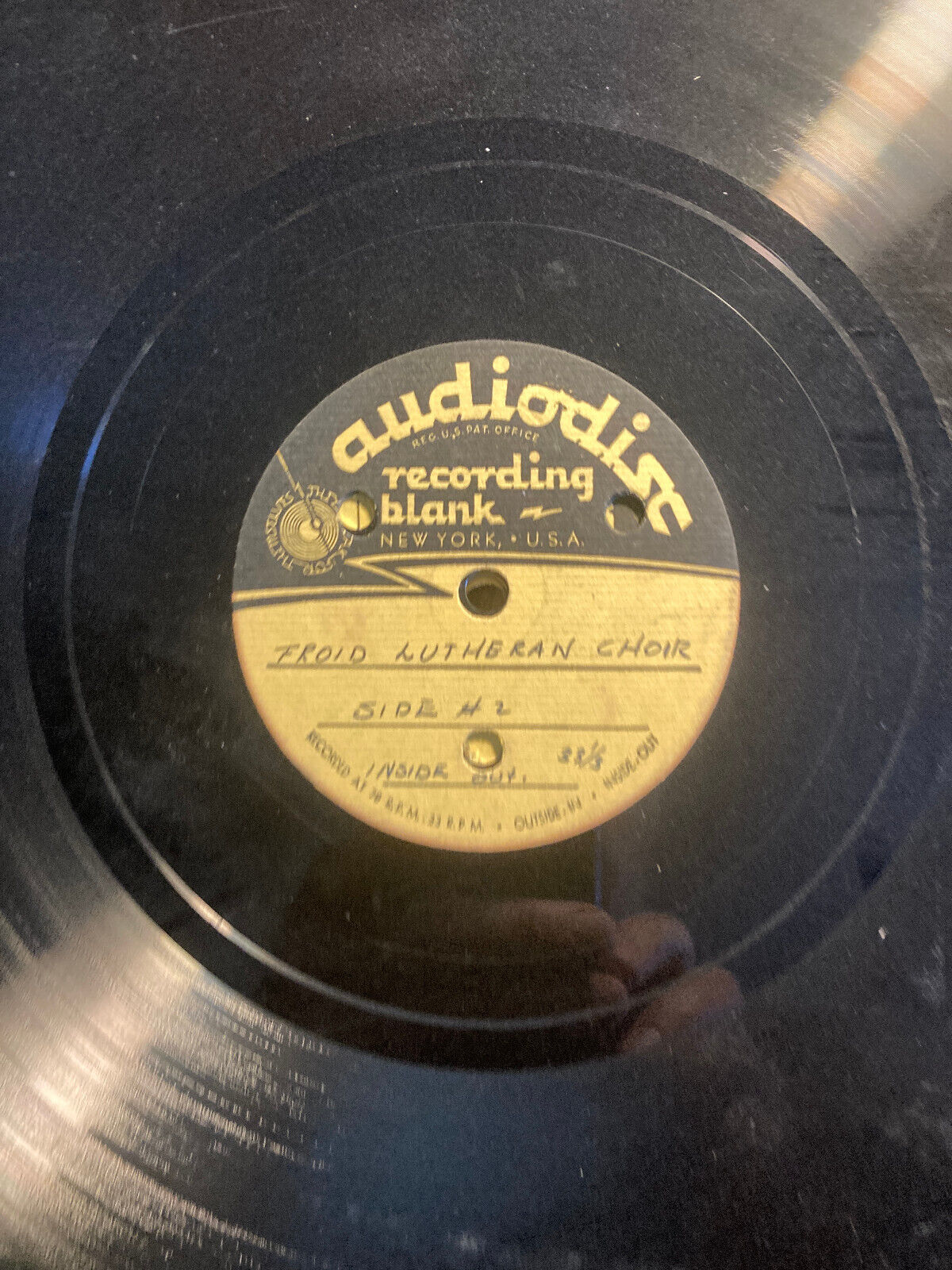
RARE 16" 78 rpm radio / home recordings FROID SUNBURST MONTANA 1951
$
30



Favourite Auctions
To save auctions to your favourites, please login
If you don't have an account, please register
Description
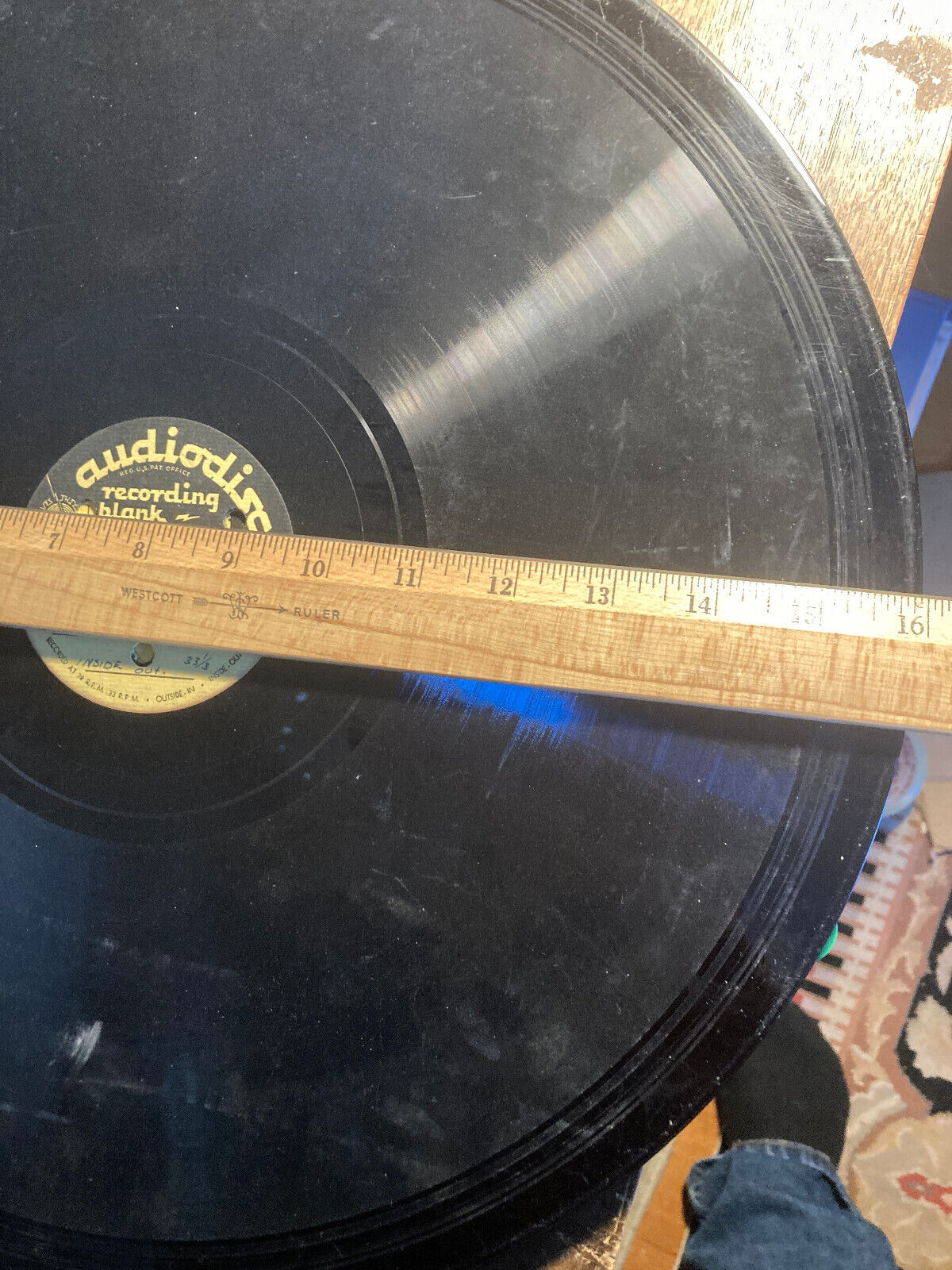
These 7 disca are 16 in across and will not fit on most turntables. They are in great shape for their age, and they have metal cores so they are pretty heavy. Shipping will be at least $15 (included in opening bid). I do not see any major scratches or defects, but I can't play them. One is marked 33 1/3, but I think they are mostly 78 speed. They are all associated with Montana and most appear to be sermons/ services / singing at a lutheran church in Froid, Montana, circa 1950s. One says " Carter Oil company" which I believe was in suburst montana.
FREE SHIPPING
WIKIPEDIA:
Home recording is the practice of recording sound in a private home instead of a professional recording studio. A studio set up for home recording is called a home studio or project studio. Home recording is widely practiced by voice actors, narrators, singers, musicians, podcast hosts, and documentary makers at all levels of success. The cost of professional audio equipment has dropped steadily as technology advances during the 21st century, while information about recording techniques has become easily available online. These trends have resulted in an increase in the popularity of home recording and a shift in the recording industry toward recording in the home studio.[1] The COVID-19 pandemic and COVID-19 lockdowns resulted in a dramatic global increase in the number of remote workers in 2020,[2][3] which is anticipated by experts to remain a permanent shift in the field of sound recording when the pandemic ends.[4][5][6][7]
Studio equipment
Until the late 1970s, music could be recorded either on low-quality tape recorders or on large, expensive reel-to-reel tape machines. Due to their high price and specialized nature, reel-to-reel machines were only practical for professional studios and wealthy artists. In 1979, Tascam invented the Portastudio, a small four-track machine aimed at the consumer market. With this new product, small multitrack tape recorders became widely available, and grew in popularity throughout the 1980s. In the 1990s, analog tape machines were supplanted by digital recorders and computer-based digital audio workstations (DAWs). These new devices were designed to convert audio tracks into digital files, and record the files onto magnetic tape (such as ADAT), hard disk, compact disc, or flash ROM.[8]
The way the room sounds or reverberates can change dramatically the way music is mixed, written, and recorded. Untreated rooms have an uneven frequency response, which means that any mixing decisions being made are being based on a sound that is ‘coloured,’ because sound mixers can not accurately hear, what is being played. Acoustic panels and bass traps can improve the sound in the room.[9]
Impact on professional recording studios
Professional recording studios have been heavily impacted by the growth of home studio technology over the last two decades. The advancements in such technology along with the moderate to low budgets of up-and-coming and even established artists have put many commercial studios out of business. Many professional engineers have moved from these commercial studios into their own homes to be able to work with their clients at a more accessible cost. Artists have also set up their home studios to self-record and produce their own material and not have to deal with high budgets and expensive studio time. Lack of album sales in recent years and major record labels cutting their budgets to fund their artists and producers to record in these high-end studios have done a significant amount of damage as well. Some of music's iconic studios have been forced to shut their doors for good due to these circumstances. The list of these studios include The Hit Factory, which was located in New York City and home to albums such as Born in the U.S.A. by Bruce Springsteen and Graceland by Paul Simon, and Sony Music Studios, which was also located in New York City and where Nirvana recorded their MTV Unplugged session. Another studio that was forced to close was Olympic Studios in London, where works by Eric Clapton, Jimi Hendrix and The Rolling Stones were recorded.[10]
Even though these commercial studios are able to produce a quality recording for the artists that record in them, many of the recording software used in home studios can emulate what the consoles and tape recorders are able to do. As mentioned in the Los Angeles Times, according to the National Association of Music Merchants (NAMM), the trade group for music retailers and manufacturers: "The total computer music market went from just under $140 million in sales in 1999 to almost a half-billion dollars in 2008".[11] So while album sales have significantly dropped in the past decade, which has forced recording studios to cut costs, the sales of computer software and technology related to music have significantly increased as well. Maureen Droney, senior director of the Recording Academy's Producers & Engineers Wing, spoke to the Los Angeles Times and reflected on what the recording studios have come to be in today's music industry with the following statement: "In some ways we've come full circle ... We've gone back to being small and entrepreneurial. People still look to commercial studios when they have something to offer that they can't do at home. But, as it is, the recording studio business started with people starting small, funky studios, oftentimes in bedrooms and garages."[11]
The land that is now Froid was homesteaded by James and Alice Baker, and who erected a building that housed a dry goods store, livery stable, and meat house. One family currently residing in Froid (the Johnsons) are descendants of this couple.[citation needed]
Froid was incorporated in 1910.[4] The town made headlines in 2007, when Governor Brian Schweitzer gave the commencement address to the high school graduating class, which consisted entirely of one student, Roxie Britton. The act received considerable soft news coverage for this distinction.[5]
Geography
Froid is located at 48°20′9″N 104°29′25″W (48.335950, -104.490264),[6] near the North Dakota border and north of Culbertson, on Highway 16.
According to the United States Census Bureau, the town has a total area of 0.28 square miles (0.73 km2), all land.[7]
Demographics
Historical population Census Pop. Note %± 1920 410— 1930 434
5.9% 1940 441
1.6% 1950 555
25.9% 1960 418
−24.7% 1970 330
−21.1% 1980 323
−2.1% 1990 195
−39.6% 2000 195
0.0% 2010 185
−5.1% 2020 195
5.4% U.S. Decennial Census[2]
2010 census
As of the census[8] of 2010, there were 185 people, 92 households, and 49 families residing in the town. The population density was 660.7 inhabitants per square mile (255.1/km2). There were 117 housing units at an average density of 417.9 per square mile (161.4/km2). The racial makeup of the town was 97.3% White, 0.5% Native American, and 2.2% from two or more races.
There were 92 households, of which 21.7% had children under the age of 18 living with them, 46.7% were married couples living together, 5.4% had a female householder with no husband present, 1.1% had a male householder with no wife present, and 46.7% were non-families. 43.5% of all households were made up of individuals, and 21.8% had someone living alone who was 65 years of age or older. The average household size was 2.01 and the average family size was 2.84.
The median age in the town was 50.9 years. 23.2% of residents were under the age of 18; 1.7% were between the ages of 18 and 24; 16.2% were from 25 to 44; 31.3% were from 45 to 64; and 27.6% were 65 years of age or older. The gender makeup of the town was 45.4% male and 54.6% female.
2000 census
As of the census[9] of 2000, there were 195 people, 97 households, and 51 families residing in the town. The population density was 688.1 inhabitants per square mile (265.7/km2). There were 122 housing units at an average density of 430.5 per square mile (166.2/km2). The racial makeup of the town was 90.77% White, 5.64% Native American, 1.54% from other races, and 2.05% from two or more races. Hispanic or Latino of any race were 1.54% of the population.
There were 97 households, out of which 20.6% had children under the age of 18 living with them, 41.2% were married couples living together, 4.1% had a female householder with no husband present, and 47.4% were non-families. 45.4% of all households were made up of individuals, and 29.9% had someone living alone who was 65 years of age or older. The average household size was 2.01 and the average family size was 2.88.
In the town, the population was spread
Sunburst has its origins as a farming community and later saw significant population growth after oil development occurred in the 1920s. A refinery was built in 1922 with the discovery of oil in the Kevin Sunburst Oil Field. Since oil development in the area ceased in the 1970s, Sunburst has once again become a primarily agricultural town. The local high school gives homage to its past, as its students are known as the Sunburst Refiners. Its name comes from what is considered a dramatic sunrise that occurs when the sun comes over the Sweetgrass Hills and illuminates the local fields.[3]
Sunburst incorporated in 1924.[3]
Geography
Sunburst is located at 48°53′0″N 111°54′32″W (48.883255, -111.908754).[4] Interstate 15 passes through the community, with access from Exit 389. The Long Lake Waterfowl Production Area is nearby.
According to the United States Census Bureau, the town has a total area of 1.99 square miles (5.15 km2), of which 1.75 square miles (4.53 km2) is land and 0.24 square miles (0.62 km2) is water.[5]
Climate
According to the Köppen Climate Classification system, Sunburst has a semi-arid climate, abbreviated "BSk" on climate maps.[6]
Demographics
Historical population Census Pop. Note %± 1930 486— 1940 709
45.9% 1950 845
19.2% 1960 882
4.4% 1970 604
−31.5% 1980 476
−21.2% 1990 437
−8.2% 2000 415
−5.0% 2010 375
−9.6% 2020 333
−11.2% U.S. Decennial Census[7][2]
As of 2000 the median income for a household in the town was $58,250, and the median income for a family was $56,038. Males had a median income of $34,500 versus $11,333 for females. The per capita income for the town was $20,244. About 1.7% of families and 4.1% of the population were below the poverty line, including 4.4% of those under age 18 and 3.7% of those age 65 or over.
2010 census
As of the census[8] of 2010, there were 375 people, 150 households, and 107 families residing in the town. The population density was 214.3 inhabitants per square mile (82.7/km2). There were 176 housing units at an average density of 100.6 per square mile (38.8/km2). The racial makeup of the town was 94.9% White, 0.5% Native American, 0.5% from other races, and 4.0% from two or more races. Hispanic or Latino of any race were 2.7% of the population.
There were 150 households, of which 34.0% had children under the age of 18 living with them, 60.7% were married couples living together, 6.7% had a female householder with no husband present, 4.0% had a male householder with no wife present, and 28.7% were non-families. 27.3% of all households were made up of individuals, and 12% had someone living alone who was 65 years of age or older. The average household size was 2.50 and the average family size was 2.98.
The median age in the town was 39.4 years. 25.1% of residents were under the age of 18; 7.2% were between the ages of 18 and 24; 22.1% were from 25 to 44; 31.9% were from 45 to 64; and 13.6% were 65 years of age or older. The gender makeup of the town was 49.6% male and 50.4% female.
Education
Sunburst Schools educates students from kindergarten through 12th grade.[9] North Toole County High School's team name is the Refiners.[10]
North Toole County Library is a public library in Sunburst.[11]
price rating












![MCA & BURZOOTIE [DRUM MACHINE] VERY RARE 1ST '85 DEFJAM VINYL 12](https://www.popsike.mobi/php/thumbnail.php?url=https://www.popsike.pics/pix/20150831/111759275355.jpg)

