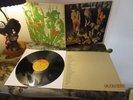
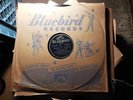
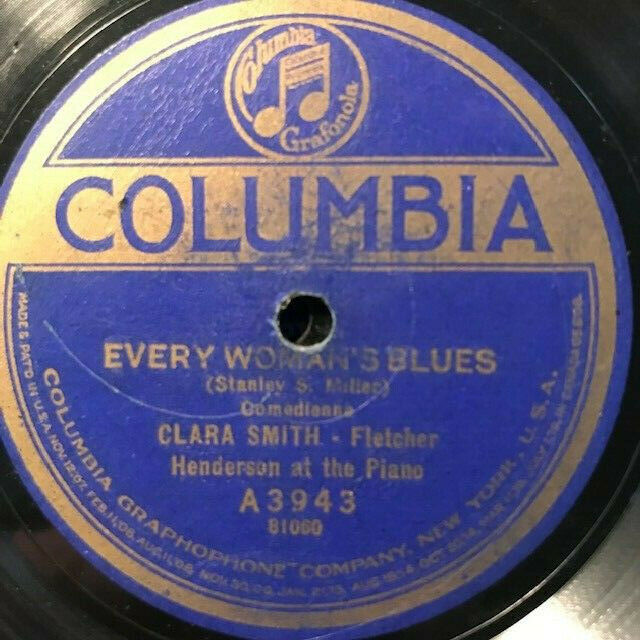
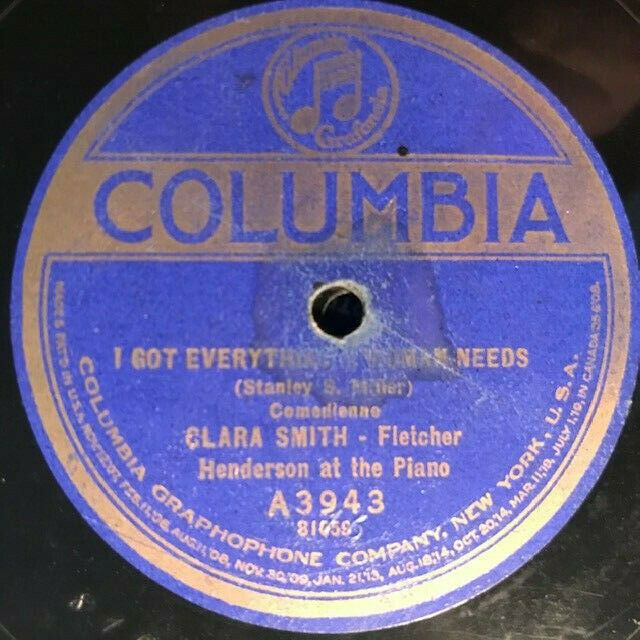
RARE 78 rpm 2 blues early Jazz V+ phonograph records Clara Smith Bessie
$
26
Favourite Auctions
To save auctions to your favourites, please login
If you don't have an account, please register
Description
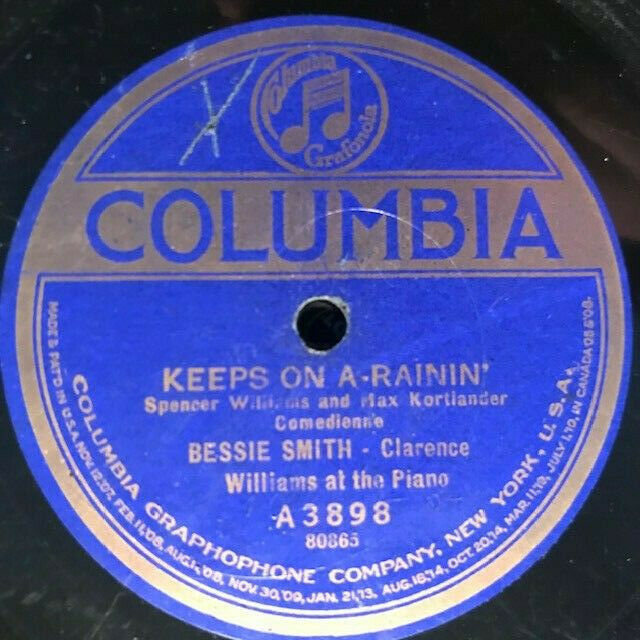
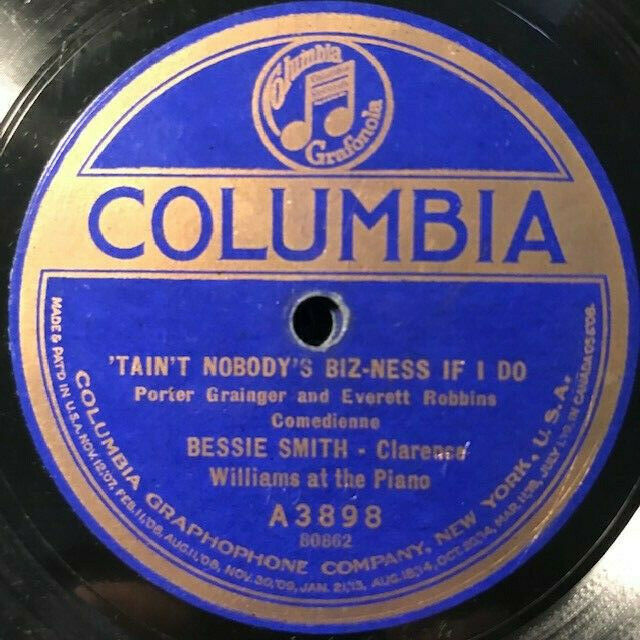
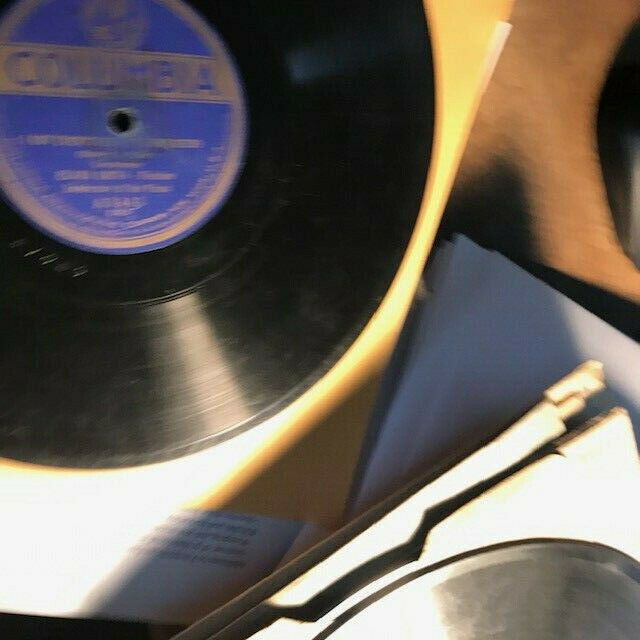
1. Bessie Smith: Keeps on Raining / Taint nobody's bizness Columbia 3898 V+ both sides, plays great! 2. Clara Smith I Got Everthing a Woman Needs / Every Woman's Blues Columbia 3943 V+ (I got side has a couple lam cracks)
WIKIPEDIA:
Blues is a music genre[3] and musical form which was originated in the Deep South of the United States around the 1860s[2] by African-Americans from roots in African-American work songs and spirituals. Blues incorporated spirituals, work songs, field hollers, shouts, chants, and rhymed simple narrative ballads. The blues form, ubiquitous in jazz, rhythm and blues and rock and roll, is characterized by the call-and-response pattern, the blues scale and specific chord progressions, of which the twelve-bar blues is the most common. Blue notes (or "worried notes"), usually thirds, fifths or sevenths flattened in pitch are also an essential part of the sound. Blues shuffles or walking bass reinforce the trance-like rhythm and form a repetitive effect known as the groove.
Blues as a genre is also characterized by its lyrics, bass lines, and instrumentation. Early traditional blues verses consisted of a single line repeated four times. It was only in the first decades of the 20th century that the most common current structure became standard: the AAB pattern, consisting of a line sung over the four first bars, its repetition over the next four, and then a longer concluding line over the last bars. Early blues frequently took the form of a loose narrative, often relating the racial discrimination and other challenges experienced by African-Americans.
Many elements, such as the call-and-response format and the use of blue notes, can be traced back to the music of Africa. The origins of the blues are also closely related to the religious music of the Afro-American community, the spirituals. The first appearance of the blues is often dated to after the ending of slavery and, later, the development of juke joints. It is associated with the newly acquired freedom of the former slaves. Chroniclers began to report about blues music at the dawn of the 20th century. The first publication of blues sheet music was in 1908. Blues has since evolved from unaccompanied vocal music and oral traditions of slaves into a wide variety of styles and subgenres. Blues subgenres include country blues, such as Delta blues and Piedmont blues, as well as urban blues styles such as Chicago blues and West Coast blues. World War II marked the transition from acoustic to electric blues and the progressive opening of blues music to a wider audience, especially white listeners. In the 1960s and 1970s, a hybrid form called blues rock developed, which blended blues styles with rock music.
Contents
- 1 Etymology
- 2 Lyrics
- 3 Form
- 4 History
- 4.1 Origins
- 4.2 Pre-war blues
- 4.2.1 Urban blues
- 4.3 1950s
- 4.4 1960s and 1970s
- 4.5 1980s to the present
- 5 Musical impact
- 6 In popular culture
- 7 See also
- 8 References
- 9 Bibliography
- 10 Further reading
- 11 External links
Etymology
This section's factual accuracy is disputed. Relevant discussion may be found on Talk:Blues. Please help to ensure that disputed statements are reliably sourced. (December 2021) (Learn how and when to remove this template message)The term Blues may have come from "blue devils", meaning melancholy and sadness; an early use of the term in this sense is in George Colman's one-act farce Blue Devils (1798).[4] The phrase blue devils may also have been derived from Britain in the 1600s, when the term referred to the "intense visual hallucinations that can accompany severe alcohol withdrawal".[5] As time went on, the phrase lost the reference to devils, and it came to mean a state of agitation or depression.[5] By the 1800s in the United States, the term blues was associated with drinking alcohol, a meaning which survives in the phrase blue law, which prohibits the sale of alcohol on Sunday.[5] Though the use of the phrase in African-American music may be older, it has been attested to in print since 1912, when Hart Wand's "Dallas Blues" became the first copyrighted blues composition.[6][7]
In lyrics the phrase is often used to describe a depressed mood.[8]
In 1827, it was in the sense of a sad state of mind that John James Audubon wrote to his wife that he "had the blues".[9]
The phrase "the blues" was written by Charlotte Forten, then aged 25, in her diary on December 14, 1862. She was a free-born black woman from Pennsylvania who was working as a schoolteacher in South Carolina, instructing both slaves and freedmen, and wrote that she "came home with the blues" because she felt lonesome and pitied herself. She overcame her depression and later noted a number of songs, such as Poor Rosy, that were popular among the slaves. Although she admitted being unable to describe the manner of singing she heard, Forten wrote that the songs "can't be sung without a full heart and a troubled spirit", conditions that have inspired countless blues songs.[10]
Lyrics
American blues singer Ma Rainey (1886–1939), the "Mother of the Blues"The lyrics of early traditional blues verses probably often consisted of a single line repeated four times. It was only in the first decades of the 20th century that the most common current structure became standard: the so-called "AAB" pattern, consisting of a line sung over the four first bars, its repetition over the next four, and then a longer concluding line over the last bars.[11] Two of the first published blues songs, "Dallas Blues" (1912) and "Saint Louis Blues" (1914), were 12-bar blues with the AAB lyric structure. W.C. Handy wrote that he adopted this convention to avoid the monotony of lines repeated three times.[12] The lines are often sung following a pattern closer to rhythmic talk than to a melody.
Early blues frequently took the form of a loose narrative. African-American singers voiced his or her "personal woes in a world of harsh reality: a lost love, the cruelty of police officers, oppression at the hands of white folk, [and] hard times".[13] This melancholy has led to the suggestion of an Igbo origin for blues because of the reputation the Igbo had throughout plantations in the Americas for their melancholic music and outlook on life when they were enslaved.[14][15]
The lyrics often relate troubles experienced within African American society. For instance Blind Lemon Jefferson's "Rising High Water Blues" (1927) tells of the Great Mississippi Flood of 1927:
Backwater rising, Southern peoples can't make no time
I said, backwater rising, Southern peoples can't make no time
And I can't get no hearing from that Memphis girl of mine
Although the blues gained an association with misery and oppression, the lyrics could also be humorous and raunchy:[16]
Rebecca, Rebecca, get your big legs off of me,
Rebecca, Rebecca, get your big legs off of me,
It may be sending you baby, but it's worrying the hell out of me.[17]
Hokum blues celebrated both comedic lyrical content and a boisterous, farcical performance style.[18] Tampa Red's classic "Tight Like That" (1928) is a sly wordplay with the double meaning of being "tight" with someone coupled with a more salacious physical familiarity. Blues songs with sexually explicit lyrics were known as dirty blues. The lyrical content became slightly simpler in postwar blues, which tended to focus on relationship woes or sexual worries. Lyrical themes that frequently appeared in prewar blues, such as economic depression, farming, devils, gambling, magic, floods and drought, were less common in postwar blues.[19]
The writer Ed Morales claimed that Yoruba mythology played a part in early blues, citing Robert Johnson's "Cross Road Blues" as a "thinly veiled reference to Eleggua, the orisha in charge of the crossroads".[20] However, the Christian influence was far more obvious.[21] The repertoires of many seminal blues artists, such as Charley Patton and Skip James, included religious songs or spirituals.[22] Reverend Gary Davis[23] and Blind Willie Johnson[24] are examples of artists often categorized as blues musicians for their music, although their lyrics clearly belong to spirituals.
Form
The blues form is a cyclic musical form in which a repeating progression of chords mirrors the call and response scheme commonly found in African and African-American music. During the first decades of the 20th century blues music was not clearly defined in terms of a particular chord progression.[25] With the popularity of early performers, such as Bessie Smith, use of the twelve-bar blues spread across the music industry during the 1920s and 30s.[26] Other chord progressions, such as 8-bar forms, are still considered blues; examples include "How Long Blues", "Trouble in Mind", and Big Bill Broonzy's "Key to the Highway". There are also 16-bar blues, such as Ray Charles's instrumental "Sweet 16 Bars" and Herbie Hancock's "Watermelon Man". Idiosyncratic numbers of bars are occasionally used, such as the 9-bar progression in "Sitting on Top of the World", by Walter Vinson.
Chords played over a 12-bar scheme: Chords for a blues in C: I I or IV I I7 IV IV I I7 V V or IV I I or V C C C C F F C C G G C CThe basic 12-bar lyric framework of a blues composition is reflected by a standard harmonic progression of 12 bars in a 4/4 time signature. The blues chords associated to a twelve-bar blues are typically a set of three different chords played over a 12-bar scheme. They are labeled by Roman numbers referring to the degrees of the progression. For instance, for a blues in the key of C, C is the tonic chord (I) and F is the subdominant (IV).
The last chord is the dominant (V) turnaround, marking the transition to the beginning of the next progression. The lyrics generally end on the last beat of the tenth bar or the first beat of the 11th bar, and the final two bars are given to the instrumentalist as a break; the harmony of this two-bar break, the turnaround, can be extremely complex, sometimes consisting of single notes that defy analysis in terms of chords.
Much of the time, some or all of these chords are played in the harmonic seventh (7th) form. The use of the harmonic seventh interval is characteristic of blues and is popularly called the "blues seven".[27] Blues seven chords add to the harmonic chord a note with a frequency in a 7:4 ratio to the fundamental note. At a 7:4 ratio, it is not close to any interval on the conventional Western diatonic scale.[28] For convenience or by necessity it is often approximated by a minor seventh interval or a dominant seventh chord.
A minor pentatonic scale; play (help·info)In melody, blues is distinguished by the use of the flattened third, fifth and seventh of the associated major scale.[29]
Blues shuffles or walking bass reinforce the trance-like rhythm and call-and-response, and they form a repetitive effect called a groove. Characteristic of the blues since its Afro-American origins, the shuffles played a central role in swing music.[30] The simplest shuffles, which were the clearest signature of the R&B wave that started in the mid-1940s,[31] were a three-note riff on the bass strings of the guitar. When this riff was played over the bass and the drums, the groove "feel" was created. Shuffle rhythm is often vocalized as "dow, da dow, da dow, da" or "dump, da dump, da dump, da":[32] it consists of uneven, or "swung", eighth notes. On a guitar this may be played as a simple steady bass or it may add to that stepwise quarter note motion from the fifth to the sixth of the chord and back.
History
Origins
Main article: Origins of the bluesThe first publication of blues sheet music may have been "I Got the Blues", published by New Orleans musician Antonio Maggio in 1908 and described as "the earliest published composition known to link the condition of having the blues to the musical form that would become popularly known as 'the blues.'"[33] Hart Wand's "Dallas Blues" was published in 1912; W.C. Handy's "The Memphis Blues" followed in the same year. The first recording by an African American singer was Mamie Smith's 1920 rendition of Perry Bradford's "Crazy Blues". But the origins of the blues were some decades earlier, probably around 1890.[34] This music is poorly documented, partly because of racial discrimination in U.S. society, including academic circles,[35] and partly because of the low rate of literacy among rural African Americans at the time.[36]
Reports of blues music in southern Texas and the Deep South were written at the dawn of the 20th century. Charles Peabody mentioned the appearance of blues music at Clarksdale, Mississippi, and Gate Thomas reported similar songs in southern Texas around 1901–1902. These observations coincide more or less with the recollections of Jelly Roll Morton, who said he first heard blues music in New Orleans in 1902; Ma Rainey, who remembered first hearing the blues in the same year in Missouri; and W.C. Handy, who first heard the blues in Tutwiler, Mississippi, in 1903. The first extensive research in the field was performed by Howard W. Odum, who published an anthology of folk songs from Lafayette County, Mississippi, and Newton County, Georgia, between 1905 and 1908.[37] The first noncommercial recordings of blues music, termed proto-blues by Paul Oliver, were made by Odum for research purposes at the very beginning of the 20th century. They are now lost.[38]
Musicologist John Lomax (left) shaking hands with musician "Uncle" Rich Brown in Sumterville, AlabamaOther recordings that are still available were made in 1924 by Lawrence Gellert. Later, several recordings were made by Robert W. Gordon, who became head of the Archive of American Folk Songs of the Library of Congress. Gordon's successor at the library was John Lomax. In the 1930s, Lomax and his son Alan made a large number of non-commercial blues recordings that testify to the huge variety of proto-blues styles, such as field hollers and ring shouts.[39] A record of blues music as it existed before 1920 can also be found in the recordings of artists such as Lead Belly[40] and Henry Thomas.[41] All these sources show the existence of many different structures distinct from twelve-, eight-, or sixteen-bar.[42][43] The social and economic reasons for the appearance of the blues are not fully known.[44] The first appearance of the blues is usually dated after the Emancipation Act of 1863,[35] between 1860s and 1890s,[2] a period that coincides with post-emancipation and later, the establishment of juke joints as places where blacks went to listen to music, dance, or gamble after a hard day's work.[45] This period corresponds to the transition from slavery to sharecropping, small-scale agricultural production, and the expansion of railroads in the southern United States. Several scholars characterize the development of blues music in the early 1900s as a move from group performance to individualized performance. They argue that the development of the blues is associated with the newly acquired freedom of the enslaved people.[46]
According to Lawrence Levine, "there was a direct relationship between the national ideological emphasis upon the individual, the popularity of Booker T. Washington's teachings, and the rise of the blues." Levine stated that "psychologically, socially, and economically, African-Americans were being acculturated in a way that would have been impossible during slavery, and it is hardly surprising that their secular music reflected this as much as their religious music did."[46]
There are few characteristics common to all blues music, because the genre took its shape from the idiosyncrasies of individual performers.[47] However, there are some characteristics that were present long before the creation of the modern blues. Call-and-response shouts were an early form of blues-like music; they were a "functional expression ... style without accompaniment or harmony and unbounded by the formality of any particular musical structure".[48] A form of this pre-blues was heard in slave ring shouts and field hollers, expanded into "simple solo songs laden with emotional content".[49]
Blues has evolved from the unaccompanied vocal music and oral traditions of slaves imported from West Africa and rural blacks into a wide variety of styles and subgenres, with regional variations across the United States. Although blues (as it is now known) can be seen as a musical style based on both European harmonic structure and the African call-and-response tradition that transformed into an interplay of voice and guitar,[50][51] the blues form itself bears no resemblance to the melodic styles of the West African griots.[52][53] Additionally, there are theories that the four-beats-per-measure structure of the blues might have its origins in the Native American tradition of pow wow drumming.[54]
No specific African musical form can be identified as the single direct ancestor of the blues.[55] However the call-and-response format can be traced back to the music of Africa. That blue notes predate their use in blues and have an African origin is attested to by "A Negro Love Song", by the English composer Samuel Coleridge-Taylor, from his African Suite for Piano, written in 1898, which contains blue third and seventh notes.[56]
The Diddley bow (a homemade one-stringed instrument found in parts of the American South in the early twentieth century) and the banjo are African-derived instruments that may have helped in the transfer of African performance techniques into the early blues instrumental vocabulary.[57] The banjo seems to be directly imported from West African music. It is similar to the musical instrument that griots and other Africans such as the Igbo[58] played (called halam or akonting by African peoples such as the Wolof, Fula and Mandinka).[59] However, in the 1920s, when country blues began to be recorded, the use of the banjo in blues music was quite marginal and limited to individuals such as Papa Charlie Jackson and later Gus Cannon.[60]
Blues music also adopted elements from the "Ethiopian airs", minstrel shows and Negro spirituals, including instrumental and harmonic accompaniment.[61] The style also was closely related to ragtime, which developed at about the same time, though the blues better preserved "the original melodic patterns of African music".[62]
The musical forms and styles that are now considered the blues as well as modern country music arose in the same regions of the southern United States during the 19th century. Recorded blues and country music can be found as far back as the 1920s, when the record industry created the marketing categories "race music" and "hillbilly music" to sell music by blacks for blacks and by whites for whites, respectively. At the time, there was no clear musical division between "blues" and "country", except for the ethnicity of the performer, and even that was sometimes documented incorrectly by record companies.[63][64]
Though musicologists can now attempt to define the blues narrowly in terms of certain chord structures and lyric forms thought to have originated in West Africa, audiences originally heard the music in a far more general way: it was simply the music of the rural south, notably the Mississippi Delta. Black and white musicians shared the same repertoire and thought of themselves as "songsters" rather than blues musicians. The notion of blues as a separate genre arose during the black migration from the countryside to urban areas in the 1920s and the simultaneous development of the recording industry. Blues became a code word for a record designed to sell to black listeners.[65]
The origins of the blues are closely related to the religious music of Afro-American community, the spirituals. The origins of spirituals go back much further than the blues, usually dating back to the middle of the 18th century, when the slaves were Christianized and began to sing and play Christian hymns, in particular those of Isaac Watts, which were very popular.[66] Before the blues gained its formal definition in terms of chord progressions, it was defined as the secular counterpart of spirituals. It was the low-down music played by rural blacks.[21]
Depending on the religious community a musician belonged to, it was more or less considered a sin to play this low-down music: blues was the devil's music. Musicians were therefore segregated into two categories: gospel singers and blues singers, guitar preachers and songsters. However, when rural black music began to be recorded in the 1920s, both categories of musicians used similar techniques: call-and-response patterns, blue notes, and slide guitars. Gospel music was nevertheless using musical forms that were compatible with Christian hymns and therefore less marked by the blues form than its secular counterpart.[21]
Pre-war blues
The American sheet music publishing industry produced a great deal of ragtime music. By 1912, the sheet music industry had published three popular blues-like compositions, precipitating the Tin Pan Alley adoption of blues elements: "Baby Seals' Blues", by "Baby" Franklin Seals (arranged by Artie Matthews); "Dallas Blues", by Hart Wand; and "The Memphis Blues", by W.C. Handy.[67]
Sheet music from "Saint Louis Blues" (1914)Handy was a formally trained musician, composer and arranger who helped to popularize the blues by transcribing and orchestrating blues in an almost symphonic style, with bands and singers. He became a popular and prolific composer, and billed himself as the "Father of the Blues"; however, his compositions can be described as a fusion of blues with ragtime and jazz, a merger facilitated using the Cuban habanera rhythm that had long been a part of ragtime;[20][68] Handy's signature work was the "Saint Louis Blues".
In the 1920s, the blues became a major element of African American and American popular music, reaching white audiences via Handy's arrangements and the classic female blues performers. The blues evolved from informal performances in bars to entertainment in theaters. Blues performances were organized by the Theater Owners Bookers Association in nightclubs such as the Cotton Club and juke joints such as the bars along Beale Street in Memphis. Several record companies, such as the American Record Corporation, Okeh Records, and Paramount Records, began to record African-American music.
As the recording industry grew, country blues performers like Bo Carter, Jimmie Rodgers, Blind Lemon Jefferson, Lonnie Johnson, Tampa Red and Blind Blake became more popular in the African American community. Kentucky-born Sylvester Weaver was in 1923 the first to record the slide guitar style, in which a guitar is fretted with a knife blade or the sawed-off neck of a bottle.[69] The slide guitar became an impor
price rating




![MARION BROWN [Three for Shepp] WL PROMO [impulse] MONO*](https://www.popsike.mobi/php/thumbnail.php?url=https://www.popsike.pics/pix/20120923/360490541794.jpg)