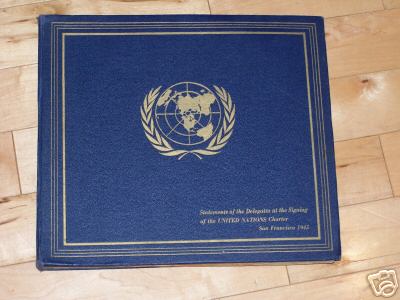
RARE RECORD SET UNITED NATION CHARTER 1945
$
118


Favourite Auctions
To save auctions to your favourites, please login
If you don't have an account, please register
Description
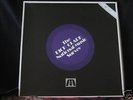
SEVEN RARE HISTORIC TRANSCRIPTION DISCS
RECORDED ON THE SCENE BY ROBERT VINCENT JUNE 26 1945
STATEMENTS OF THE DELEGATES AT THE SIGNING OF THE UNITED NATIONS CHARTER SAN FRANCISCO 1945
THIS YEAR WAS ITS 60TH ANNIVERSARY
I HAVE PROVIDED LINKS TO SITES WITH INFORMATION ON THE UN CHARTER AND ROBERT VINCENT AND V DISCS
http://www.un.org/aboutun/sanfrancisco/
Forty-five nations, including the four sponsors, were originally invited to the
San Francisco Conference: nations which had declared war on Germany and Japan
and had subbscribed to the United Nations Declaration. One of these, Poland,
did not attend because the composition of her new government was not announced
until too late for the conference. Therefore, a space was left for the
signature of Poland, one of the original signatories of the United Nations
Declaration. At the time of the conference there was no generally recognized
Polish Government, but on June 28, such a government was announced and on
October 15, 1945 Poland signed the Charter, thus becoming one of the original
Members.
France suggested that Syria and Lebanon be invited and these two states were
asked to attend. The conference itself invited four other states — the
Byelorussian Soviet Socialist Republic, the Ukrainian Soviet Socialist
Republic, newly-liberated Denmark and Argentina.
Thus delegates of fifty nations in all, gathered at the City of the Golden
Gate, representatives of over eighty per cent of the world's population, people
of every race, religion and continent; all determined to set up an organization
which would preserve peace and help build a better world. They had before them
the Dumbarton Oaks proposals as the agenda for the conference and, working on
this basis, they had to produce a Charter acceptable to all the countries.
There were 850 delegates, and their advisers and staff together with the
conference secretariat brought the total to 3,500. In addition, there were more
than 2,500 press, radio and newsreel representatives and observers from many
societies and organizations. In all, the San Francisco Conference was not only
one of the most important in history but, perhaps, the largest international
gathering ever to take place.
The heads of the delegations of the sponsoring countries took turns as chairman
of the plenary meetings : Anthony Eden, of Britain, Edward Stettinius, of the
United States, T. V. Soong, of China, and Vyacheslav Molotov, of the Soviet
Union. At the later meetings, Lord Halifax deputized for Mr. Eden, V. K.
Wellington Koo for T. V. Soong, and Mr Gromyko for Mr. Molotov.
Plenary meetings are, however, only the final stages at such conferences. A
great deal of work has to be done in preparatory committees before a
proposition reaches the full gathering in the form in which it should be voted
upon. And the voting procedure at San Francisco was important. Every part of
the Charter had to be and was passed by a two-thirds majority.
This is the way in which the San Francisco Conference got through its
monumental work in exactly two months.
The conference formed a "Steering Committee," composed of the heads of all the
delegations. This committee decided all matters of major principle and policy.
But, even at one member per state, the committee was fifty strong, too large
for detailed work; therefore an Executive Committee of fourteen heads of
delegations was chosen to prepare recommendations for the Steering Committee.
Then the proposed Charter was divided into four sections, each of which was
considered by a "Commission." Commission one dealt with the general purposes of
the organization, its principles, membership, the secretariat and the subject
of amendments to the Charter. Commission two considered the powers and
responsibilities of the General Assembly, while Commission three took up the
Security Council.
Commission four worked on a draft for the Statute of the International Court of
Justice. This draft had been prepared by a 44-nation Committee of Jurists which
had met in Washington in April 1945.
All this sounds over-elaborate — especially when the four Commissions
subdivided into twelve technical committees — but actually, it was the
speediest way of ensuring the fullest discussion and securing the last ounce of
agreement possible.
There were only ten plenary meetings of all the delegates but nearly 400
meetings of the committees at which every line and comma was hammered out. It
was more than words and phrases, of course, that had to be decided upon. There
were many serious clashes of opinion, divergencies of outlook and even a crisis
or two, during which some observers feared that the conference might adjourn
without an agreement.
There was the question, for example, of the status of "regional organizations."
Many countries had their own arrangements for regional defence and mutual
assistance. There was the Inter-American System, for example, and the Arab
League. How were such arrangements to be related to the world organization? The
conference decided to give them part in peaceful settlement and also, in
certain circumstances, in enforcement measures, provided that the aims and acts
of these groups accorded with the aims and purposes of the United Nations.
The League of Nations had provided machinery for the revision of treaties
between members. Should the United Nations make similar provisions? The
conference finally agreed that treaties made after the formation of the United
Nations should be registered with the Secretariat and published by it. As to
revision, no specific mention was made although such revision may be
recommended by the General Assembly in the course of investigation of any
situation requiring peaceful adjustment.
The conference added a whole new chapter on the subject not covered by the
Dumbarton Oaks proposals: proposals creating a system for territories placed
under United Nations trusteeship. On this matter there was much debate. Should
the aim of trusteeship be defined as "independence" or "self-government" for
the peoples of these areas? If independence, what about areas too small ever to
stand on their own legs for defence? It was finally recommended that the
promotion of the progressive development of the peoples of trust territories
should be directed toward "independence or self-government."
There was also considerable debate on the jurisdiction of the International
Court of Justice and the conference decided that member nations would not be
compelled to accept the Court's jurisdiction but might voluntarily declare
their acceptance of compulsory jurisdiction.
Likewise the question of future amendments to the Charter received much
attention and finally resulted in an agreed solution.
Above all, the right of each of the "Big Five" to exercise a "veto" on action
by the powerful Security Council provoked long and heated debate. At one stage
the conflict of opinion on this question threatened to break up the conference.
The smaller powers feared that when one of the "Big Five" menaced the peace,
the Security Council would be powerless to act, while in the event of a clash
between two powers not permanent members of the Security Council, the "Big
Five" could act arbitrarily. They strove therefore to have the power of the
"veto" reduced. But the great powers unanimously insisted on this provision as
vital, and emphasized that the main responsibility for maintaining world peace
would fall most heavily on them. Eventually the smaller powers conceded the
point in the interest of setting up the world organization.
This and other vital issues were resolved only because every nation was
determined to set up, if not the perfect international organization, at least
the best that could possibly be made.
Thus it was that in the Opera House at San Francisco on June 25, the delegates
met in full session for the last meeting. Lord Halifax presided and put the
final draft of the Charter to the meeting. "This issue upon which we are about
to vote," he said, "is as important as any we shall ever vote in our lifetime."
In view of the world importance of the occasion, he suggested that it would be
appropriate to depart from the customary method of voting by a show of hands.
Then, as the issue was put, every delegate rose and remained standing. So did
everyone present, the staffs, the press and some 3000 visitors, and the hall
resounded to a mighty ovation as the Chairman announced that the Charter had
been passed unanimously.
The next day, in the auditorium of the Veterans' Memorial Hall, the delegates
filed up one by one to a huge round table on which lay the two historic
volumes, the Charter and the Statute of the International Court of Justice.
Behind each delegate stood the other members of the delegation against a
colorful semi-circle of the flags of fifty nations. In the dazzling brilliance
of powerful spotlights, each delegate affixed his signature. To China, first
victim of aggression by an Axis power, fell the honour of signing first.
"The Charter of the United Nations which you have just signed," said President
Truman in addressing the final session, "is a solid structure upon which we can
build a better world. History will honor you for it. Between the victory in
Europe and the final victory, in this most destructive of all wars, you have
won a victory against war itself. . . . With this Charter the world can begin
to look forward to the time when all worthy human beings may be permitted to
live decently as free people."
Then the President pointed out that the Charter would work only if the peoples
of the world were determined to make it work. "If we fail to use it," he
concluded, "we shall betray all those who have died so that we might meet here
in freedom and safety to create it. If we seek to use it selfishly — for the
advantage of any one nation or any small group of nations — we shall be equally
guilty of that betrayal."
The United Nations did not come into existence at the signing of the Charter.
In many countries the Charter had to be approved by their congresses or
parliaments. It had therefore been provided that the Charter would come into
force when the Governments of China, France, Great Britain, the Soviet Union
and the United States and a majority of the other signatory states had ratified
it and deposited notification to this effect with the State Department of the
United States.
On October 24, 1945, this condition was fulfilled and the United Nations came
into existence. Four years of planning and the hope of many years had
materialized in an international organization designed to end war and promote
peace, justice and better living for all mankind.
MESSAGE OF THE SECRETARY-GENERAL
ON THE 60TH ANNIVERSARY
OF THE UNITED NATIONS CHARTER
26 June 2005
Dear friends,
Sixty years ago, in San Francisco, the representatives of 50 nations signed the
United Nations Charter.
In the name of the peoples of the United Nations, they pledged to save
succeeding generations from the scourge of war. Those words are engraved on the
collective memory of mankind.
They reaffirmed their faith in fundamental human rights; in the dignity of the
human person; in the equal rights of men and women, and of nations large and
small.
They pledged to establish conditions under which justice and respect for law
could be maintained.
They promised to promote social progress, and better standards of life, in
larger freedom.
Over sixty years, the United Nations has striven to redeem those pledges.
We have had many successes. We have kept the peace in many places. We have
helped banish smallpox and polio from almost every country. We have give
millions of children an education that their parents could not dream of. We
have helped organize elections, from Afghanistan to Burundi. And we have
brought relief to victims of disasters like the Indian Ocean tsunami.
We have had failures. The worst, perhaps, was our collective failure to prevent
the genocide in Rwanda.
Today, in a new century, we face new threats and challenges, but also new
opportunities.
Those better standards of life in larger freedom are now within our reach. To
reach them, we must advance on all three fronts at once: development, security
and human rights.
Never in the history of the United Nations have bold decisions been more
necessary. And never have they been more possible.
This September, at the 2005 World Summit, leaders from 191 nations have the
chance to make those decisions. With support, and encouragement from you, the
peoples of the world, I believe they will.
Thank you very much.
RECORDED ON THE SCENE BY ROBERT VINCENT
site on v-discs
http://members.aol.com/boardwalk7/vdisc/vdisc.html
http://www.lib.msu.edu/vincent/about.htm
Now Lieutenant George Robert Vincent enters the picture. Vincent had a long
association with both the armed forces and recorded music. He fought in World
War I as a 17-year old lieutenant. He later worked with Thomas Edison,
designing improvements to the phonograph. By 1942, he rejoined the Army and was
assigned to the Armed Forces Radio Service as a technical officer, and worked
with Bronson's 16-inch transcription discs.
Vincent knew the soldiers wanted to hear new music, so he asked his supervisors
if a special recording project could be undertaken that would provide new songs
to the platoons. In July 1943, Vincent discussed the project with Major
Bronson. Bronson okayed it, but told Vincent that there was no money in the
Army budget to start a record company. Undaunted, Vincent met with the Army's
fiscal officer, Major Howard Haycraft, who immediately allocated one million
dollars to Vincent's new project.
With money in hand, Vincent devoted all his time to the music program. He
recruited Steve Sholes, a former A&R man at RCA Victor who supervised jazz
recordings by Sidney Bechet and Jelly Roll Morton, to assist him. Vincent's
record company now had a name - "V-Discs," a sobriquet coined by Vincent's
secretary. It also acquired a logo - a red-white-and-blue graphic designed by a
staff artist at Yank magazine on a $5 retainer.
The first problem was trying to find a suitable substitute for shellac, the
main component for records. Four out of every five transcription discs sent
overseas arrived in pieces. And when the Japanese took over French Indochina,
America lost its supply of imported shellac. Although shellac could be recycled
and reused (and many Americans donated their old 78's in scrap drives for war
materials), the music was drowned out by the loud surface noise on recycled
shellac discs.
After much testing, Vincent's team found that Vinylite, a Union Carbide
product, could be used as a viable substitute for shellac. Because the Army
also used Vinylite for insulation and life rafts, V-Discs used a second resin -
Formvar, a Canadian-invented polyvinyl - in conjunction with Vinylite (one of
the companies that pressed records for V-Disc, Columbia, refused to use either
compound, instead making V-Discs out of whatever shellac they could allocate).
After Steve Sholes joined the V-Disc project, two other enlisted men signed on
- Morty "Perfect Pitch" Palitz, who spent his civilian life with Decca,
Brunswick and Columbia records; and Walt Heebner, a former RCA sales department
employee. Heebner's assignment was to convince the AFM and Petrillo to grant a
special waiver to record V-Discs for the Army.
As for Captain Vincent, he was promoted to Major and received the Legion of
Merit award for his services with the V-Disc project. He later designed the
vast multilingual translation complex for the Nuremberg War Crimes trials, and
installed a similar electronic multilingual translation system into the new
United Nations building.
History of Herbert Vere Evatt
http://evatt.labor.net.au/publications/papers/132.html
http://www.lib.flinders.edu.au/resources/collection/special/evatt/evattbiog.html
IF YOU HAVE ANY QUESTIONS PLEASE FEEL FREE TO EMAIL ME. THESE RECORDS ARE RARE AND THE VINCENT VOICE LIBRARY AT THE MICHIGAN STATE UNIVERSITY DOES NOT HAVE A SET OF THESE RECORDS. THEY HAVE A RECORDING OF IT. I INQUIRED ABOUT THESE RECORDS THERE AND SPOKE WITH A JOHN SHAW AND HE SAID TO CALL THE UN WHICH I DID AND THEY DIDNT HAVE ANY CLUE AS TO WHAT I WAS TALKING ABOUT. SO I DONT THINK TO MANY PEOPLE KNOW THAT THESE DO EXIST. THEY HAVE 50 COUNTRIES SPEAKING IN THIER LANGUAGES AND TWO OF THE SPEAKERS WERE HERBERT VERE EVATT AND PRIME MINISTER FRANCIS MICHAEL FORD. I DONT THINK THESE WERE EVER PLAYED AND WERE GIVEN OUT TO ONLY A FEW AS A TOKEN OF PARTICIPATION IN THIS HISTORIC EVENT. THE CONDITION OF THE SET IS GREAT WITH SOME MINOR EDGE WEAR ON THE COVER ON THE SIDE. NOT BAD. I HAVE HAD THESE MYSELF FOR A FEW YEARS AND HAVE HAD A HARD TIME PARTING WITH THEM. I DID NOT PLAY THEM MYSELF EITHER IN FEAR OF DAMAGING THEM. I WOULD LIKE THESE TO GO TO A SERIOUS COLLECTOR WHO WILL TREASURE THEM AS I HAVE.
I HOPE I'V GIVEN YOU ENOUGH INFORMATION..THANK YOU!!!!
PAYMENT: MONEY ORDERS, CASHIER CHECKS OR PAYPAL
BUYER PAYS SHIPPING
price rating