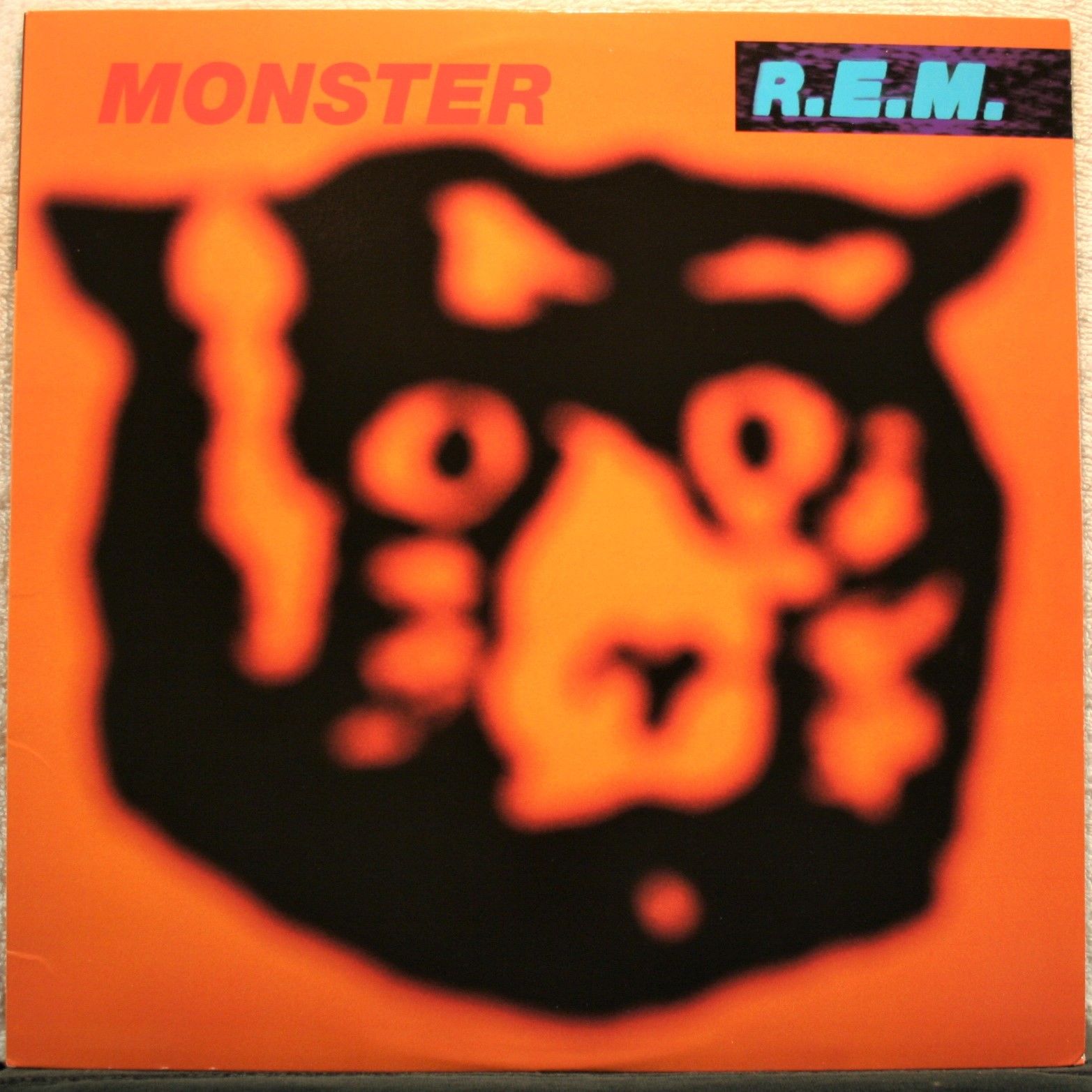
R.E.M. MONSTER ORIGINAL 1994 NEAR MINT CONDITION
$
85


Favourite Auctions
To save auctions to your favourites, please login
If you don't have an account, please register
Description
R.E.M. ***Monster*** NEAR MINT COVER AND VINYL, PLAYED ONCE WHEN PURCHASED
Jump to navigationJump to search Monster Studio album by R.E.M. Released September 27, 1994 Recorded October 1993 – May 1994 Studio- Kingsway Studio, New Orleans
- Crossover Soundstage, Atlanta
- Criteria Studios, Miami
- Ocean Way Recording, Los Angeles
- Grunge
- alternative rock
- punk rock
- glam rock
- Scott Litt
- R.E.M.
(1993) Monster
(1994) R.E.M.: Singles Collected
(1994) Singles from Monster
- "What's the Frequency, Kenneth?"
Released: September 5, 1994 - "Bang and Blame"
Released: October 31, 1994 - "Strange Currencies"
Released: April 18, 1995 - "Crush with Eyeliner"
Released: August 15, 1995 - "Tongue"
Released: October 31, 1995
Monster is the ninth studio album by American rock band R.E.M., and was released on September 27, 1994 by Warner Bros. Records. Produced by the band and Scott Litt and recorded at four studios, the album was an intentional stylistic shift from R.E.M.'s previous two albums—Out of Time (1991) and Automatic for the People (1992)—with loud, distorted guitar tones and simple arrangements. Michael Stipe's lyrics, dealing with the nature of celebrity, are sung by him in several characters.
Led by the successful single, "What's the Frequency, Kenneth?", Monster debuted at number one in the United States and at least seven other countries and received generally-positive reviews. Four more singles were released from the album in 1995, including the UK top-20 hits "Bang and Blame", "Strange Currencies", and "Tongue". That year, the band promoted the album with their first concert tour since 1989; although the tour was commercially successful, band members suffered several health problems. The album's follow-up, New Adventures in Hi-Fi, was primarily recorded during the tour.
Contents
- 1Recording
- 2Music
- 3Packaging
- 4Release and reception
- 5Tour
- 6Track listing
- 7Personnel
- 8Charts
- 8.1Weekly charts
- 8.2Year-end charts
- 8.3Certifications and sales
- 9Notes and sources
- 10Citations
Recording[edit]
Early in 1993, R.E.M. convened a four-day meeting in Acapulco to plan their next two years. The group agreed on a plan for 1994 through 1996, which included recording a new album and touring to promote it.[1] Drummer Bill Berry was particularly eager to tour (which the band had not done since 1989), and insisted that the album "rock". The band agreed that after Out of Time and Automatic for the People, they did not want to record another slow-paced album.[2]
Later that year, R.E.M. began recording their ninth album.[2] Pre-production took place at Kingsway Studio in New Orleans under the supervision of Mark Howard, who had worked on Automatic for the People.[3] Guitarist Peter Buck said that the band wrote 45 songs, including "a whole album's worth of acoustic stuff" which they demoed.[1] According to Howard, the sessions were experimental: "The bass had a tremolo sound on it. It was a more inventive session for them." The studio did not have a control room, so Howard recorded Michael Stipe singing lyrical ideas while lying on a couch: "Being able to put those vocals down helped him write the lyrics to a lot of songs on Monster."[4] When the sessions were finished Howard played the recordings to co-producer Scott Litt, who had worked with the band since their fifth album (Document).[3]
Part of Monster was recorded at Criteria Studios.In February 1994, the band moved to Crossover Soundstage in Atlanta, Georgia. At Crossover, most of the album's basic tracks were recorded live as if the band were playing in concert. Litt said, "I thought since they hadn't toured in a while, it would be good for them to get into that mind-set—you know, monitors, PA, standing up".[5] The sessions were hampered by several events, including Berry and bassist Mike Millsfalling ill on separate occasions, Buck and Stipe leaving to visit family members and the deaths of Stipe's friends, River Phoenix and Kurt Cobain.[4] The band wrote and recorded "Let Me In" in tribute to Cobain and dedicated the album to Phoenix,[5] whose sister Rain provided background vocals on "Bang and Blame".
In late April 1994 the band relocated to Criteria Studios in Miami, Florida, but recording was interrupted because Stipe had an abscessed tooth.[6] Unlike previous album sessions, by the time production moved to Ocean Way Recording in Los Angeles the band was behind schedule. Litt attributed the delay to recording live at Crossover, which lengthened the mixing process; he told Rolling Stone, "We're trying to figure out how raw to leave it and how much to studiofy it." Stipe was still writing songs when the band was supposed to be mixing the album. Tensions arose among the band members, who were staying in different locations in Los Angeles and would rarely be in the studio at the same time.[5] The situation came to a head when the group was recording at Louie's Clubhouse (Litt's home studio in Los Angeles); years later, Stipe recalled, "We broke up ... We reached the point where none of us could speak to each other, and we were in a small room, and we just said 'Fuck off' and that was it."[7] The group met to resolve their issues; Mills told Rolling Stone, "We have to begin working as a unit again, which we haven't been doing very well lately."[5]
Music[edit]
"What's the Frequency, Kenneth?" MENU 0:00 Sample of "What's the Frequency, Kenneth?", the first single from Monster. The song's loud, distorted guitars were an intentional departure from R.E.M.'s previous two albums. Problems playing this file? See media help.Unlike R.E.M.'s previous two albums, Monster incorporated distorted guitar tones, minimal overdubs, and touches of 1970s glam rock. Peter Buck described the album as "a 'rock' record, with the 'rock' in quotation marks." He explained, "That's not what we started out to make, but that's certainly how it turned out to be. There's a nudge, nudge, wink, wink feel to the whole record. Like, it's a rock record, but is it really?"[2] Mike Mills told Time, "On past albums we had been exploring acoustic instruments, trying to use the piano and mandolin, and we did it about all we wanted to do it. And you come back to the fact that playing loud electric-guitar music is about as fun as music can be."[8] Stipe's vocals were pushed down in the mix.[2] Buck's guitar work on the album was inspired by the tremolo-heavy guitar playing of Glen Johansson of Echobelly, who supported R.E.M. on some of the Monster Tour.[9] The album's music has been described as grunge[10][11][12] and alternative rock[13][14] by critics. The band has called it a "foxy, in-your-face, punk rock, trashed and stupid" record.[12] "What's the Frequency, Kenneth?", "Crush with Eyeliner" and "Circus Envy" have been described as glam rock.[12]
Stipe wrote Monster's lyrics in character; this, according to biographer Dan Buckley, "set the real Stipe at a distance from the mask adopted for each song." The album dealt with the nature of celebrity and "the creepiness of fandom as pathology".[15] Buck called the album a reaction to the band's popularity: "When I read the lyrics I thought, all these guys are totally fucked up. I don't know who they are, because they're not Michael. I would say that this was the only time where he's done characters that are creepy, and I don't know if anyone got that. He was getting out his things by acting out these parts that are not him."[16] The band noted that at the end of certain songs, they left blank choruses (where Mills and Berry would usually sing harmony) so fans could sing along.[1]
"The song 'Let Me In' is me on the phone to Kurt, trying to get him out of the frame of mind he was in," said Stipe. "I wanted him to know he didn't need to pay attention to all this; that he was going to make it through. I know what the next Nirvana record was going to sound like. It was going to be an amazing fucking record, and I'm a little angry at him for killing himself. He and I were going to make a trial run of the album. It was set up. He had a plane ticket. At the last minute he called and said, 'I can't come.'"[17]
Packaging[edit]
The cover art features a blurred drawing of a bear's head against an orange background. The concept originated when Stipe showed cover artist Chris Bilheimer a balloon he wanted to use as the album cover and told him to "play around with". Bilheimer changed the color of the balloon (which was originally green), and re-photographed the bear head. When he was down to the last few frames on a roll of film, he took a few photos without bothering to focus the shots (which he and Stipe ended up liking the best).[18] The jewel case of the original CD release of Monster also featured an orange polystyrene media tray, akin to the yellow one used for the Automatic for the People CD.
The back cover has the body of the bear next to the track listing, and the inside sleeve features images of the cartoon character Migraine Boy. "I lifted Migraine Boy from the Flagpole," Stipe told Molly McCommons, his 12-year-old interviewer and daughter of Flagpole editor Pete McCommons. "I'd like to officially thank Flagpole for introducing me to Greg Fiering and Migraine Boy. I haven't met Greg, but I've talked to him a lot on the phone. We were actually in San Francisco at the same time, but I was working on another project and we had a television visit for about two hours. This is an exclusive. I don't think anybody else knows about Migraine Boy yet."[19]
The booklet contains several alternate names and working titles of songs recorded for the album. In interviews, the band has described its process of naming albums: they tape a large sheet of paper on the studio wall, and then write down random ideas as they occur. One song mentioned on the list is "Revolution," an outtake which later appeared on the Batman & Robin soundtrack and the bonus disc of In Time: The Best of R.E.M. 1988–2003. "Yes, I Am Fucking with You" was the working title of "King of Comedy".[5]
The limited-edition deluxe CD was packaged with a 52-page hardcover book of photographs and artwork (including Migraine Boy), similar to the visual extras in other 1980s and 1990s limited-edition R.E.M. albums (which were usually overseen and directed by Stipe). The Monster book also included an obi strip and a different design printed on the disc itself, which fitted into a die-cut, star-shaped opening inside the book's cover.[citation needed]
Release and reception[edit]
Professional ratings Review scores Source Rating AllMusic [20] Blender [21] Chicago Tribune [22] Entertainment Weekly B+[23] Los Angeles Times [24] NME 7/10[25] Q [26] Rolling Stone [27] Select 3/5[28] The Village Voice A?[29]Monster debuted at number one on the Billboard charts[30] and the British album charts.[31] There were several hits from the album; particularly "What's the Frequency, Kenneth?" and "Bang and Blame", which charted better than any single from Automatic for the People in the United States[32] and Canada.[33][34][nb 1] These two singles were also successful in the United Kingdom, peaking at number nine and number 15 respectively.[36] "Star 69" also charted, although it was not released as a single. The album was among the first promoted with online content, which was also distributed via floppy disk.[citation needed]
The album was generally praised; Rolling Stone gave Monster four-and-a-half stars.[27] Critic Robert Palmer noted that Stipe's lyrics dealt with issues of identity ("The concept of reality itself is being called into question: Is this my life or an incredible virtual simulation?"), and the singer occasionally "begins to sound not unlike the proverbial rock star, whining about all those fans who just won't let him alone." Palmer added, "What's truly impressive about Monster is the way R.E.M. make an album with such potentially grave subject matter so much fun."[27] NME gave the album a seven-out-of-ten rating. Reviewer Keith Cameron wrote, "It's fun, frequently, but we feel distanced, engaged only on a secondhand level. Moreover, the loudly trumpeted fox factor has been conspicuous by its absence." According to Cameron, "At best stunning, at worst merely diverting, Monster sounds like the album they 'had' to make, to clear out their system, a simple prop to occupy our time ..."[37] Allmusic gave the album two-and-a-half stars out of five; Stephen Thomas Erlewine wrote, "Monster doesn't have the conceptual unity or consistently brilliant songwriting of Automatic for the People, but it does offer a wide range of sonic textures that have never been heard on an R.E.M. album before."[20]
In 2005, Warner Bros. released expanded two-disc editions of all the band's Warner Bros. studio albums. The Monster reissue included a CD, a DVD-Audio disc with a 5.1-channel surround-sound mix of the album, and concert footage from the Monster Tour.[38] The original CD booklet's liner notes were expanded with lyrics and a photo gallery.[39]
In November 2011 Monster was ranked ninth on Guitar World's top-ten list of 1994 guitar albums, between Rancid's Let's Go and Tesla's Bust a Nut.[40] Guitar World also included the album on their "Superunknown: 50 Iconic Albums That Defined 1994" list.[41] Rolling Stone originally named it the year's second-best album, but in 2014 they ranked it the fifteenth-best.[42] "What's the Frequency, Kenneth?" was ranked at number 16 of Paste's list of The 20 Best R.E.M. Songs of All Time in 2009,[43] number 11 of Consequence of Sound's list of R.E.M.’s Top 20 Songs,[44] and number 19 of ThoughtCo's list of the Top 40 Best R.E.M. Songs.[45]
Tour[edit]
After not touring for their previous two acoustic albums, R.E.M. used an elaborate rock show to promote Monster; bassist Mike Mills (pictured in 2008) had a new look, with long hair and Nudie suits.Despite their highest chart positions to date in 1991 and 1992, R.E.M. elected not to tour after they found the year-long Green tour exhausting.[46] The Monster Tour was the group's first outing in six years. The tour, which played arenas and amphitheaters, began in January 1995 with shows in Australia and Japan and continued throughout Europe and the United States for the rest of the year. Support acts included Sonic Youth and Radiohead. Although the tour was a commercial success, it was difficult for the group.[47] On March 1, Berry collapsed onstage during a performance in Lausanne, Switzerland due to a brain aneurysm. He had surgery immediately, and recovered fully within a month. Berry's aneurysm was the beginning of a series of health problems for the band; Mills had surgery to remove an intestinal adhesion in July, and a month later Stipe had emergency surgery to repair a hernia.[48] However, the group composed and debuted a number of new songs on the tour and recorded most of New Adventures in Hi-Fi (their next album) on the road. They used eight-track recorders to capture the shows, and based the new album on those recordings.[49]
Track listing[edit]
All songs written by Bill Berry, Peter Buck, Mike Mills and Michael Stipe.
Side one – "Head side"
- "What's the Frequency, Kenneth?" – 4:00
- "Crush with Eyeliner" – 4:39
- "King of Comedy" – 3:40
- "I Don't Sleep, I Dream" – 3:27
- "Star 69" – 3:07
- "Strange Currencies" – 3:52
Side two – "Tail side"
- "Tongue" – 4:13
- "Bang and Blame" – 5:30
- "I Took Your Name" – 4:02
- "Let Me In" – 3:28
- "Circus Envy" – 4:15
- "You" – 4:54
Personnel[edit]
R.E.M.
- Bill Berry – drums, percussion, bass guitar, backing vocals, production
- Peter Buck – guitar, Farfisa organ on "Let Me In", production
- Mike Mills – bass guitar, piano, organ, vocals, guitar on "Let Me In", production
- Michael Stipe – lead vocals, production
Additional musicians
- Ané Diaz – backing vocals on "Bang and Blame"
- Sally Dworsky – backing vocals on "King of Comedy" and "Bang and Blame"
- Lou Kregl - backing vocals on "Bang and Blame"
- Thurston Moore – vocals and guitar on "Crush with Eyeliner"
- Rain Phoenix – backing vocals on "Bang and Blame"
- Lynda Stipe – backing vocals on "Bang and Blame"
Technical personnel
- David Colvin – second engineer (Crossover)
- Jeff DeMorris – second engineer (Ocean Way)
- Mark Gruber – second engineer (Criteria)
- Mark Howard – engineering (Kingsway)
- Victor Janacua – second engineer (Ocean Way)
- Scott Litt – production
- Stephen Marcussen – mastering engineer (Precision Mastering)
- Pat McCarthy – engineering
- Mark "Microwave" Mytrowitz – technical assistance
Charts
price rating


![THIN LIZZY BLACK ROSE A ROCK LEGEND VERTIGO 17PP-2 Japan [Vinyl from VDS TOKYO]](https://www.popsike.mobi/php/thumbnail.php?url=https://www.popsike.pics/pix/20221229/354483736686.jpg)