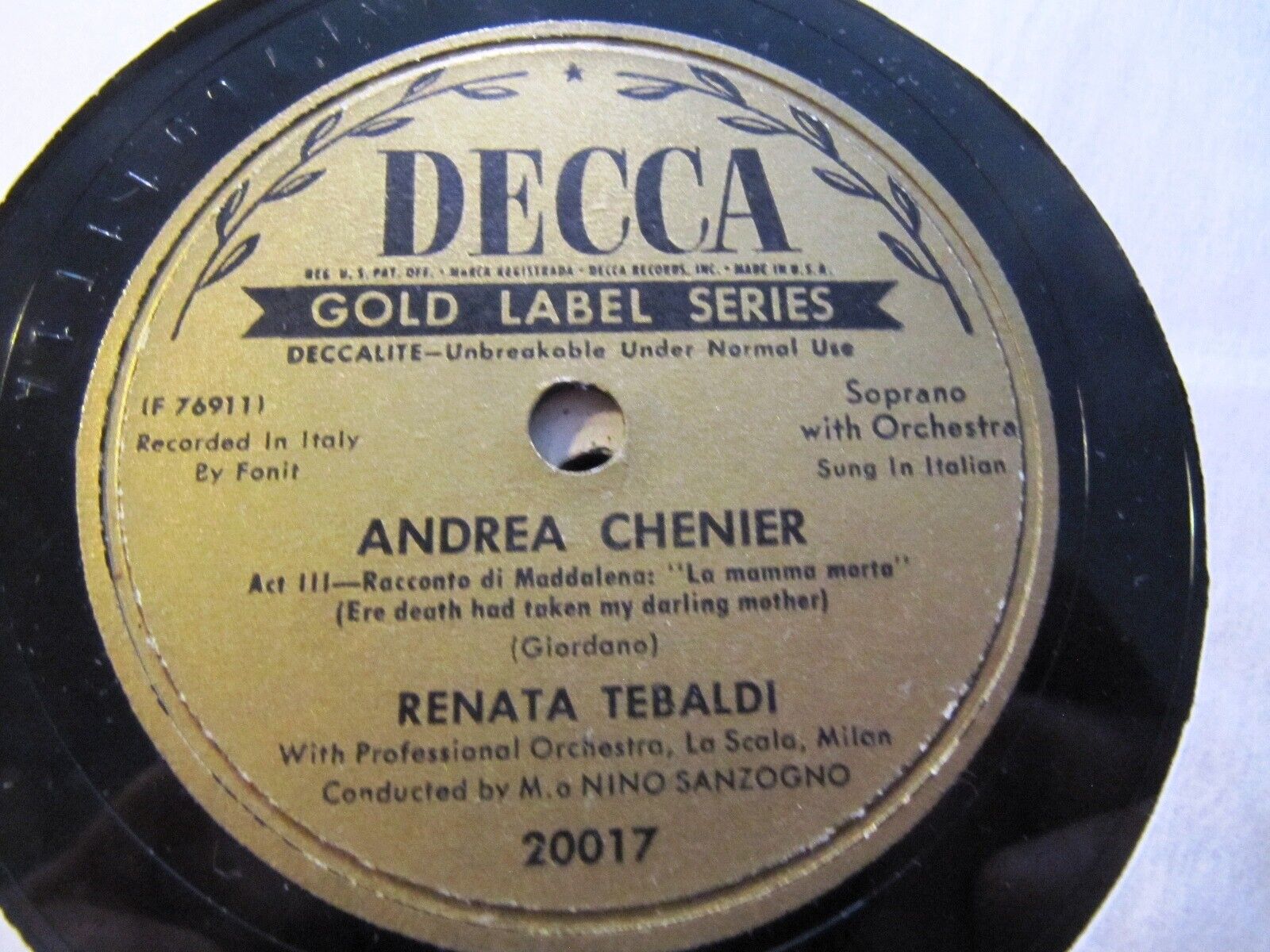
RENATA TEBALDI 1st REC La Wally / ANDREA CHENIER Mamma Morta Nino Sanzogno DECCA
$
30


Favourite Auctions
To save auctions to your favourites, please login
If you don't have an account, please register
Description
A series of great early Opera performances: From 1902 G&Ts to 40s wartime German records:
Renata Tebaldi's very first recordings at age 26 made in Milan in 1950
In La mamma morta from Andrea Chenier Tebaldi shows her fire. Here she is as vivid and dramatic as one could wish, whilst retaining her fine sense of line.
Alfredo CATALANI (1854 - 1893)
"Ebben? Ne andro lontana" (La Wally)
Umberto GIORDANO (1867 - 1948)
La mamma morta (Andrea Chenier) (1896)
Conductor – Nino Sanzogno
Orchestra – Proff. d' Orch. Del Teatro Alla Scala*
Soprano Vocals – Renata Tebaldi
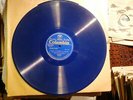
Orig US Issue Great Gold Label US Decca 12" 78 rpm record
EXCELLENT close to pristine light scuffs, tiny scratch does not sound , plays EXCEPTIONALLY quiet some ticks
AMAZING SINGING
A SUPERB COPY
In May 1946, when Milan’s venerable La Scala theatre reopened after World War II, conductor Arturo Toscanini selected Renata Tebaldi, then 24, to sing music by Rossini and Verdi for that watershed concert. ‘Ah, la voce d’angelo’ – the voice of an angel – was Toscanini’s reported verdict, In her heyday, she was known as ‘La Superba’. At the Metropolitan Opera, where she was utterly adored, she was, less poetically, ‘Miss Sold-Out’. Her stage career lasted some three decades, and she retired in 1976 at the comparatively early age of 54.The items on the 1949 recital were first issued by Decca on 78rpm, later collected on LP. The 1955 recital was issued on two ten-inch discs in February and May 1956, then issued collectively on an LP in November 1958.
Giulietta Simionato, the great mezzo-soprano, commented, ‘Hers was a voice we shall never hear again and none shall ever equal – and all thanks to Decca’, the record label with which she had an almost exclusive relationship. Her first studio recordings (tracks 1–6 here) were made in Geneva near the end of 1949. These were released on 78 rpm, and then on a long-playing record. Her first recordings of complete operas came in 1951, with Tosca, Madama Butterfly and La Bohème. Her conductor, for all of these sessions, was Alberto Erede, who, although only thirteen years older than Tebaldi, was experienced on the international scene. These signature roles, which also included Desdemona in Verdi’s Otello, were recorded twice (the second time in stereo), with little or no deterioration in her voice. The studio recitals from 1949 and 1955 are particularly valuable for their inclusion of arias from operas that Tebaldi never recorded in their entirety (Faust, Le nozze di Figaro, Lodoletta, Guglielmo Tell and Cecilia), although she sang all of these roles on stage.
Those who heard Tebaldi live remarked that her studio recordings did not do her full justice, but they were best-sellers for Decca, and continue to remain artistically and commercially viable today.
price rating