ROLLING STONES 1975 NERVOUS BREAKDOWN L.A. FRIDAY ***ORGINAL BOOTLEG LP VINYL***
$
50


Favourite Auctions
To save auctions to your favourites, please login
If you don't have an account, please register
Description
Rolling Stones L.A. Friday Bootleg
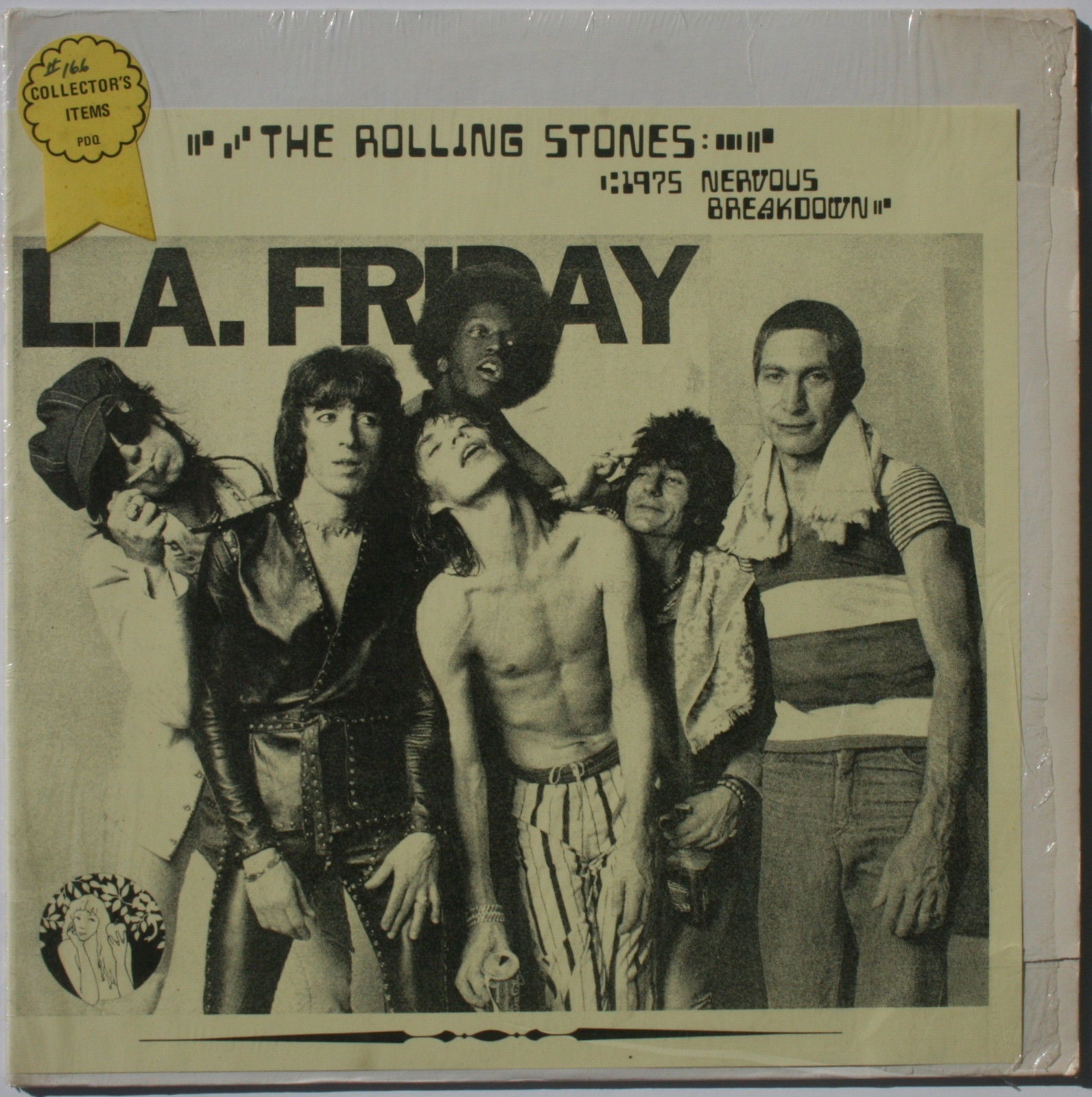
Rolling Stones - L.A. Friday: 1975 Nervous Breakdown
ORGINAL BOOTLEG VINYL ALBUM FROM THE LEGANDARY IDLE MIND PRODUCTIONS
The Album - The Rolling Stones' Tour of the Americas '75 was a concert tour originally intended to reach both North and South America. The plans for concerts in Central and South America never solidified, however, and the tour covered only the United States and Canada. The tour totaled 46 shows and started with a bang, the band playing on a flatbed truck driving down 5th Avenue in New York City, showcasing their new guitarist, Ronnie Wood. This was an interesting transition period for the Rolling Stones as Wood (he was not officially named a Rolling Stone until December 19, 1975) had recently replaced Mick Taylor who had left the band after a chat with Jagger at a December 1974 party at Robert Stigwood's. The July 9-13, 1975, performances of the tour were held at the L.A.'s Inglewood Forum and are arguably the most inspired and intense of the tour as the band seemed to take the high profile of the venue and the city quite seriously. Long time sidemen Bobby Keys and Jim Price on brass were not featured on this tour, being replaced by Billy Preston on keyboards and Ollie E. Brown (from Stevie Wonder’s band) on percussion. Bobby Keys made a guest appearance on "You Can't Always Get What You Want" (Track B1) and "Brown Sugar" (Track B3) at the Forum shows. Idle Mind Productions (one of the top bootleggers of the 1970's) released the Forum performances immediately after the tour on three separate bootleg vinyl LPs: 1) Who Went to Church This Sunday? 1975 Tour of the Americas, Pt. 1; 2) Charlie Watts and His Fabulous Rolling Stones: 1975 Tour of the Americas, Pt. 2; and 3) L.A. Friday: 1975 Nervous Breakdown, (basically this is 1975 Tour Of The Americas part three, although it was not labeled as such). In 1976, Idle Mind Productions reissued the three single albums as a 3 LP box, using the insert from the first release and blacking out “part one”: This listing is for the original third album. This album includes 10 tracks, five of which were recorded at the Forum, on July 13, and, three on July 10. Tracks 4 and 5 on side one were recorded at Baton Rouge, Louisiana, on June 1, 1975. The title of the album LA Friday is mis-titled as the major recordings were actually made on Thursday, July 10th and Sunday July 13th.
Vicki Vinyl and Idle Mind Productions - 1975 was quite a year for live show tapers and bootleggers. Led Zeppelin toured from January to March, Pink Floyd started their in April, and as did Rolling Stones' Tour of the Americas '75 from June 1, 1975 to August 8, 1975. The Sound Recording Amendment to U.S. copyright law which for the first time extended copyright protection to sound recordings was not adopted until October 19, 1976. The law combined both counterfeit and ‘pirate’ recordings in the same category as “misappropriated” recordings, “making bootlegs the legal equivalent of any pirate album containing commercially released material in alternative packaging” In addition, this law provided for the first time that the owner of any exclusive right (for example, mechanical reproduction) could now claim action for infringement. This right previously lay with the copyright owner of a work exclusively. As a result, record companies could now instigate legal proceedings without the cooperation of the artist.
Prior to the new law, Wizardo Records, John Wizardo ( (aka Jon Tschirgi) was a very serious rock bootleg collector of the very first generation, who hunted down copies of every bootleg released anywhere in the world up to the early 1970s - when he decided to start making his own instead. Although specializing in Beatles bootlegs Wizardo also released several Floyd titles. Apart from his main label, Wizardo also released albums on Fan-Buys Marketing, Old Glory Records & Dog & Cat Records. Later on he teamed up with a partner (Andrea Waters) known as Vicki Vinyl, who already had her own labels - Idle Mind Productions (IMP ), Teddy Bear records & Slipped Disc Records - and they produced some titles together.
Vicky Vinyl was able to secure copies of excellent audience recordings of the July 9-13, Rolling Stones performances that were held at the Forum that were made by local concert taper Mike Millard, who worked in the Audio Visual Department at Mt. San Antonio College in Orange County, CA. Her products clearly shows Vicky Vinyl’s love for the Rolling Stones band in every detail and stands high above any output from most of the contemporary bootleggers at that time. Vicky had a mail order business and owned a record store called Beggars Banquet located at the corner of Beach and Ball in Anaheim.
In December 1976, a whole bunch of people including Vicky Vinyl, a guy distributing Wizardo Records and a number of stores were busted by the FBI who eventually offered all sorts of deals to the defendants. The FBI's first attempt to suppress California's bootleg mini-industry had not been a resounding success. Vicky Vinyl had bounced back from her initial bust and kept making bootlegs. By 1978 she reissued older and pressed new releases on the Slipped Disc – Piste records labels, claiming to come out of France. It is report that by early 1979, she was responsible for something like 130 titles, She was basically a one women record company. On June 8 & 9, 1979 the FBI raided a commercial storage unit (E-1 at 1835 Whitter Blvd. Costa Mesa, CA) that contained 12 tons of underground records and recording paraphernalia, The unit had been rented by Andera Ellen Waters aka Andera Brown aka Vicki Vinyl. The FBI had been claimed to have been investigating Waters since August 28, 1974 when she reportedly was observed selling LP's from the trunk of her car in Goleta, CA.
In 1978 Waters had produced an album entitle Piece De Resistance and its companion triple album Live In the Promised Land. These albums led to a high-profile legal action, with Bruce Springsteen and CBS filing a civil suit in July 1979 against Vicki Vinyl (Andrea Waters), the bootlegger identified as responsible for both sets, and her associate, Jim Washburn, together with stores which had sold copies of the records. Having lost the suit, the two defendants (principally Waters) were ordered to pay $5,000 for copyright infringement and 43 times $50,000 for each violated music copyright, adding up to $2,150,000, CBS received $1,500 and court costs of $105,573. However, neither party could collect on the judgment as Waters and Washburn had already declared bankruptcy, aided by the relatively long time span between the FBI bust and CBS’ filing their civil suit for damages. Waters herself ceased production after these legal setbacks.
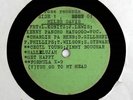
The Cover - The track listing, recording info & pictures consists of nothing more than a wraparound yellow paper photocopy that has been secured to the front and back of the album cover. Included on the cover is an image of the Idle Mind Productions, Inc. label. It is rumored that the female on the label is a likeness to Vicky Vinyl. Pictured on the from cover of the album, from left to right are, Bill Wyman, Ronnie Wood, Ollie Brown, Mick Jagger, Keith Richards and Charlie Watts. The rear of the album has a notation that the record should be played loud.
When Bootlegs Started: In late 1968 a couple of California teenagers stumbled upon several reels of tapes that have become known as Minnesota Hotel tapes. How they came to acquire these tapes has never exactly been explained and is the stuff of legend. Before the 1960's, record companies usually held onto all tapes from artists' recording sessions. But artists like Dylan and the Beatles took more control of the process of making records, recording where they felt like it, in a house in Woodstock, for example and the record labels lost control of the process. The tapes these two teenagers stumbled upon contained some previously unreleased Dylan songs and alternate versions of some songs that had already been released. Open-reel tape decks were expensive at the time, and beyond the budget of these kids, so they approached a record manufacturing plant to master and press the tapes in the lowest quantity allowed, which was 100 pieces.
In the 1960's, cassette tapes were not commonly available, and everyone had a turn-table, so it was not unusual for people to make records to pass on information as they do with tapes today. High school bands made records of their annual concerts and church groups made records of their favorite hymn performance. Pressing 100 records was considerably cheaper than buying a tape deck and at the time there was nothing illegal about it. The kids made these 100 Dylan records, thinking of them more as novelties rather than as albums per se. They gave them away to friends and soon friends of friends began to inquire about them. People began to offer money for the discs, which were packaged in a plain white sleeve. A record store approached the kids to ask if they could have 100 copies at $4 a piece. So the kids made 500 more, started to sell them for a couple of bucks each, and the modern American bootlegging industry was born. The record became known as "The Great White Wonder" and over the next decade it sold so many copies some claimed it should have made it onto the Bill-board charts.
The teenagers went on to form the Trade Mark of Quality (TMQ) record label and to become the biggest bootleggers in music history. Today The Great White Wonder is recognized as the first significant bootleg album. By the mid 1970's a whole host of smaller bootleg labels had sprung up including Rubber Dubber, Immaculate Conception Records (ICR), Contraband Music (CBM), Dittolino Discs, Kustom Records, Idle Mind Productions (IMP), K&S Records, Berkeley Records, Smilin' Ears, and Ze Anonym Plattenspeiler. Their product was a thick, black record in a white jacket. To simplify matters they are referred to in this text as White Cover Folks (WCF).
When bootlegging began in the late 1960's, it was not illegal. Those first copies of The Great White Wonder were sold in legitimate record stores over the counter and were stuck in the Dylan section in the records racks. In the early 1970's, every hip record store in town had stacks of bootlegs for sale, and many times they were cheaper and occasionally better than the regular record company releases. The law changed in February 1972, when the U.S. Congress passed a bill that outlawed the exhumation of pet cemeteries for the purpose of road construction. In an effort to quickly pass a law to deal with the increasing number of bootleg albums, the recording lobby persuaded Congress to attach an amendment to the pet cemetery bill making it a felony to manufacture bootleg, pirate, or counterfeit sound recordings for the purpose of resale. The law has been open to interpretation over the years and though court cases are still occasionally fought over the specifics of copyright infringement, bootlegging remains illegal.
What is a bootleg: It is important to distinguish between the different forms of music piracy. A "bootleg" is defined as an illegally manufactured disc or tape that includes previously unreleased live or studio recordings. A "pirate" is considered a copy of a commercially available recording that has been repackaged in its own unique packaging. A "counterfeit", finally, is a copy of a commercially available recording that duplicates all aspects of the original official copy, including the packaging. These distinctions are important because the perpetrators of each different level approach the project with a different intention. Pirates and counterfeits are usually made by professionals with the sole intent of high profits. Most bootlegs are manufactured by fans. Even the Recording Industry Association of America (RIAA), the body that actually takes bootleggers to court) admits that bootlegging is small potatoes compared to the millions of dollars in losses record companies face from pirates and counterfeits. Usually the RIAA does not distinguish between the various forms of bootlegging when they report on raids or actions they have taken, so when you read about 100,000 records being seized they usually aren't talking about copies of The Great White Wonder.
Vinyl LP Album Details:
Release Date in US: 1975
Record Date: June 1, July 10 and July 13, 1975
price rating


![Pedro Infante Flor Sin Retoño [1964] Vinyl LP Latin Mariachi Ranchera Peerless](https://www.popsike.mobi/php/thumbnail.php?url=https://www.popsike.pics/pix/20230531/115820312952.jpg)


![J.R.R. Tolkien's The Lord Of The Rings [VINYL] Leonard Rosenman Vinyl](https://www.popsike.mobi/php/thumbnail.php?url=https://www.popsike.pics/pix/20181212/392192065671.jpg)