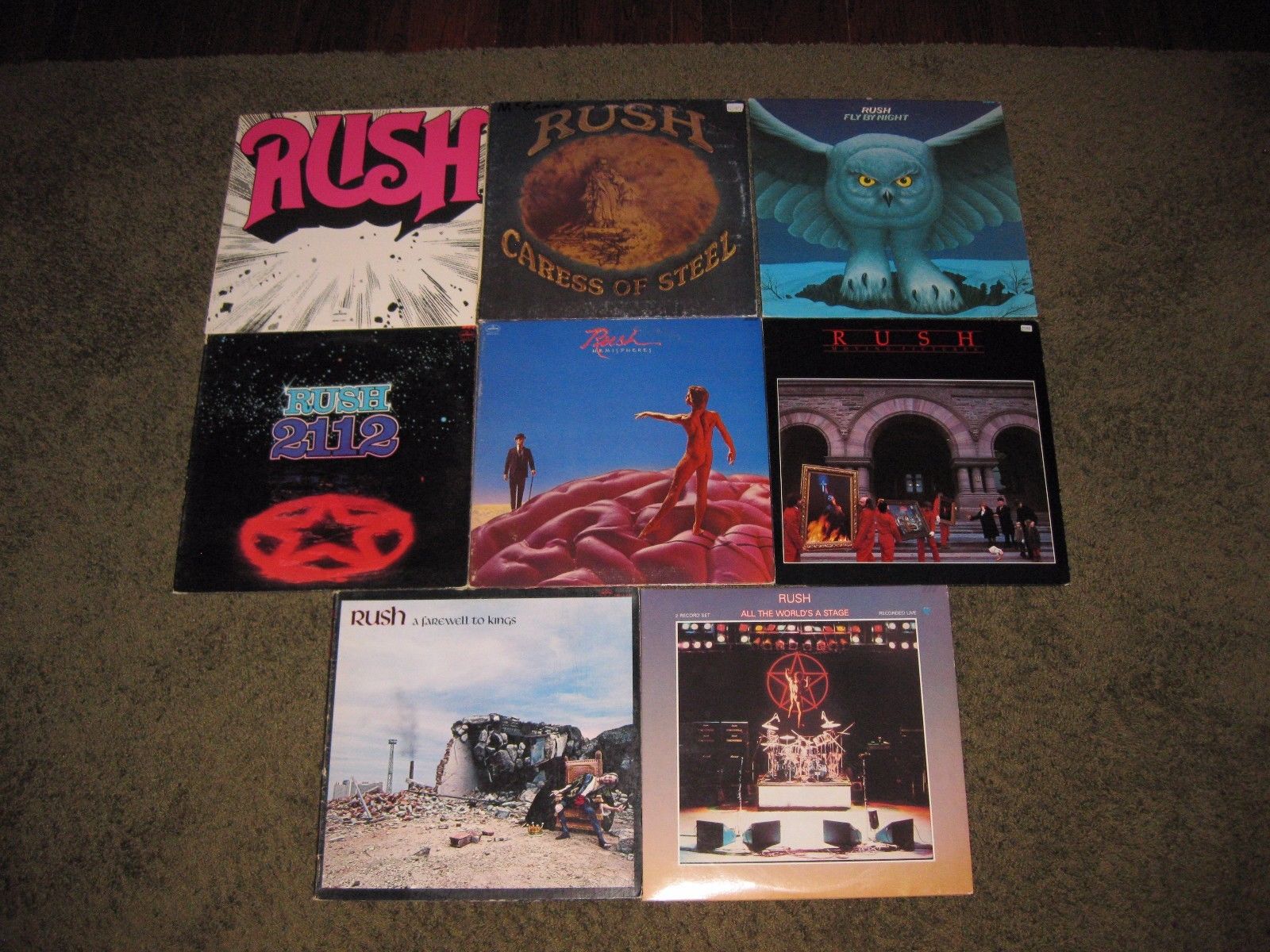
RUSH - All 8 LP's - Vinyl From Excellent to VG - Jackets From Excellent To Good
$
52


Favourite Auctions
To save auctions to your favourites, please login
If you don't have an account, please register
Description
Rush - Rush, All The World's A Stage, 2112, Fly By Night, Caress Of Steel, A Farewell To Kings, Moving Pictures, Hemispheres. All 8 Awesome Albums From Rush. Some Argue The Best 3 Piece Band Of All Time. Jackets And Vinyl Are EX To VG Except Farewell To Kings That Has A Jacket In Pretty Rough Condition On The Back As Shown In Photos.
1968–1976: Blues and hard rock years[edit]
The original line-up formed in the neighbourhood of Willowdale in Toronto, Ontario, by guitarist Alex Lifeson, bassist and front man Jeff Jones, and drummer John Rutsey. Within a couple of weeks of forming, and before their second performance, bassist and lead vocalist Jones left the band and was replaced by Geddy Lee, a schoolmate of Lifeson's. After several line-up reformations, Rush's official incarnation formed in May 1971 consisting of Lee, Lifeson, and Rutsey. The name "Rush" was suggested by John Rutsey's brother, Bill.[7] The band was managed by local Toronto resident Ray Danniels, a frequent attendee of Rush's early shows.[8][9]
After gaining stability in the line-up and honing their skills on the local bar and high school dance circuit, the band members released their first single "Not Fade Away", a cover of the Buddy Holly song, in 1973. Side B contained an original composition, "You Can't Fight It", credited to Lee and Rutsey. The single generated little reaction (#99 on the RPM charts) and, because of record company indifference, the band formed their own independent record label, Moon Records.
With the aid of Danniels and the newly enlisted engineer Terry Brown, the band released its self-titled debut album in 1974, which was considered highly derivative of Led Zeppelin.[10] Rush had limited local popularity until the album was picked up by WMMS, a radio station in Cleveland, Ohio. Donna Halper, a music director and DJ working at the station, selected "Working Man" for her regular playlist. The song's blue-collar theme resonated with hard rock fans, and this newfound popularity led to the album being re-released by Mercury Records in the U.S.[11]
Immediately after the release of the debut album, Rutsey left the band due to health difficulties stemming from diabetes, and his distaste for touring. His last performance with the band was on July 25, 1974, at Centennial Hall in London, Ontario. Rush held auditions for a new drummer and selected Neil Peart as Rutsey's replacement. Peart officially joined the band on July 29, 1974, two weeks before the group's first US tour. They performed their first concert together, opening for Uriah Heep and Manfred Mann with an attendance of over 11,000 people at the Civic Arena in Pittsburgh, Pennsylvania on August 14. In addition to becoming the band's drummer, Peart assumed the role of principal lyricist from Lee, who had very little interest in writing, despite having penned the lyrics of the band's first album.[12] Lee and Lifeson focused primarily on the instrumental aspects of Rush. Fly by Night (1975), Rush's first album after recruiting Peart, saw the inclusion of the band's first epic mini-tale "By-Tor and the Snow Dog", replete with complex arrangements and a multi-section format. Lyrical themes also underwent dramatic changes because of Peart's love for fantasy and science-fiction literature.[13] Despite these many differences, some of the music and songs still closely mirrored the blues style found on Rush's debut.[8][13]
The band followed Fly by Night quickly with Caress of Steel (1975), a five-track album featuring two extended multi-chapter songs, "The Necromancer" and "The Fountain of Lamneth". Some critics said Caress of Steel was unfocused and an audacious move for the band because of the placement of two back-to-back protracted songs, as well as a heavier reliance on atmospherics and story-telling, a large deviation from Fly by Night.[15] Intended to be the band's break-through album, Caress of Steel sold below expectations and the promotional tour consisted of smaller venues, which led to the moniker the "Down the Tubes Tour".[16]
In light of these events, Rush's record label tried to pressure the members into moulding their next album in a more commercially friendly and accessible fashion; the band ignored the requests and developed their next album 2112 with a 20-minute title track divided into seven sections. Despite this, the album was the band's first taste of commercial success and their first platinum album in Canada.[17] The supporting tour culminated in a three-night stand at Massey Hall in Toronto, which the band recorded for the release of their first live album, All the World's a Stage. AllMusic critic Greg Prato notes the album demarcates the boundary between the band's early years and the next era of their music.[18][19]
1977–1981: Progressive era[edit]
After 2112, Rush went to the United Kingdom to record A Farewell to Kings (1977) and Hemispheres (1978) at Rockfield Studios in Wales. These albums saw the band members expanding the progressive elements in their music. "As our tastes got more obscure", Lee said in an interview, "we discovered more progressive rock-based bands like Yes, Van der Graaf Generator and King Crimson, and we were very inspired by those bands. They made us want to make our music more interesting and more complex and we tried to blend that with our own personalities to see what we could come up with that was indisputably us."[20] Increased synthesizer use, lengthy songs, and highly dynamic playing featuring complex time signature changes became a staple of Rush's compositions. To achieve a broader, more progressive sound, Lifeson began to experiment with classical and twelve-string guitars, and Lee added bass-pedal synthesizers and Minimoog. Likewise, Peart's percussion became diversified in the form of triangles, glockenspiel, wood blocks, cowbells, timpani, gong, and chimes. Beyond instrument additions, the band kept in stride with the progressive rock trends by continuing to compose long, conceptual songs with science fiction and fantasy overtones. As the new decade approached, Rush gradually began to dispose of its older styles of music in favour of shorter and sometimes softer arrangements. The lyrics up to this point were heavily influenced by classical poetry, fantasy literature, science fiction, and the writings of novelist Ayn Rand, as exhibited most prominently by their 1975 song "Anthem" from Fly By Night and a specifically acknowledged derivation in 2112 (1976).[21]
Permanent Waves (1980) shifted Rush's style of music with the introduction of reggae and new wave elements.[22] Although a hard rock style was still evident, more synthesizers were introduced. Moreover, because of the limited airplay Rush's previous extended-length songs received, Permanent Waves included shorter, more radio-friendly songs such as "The Spirit of Radio" and "Freewill", two songs that helped Permanent Waves become Rush's first US Top 5 album.[23] Meanwhile, Peart's lyrics shifted toward an expository tone with subject matter that dwelled less on fantastical or allegorical story-telling and more heavily on topics that explored humanistic, social, and emotional elements. Rush joined with fellow Toronto-based rock band Max Webster on July 28, 1980, to record "Battle Scar" for their 1980 release, Universal Juveniles.[24] Max Webster lyricist Pye Dubois offered the band lyrics to a song he had written. The band accepted; the song went on, after reworking by Peart, to become "Tom Sawyer".[24]
Rush's popularity reached its pinnacle with the release of Moving Pictures in 1981. Moving Pictures essentially continued where Permanent Waves left off, extending the trend of accessible and commercially friendly progressive rock that helped thrust them into the spotlight. The lead track, "Tom Sawyer", is probably the band's best-known song[25] with "Limelight" also receiving satisfactory responses from listeners and radio stations. Moving Pictures was Rush's last album to feature an extended song, the eleven-minute "The Camera Eye". The song also contained the band's heaviest usage of synthesizers yet, hinting Rush's music was shifting direction once more. Moving Pictures reached No. 3 on the Billboard 200 album chart and has been certified quadruple platinum by the Recording Industry Association of America.[26]
Following the success of Moving Pictures and having completed another four studio albums, Rush released a second live recording, Exit...Stage Left, in 1981.price rating