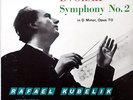
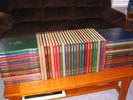
Rachmaninoff SYMPHONY No. 3 Classic Records BOULT/LSO 45 rpm 4 x Lacquers EXC
$
230


$ 230
Sold For
Oct 21, 2025
Sold Date
Sep 28, 2025
Start Date
1
Number Of Bids
USA
Country Of Seller
eBay
Sold at
Favourite Auctions
To save auctions to your favourites, please login
If you don't have an account, please register
Description
Rachmaninoff Symphony No. 3 / Russian Easter Overture Classic Records LSC-2185-45 45rpm 4 x Lacquers Bernie Grundman Excellent
Label:
Classic Records LSC-2185-45Series:
Living StereoFormat:
Lacquers x 4, 12", Reissue, Remastered, Stereo, Test PressingsCountry:
USReleased:
1994Genre:
ClassicalStyle:
RomanticTracklist:
Symphony No. 3, In A Minor, Op. 44 Composed By – Sergei Vasilyevich Rachmaninoff A1 Lento A2 Adagio Ma Non Troppo
B1 Allegro B2 Russian Easter Overture Composed By – Nikolai Rimsky-Korsakov
- Manufactured By – Classic Records
- Conductor – Sir Adrian Boult
- Orchestra – London Philharmonic Orchestra
- Sleeve Notes – Helen H. Less
- Recorded in England
- Engineered by Kenneth Wilkinson
- Lacquers cut by Bernie Grundman
- Matrix / Runout ( Side A Runout Etched): LSC-2185-A1-45 Bernie Grundman (signature)
- Matrix / Runout ( Side A Runout Etched): LSC-2185-A2-45 Bernie Grundman (signature)
- Matrix / Runout ( Side A Runout Etched): LSC-2185-B1-45 Bernie Grundman (signature)
- Matrix / Runout ( Side A Runout Etched): LSC-2185-B2-45 Bernie Grundman (signature)
RACHMANINOV: SYMPHONY No. 3 in A minor, Op.44 Rachmaninov’s Third Symphony has been widely written off as a failure, yet in recent years his youthful First has been hailed as one of the finest of all Russian symphonies. This is an ironical situation. Rachmaninov as a composer was beset with self doubts, but in the case of his Third Symphony he was, for once, thoroughly satisfied and convinced of its worth, notwithstanding the poor*reception it received from both public and critics on its first and subsequent performances. His attitude towards his First Symphony was very different. Following its first and very bad performance, which took place at St. Petersburg early in 1897 under Glazunov’s direction, he refused to allow it to be played again, and eventually destroyed the manuscript. Only after his death was the score re-constructed from the orchestral parts that were found in the archives of the Leningrad Conservatory. Completely ignoring the composer’s own opinions critics of the Third have spoken of its lack of compulsion; while admitting its technical mastery—especially as regards the orchestration—they came to the conclusion that by 1936 the composer’s powers had deserted him and that he had no longer anything of significance to say; accordingly he merely trotted out his old ideas in a more sophisticated setting, hoping that this would conceal the absence of any real musical purpose. Recently Rachmaninov’s music has come in for a certain amount of re-valuation, and, with more attention being paid to the later and less popular large scale works, the myth about the composer’s declining powers has. been largely exploded. To many musicians the last of the three symphonies is also the finest. Rachmaninov’s career is readily divisible into two periods, the line between them being the year 1917, when he left his native Russia for ever. Up to that time he had forty works to his credit, excluding small and unpublished pieces. During the remaining twenty-six years of his life he produced only six further compositions, and none at all for ten years. The main reason for this was his commitments as an executant—he was one of the finest pianists of his age. The first composition after his departure from Russia was his Fourth Piano Concerto (1927, but revised later); it did not and still has not achieved anything like the success of the Second and Third Concertos, and it was largely responsible for the widespread view that the composer had written himself out. Then came the Three Russian Songs for choir and orchestra (1930), which have remained very little known; the Variations on a Theme by Corelli for piano (1932); the Rhapsody on a Theme of Paganini for piano and orchestra (1934); the Third Symphony (1936); and the Symphonic Dances for orchestra (1941). The Corelli Variations raised hopes that the composer would still produce a work worthy of being placed beside the Second and Third Concertos, and these hopes were fulfilled by the Rhapsody, which by and large is typical Rachmaninov. Not so the Third Symphony or the Symphonic Dances, which seemed to follow in the path of the unpopular Fourth Concerto. One, and probably the main, reason for the Third Symphony’s sour reception initially is that admirers of composers hate to see them change course. Rachmaninov was no modernist, and he was out of sympathy with most of the technical innovations of his day; but this is not to say that he stood still as a composer. That he should have left his public behind is the more understandable in view of his period of silence. The differences between the Second and Third Symphonies are considerable, but they are no greater than one would expect to find between two works separated by a distance of thirty years. Naturally the Third contains the composer’s finger prints, but gone is his characteristic brand of pessimistic romanticism. In its place is to be found a more objective approach, coupled at times with a more pungent harmonic idiom that we do not normally associate with the composer. The Third Symphony gains over its predecessor through being more concise, and by having more transparent and more colourful orchestration. Particularly concise is the first of the three movements. It begins with a motto theme stated in unison by two clarinets, a muted horn and a solo muted cello—an unusual and elusive piece of colouring. This is a typical Rachmaninov utterance centering around a single note—in fact it consists only of this note and its neighbours above and below—but the role it plays is relatively small, and certainly far less important than the one allotted to the motto in the Second Symphony. The change of tempo from Lento to Allegro moderato comes during the short introduction and not at the end of it, as one would expect. There follows a fairly regular sonata-form movement with an unusually short exposition. The second subject is one of those ‘big’ Rachmaninov themes, but it is not worked out into a typical Rachmaninov climax; instead it becomes forceful and has most of the sentiment knocked out of it when it is handed over to the brass—no wonder the first audiences were disappointed! The second movement combines the functions of both a slow one and a scherzo, the latter forming the central panel. A solo horn begins with a variant of the motto, the accompaniment being provided by a harp. Then several short sections introduce a succession of ideas, the most important of which are the theme for solo violin and the one announced by a solo flute before being handed over to the bass clarinet. It is from the flute theme that much of the first part of the movement derives. For instance, it is taken up at twice the speed by the violins, while later the cellos form an expressive melody from it. The lively scherzo section is notable for its delicacy—a solo trumpet and percussion instruments are used quietly with great effect, and there is an important part for the celesta. The recapitulation of the first part of the movement is much condensed and varied. There is only a brief, but most expressive, reference to the flute theme, the one first announced by the violin now dominating. Rachmaninov wrote no finer symphonic movement. The finale is somewhat enigmatic, mainly because of its extraordinary and unexpected coda, which greatly increases the rhapsodic impression and gives the movement the feel of a symphonic poem. A whole series of ideas are stated during the course of the first section, which corresponds to, although it is far from being, a normal exposition. The most important theme is the first, for in the central or development section it becomes the basis of a lengthy fugato. Again the recapitulation is shortened and varied, but then comes the coda, introducing ideas and textures that are in marked contrast to the rest of the movement.
RUSSIAN EASTER OVERTURE, Op. 36 Rimsky-Korsakov (1844-1908) composed music which belongs to the period dominated by ‘The Five’, his contemporaries being Balakirev, Borodin, Cui and Mussorgsky. His music has a strong national flavour, is colourful, boisterous, and characterised by rich, expressive orchestration. He often chose liturgical bases for his works, as in this overture. The opening theme, on which the overture is built, is a melody of the Russian Church. This opening theme is given first to the woodwind and later taken up by other sections of the orchestra. There is a central passage in which the percussion, including glockenspiel, cymbal, bass drum and gong, play a large part. The gong is used to imitate a deep toned bell. There is a long Coda and the work ends after a vigorous restatement of the second theme.
price rating