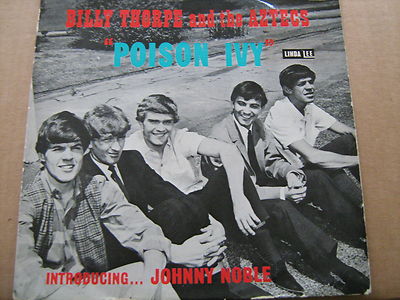
Rare Billy Thorpe & Aztecs LP POISON IVY (b-side is Johnny Noble & The Mods)
A$
39
$
26


Favourite Auctions
To save auctions to your favourites, please login
If you don't have an account, please register
Description
You might also be interested in an EP signed by the 4 original Aztecs ( Vince Melouney, Col Baigent,Tony Barber & Johnny Watson....also listed for sale...in another of my auctions).
MONAURAL ( Calendar Records) R66-53.
Side 1 is Billy Thorpe & The Aztecs and side 2 is Johnny Noble ( and boy..oh boy...does he go alright!!). Some aging of the cover...but still fantastic and some light scratches on the vinyl..more on the b-side..but from memory ( played this awhile back now)..it plays and sounds great!!
MULTIPLE LPS GOING TOGETHER ARE POSTED FOR $12 IN AUSTRALIA...no matter how many you buy. Postal discounts for combined lots overseas as well.
Poison Ivy, Broken Things,Blue Day,You Don't Love Me,Smoke and Stack,Board Boogie~side 1. Ruby Baby,That'll Be All Right,This Little Girl,Mean Women Blues,Be Bop A Lula,It's All In The Game~Side 2 ( Johnny Noble & The Mods).
Using the numbered gradings I work with..this record is 7.5-8/10 on the vinyl and 7.5-8/10 on cover .
... my gradings are visual and a full refund ( plus postage) will be given...if the playing quality is defect.
REVIEW: Micko
You might even say Introducing Billy Thorpe & The Aztecs too as this was the first album to bear their name. However by this stage, after just 2 singles including a monster #1 hit (Blue Day & Poison Ivy), the band had left the small independent Linda Lee label for greener pastures at Parlophone. So what to do?
The Aztecs had released a single before Billy & Tony Barber had joined called "Smoke & Stack" b/w "Board Boogie". Combined with both sides of the above Billy fronted singles that took care of side one for Festival/Linda Lee.
But how about Side 2? Well with the Beatles hitting big & instrumental bands fading away, when the Aztecs were first looking for a singer to front the band, they chose Johnny Noble. He made several concert appearances with them & had even started recording with The Aztecs. However Noble soon decided he wanted to go it alone. So Festival simply used some Johnny Noble tracks for the 2nd side of the album.
Now it get's confusing tho. On one of his singles also included on this album, backing is credited to The Mods, as is one other track here. The others are with the ATN Orchestra & Choir. What I don't know is whether "The Mods" are in fact The Aztecs under a pseudonym.
Another interesting point is that despite Johnny isssuing 6 singles on Linda Lee, only one "That'll Be Alright/"This Little Girl" is included here. The other tracks are the rock standards Mean Woman Blues (also with "The Mods"), Ruby Baby, Be Bop A Lula & It's All In The Game. His only charting single "Lonely City" is not included.
COMMENT: From Wikipedia, the free encyclopedia
Beginning
Originally a four-piece instrumental group who had put out one surfing instrumental, "Smoke & Stack", they formed in Sydney in 1963. With the advent of the Merseybeat sound, they added a lead singer, Billy Thorpe. His powerful voice and showmanship (which made him one of the most popular and respected rock performers in Australian music), completed the original line-up, which consisted of drummer Col Baigent, bassist John "Bluey" Watson and guitarists Tony Barber and Vince Maloney (who later played with The Bee Gees).
Chart success
The group broke through in mid-1964 with a massive nationwide hit, their cover of the Leiber and Stoller classic "Poison Ivy", which famously ousted The Beatles from the #1 spot on the Sydney charts at the very moment that the group was making its first and only tour of Australia -- a feat which resulted in Thorpe being invited to meet the Fab Four at their hotel. Over the next twelve months the band reigned supreme as the most popular 'beat' group in Australia, scoring further hits with the songs "Mashed Potato", "Sick And Tired" and "Somewhere Over the Rainbow", until they were eclipsed by the emergence of The Easybeats in 1965.
During 1965 the original Aztecs quit after a financial dispute, so Thorpe put together a new five-piece version consisting of drummer Johnny Dick, pianist Jimmy Taylor, guitarists Col Risby and Mike Downes and NZ-born bassist Teddy Toi. This group performed until 1966, scoring further hits with "Twilight Time", "Hallelujah I Love Her So", "Love Letters" and "Word For Today".
Thorpe went solo in 1967 and for a brief time he hosted his own TV pop show, It's All Happening, but personal problems and a widely publicised bankruptcy brought this phase of his career to an end in 1968. but then as he went solo he became more of an outcast
New Style, New Lineup
In 1969 Thorpe decided to try England, after being offered a recording deal by the Australian-born, London-based impresario Robert Stigwood, who had risen to become manager of The Bee Gees and Cream. While rehearsing a backing band in Melbourne that would form the basis for a new Aztecs, the guitarist unexpectedly dropped out, leaving Thorpe to assume lead guitar role at short notice. It marked another turning point in his career and from this point on Thorpe played lead guitar in The Aztecs as well as continuing as lead vocalist. His planned six-week stay in Melbourne soon stretched into months and eventually Thorpe decided to remain in Australia and re-launch his career.
Thorpe himself openly acknowledges that this new 'heavy' version of the Aztecs owes much to 'guitar hero' Lobby Loyde. Lloyde already had a cult following due to his stints in two of the most original Australian bands of the Sixties, The Purple Hearts and The Wild Cherries. While his stint in the new Aztecs was short (only a few months), his musical influence proved crucial in steering Thorpe in a completely new direction, and he strongly encouraged Thorpe to keep playing guitar.
The new Aztecs' blues-based heavy-rock repertoire was dramatically different in style from the original group, and they quickly became famous (or notorious) for the ear-splitting volume at which they played. Thorpe had also drastically changed his appearance -- he grew a beard, often wore his now shoulder-length hair braided in a pigtail, and he had long since traded the tailored suits for jeans and t-shirts. Needless to say this did not endear to people who came to the shows expecting the 'old' Billy Thorpe of the "Poison Ivy" era, and this led to sometimes violent confrontations with disgruntled fans and promoters.
Their breakthrough recording was an ambitious album, The Hoax Is Over, recorded in September 1970 with new drummer Kevin Murphy. The album was an unequivocal signal of the Aztecs' new direction, containing only four tracks, three of which were Thorpe originals. The LP is dominated by two extended tracks: a version of Johnny "Guitar" Watson's "Gangster Of Love", which clocked in at 24:35 and ran the entire length of Side 1 (an unprecedented move in Australian pop music) and Thorpe's own "Mississippi" which ran 19'35". According to Thorpe, the band (which at this time comprising himself, Murphy, pianist Warren Morgan, guitar legend Lobby Loyde and bassist Paul Wheeler), were all high on LSD and jammed continuously while engineer Ernie Rose just let the tapes roll. The result heralded the fully-fledged arrival of the new Aztecs and live shows at Melbourne venues consolidated the band's reputation and drew enthusiastic responses
With my gradings, sing out if you prefer the goldmine index..but to line up the score out of 10..
10/10 would be mint
9/10 would be near mint
8.5/10 VG+
8/10 VG
7.5/10 VG-
7/10 Good
6/10 Fair
5/10 Poor
"MINT: The record itself is in brand new condition with no surface marks or deterioration in sound quality. The cover and any extra items such as the lyric sheet, booklet or poster are in perfect condition. Records advertised as Sealed or Unplayed should be Mint. = 10/10
EXCELLENT: The record shows some signs of having been played, but there is very little lessening in sound quality. The cover and packaging might have slight wear and / or creasing. ( or NEAR MINT= 9/10)
VERY GOOD: The record has obviously been played many times, but displays no major deterioration in sound quality, despite noticeable surface marks and the occasional light scratch. Normal wear and tear on the cover or extra items, without any major defects, is acceptable. ( 8/10 OR 8.5/10 IF VG+)
GOOD: The record has been played so much that the sound quality has noticeably deteriorated, perhaps with some distortion and mild scratches. The cover and contents suffer from folding, scuffing of edges, spine splits, discolouration, etc. (7/10)
FAIR: The record is still just playable but has not been cared for properly and displays considerable surface noise; it may even jump. The cover and contents will be torn, stained and / or defaced. (6/10)
price rating