Raymond Scott Brown-Forman Distillers Rare Promo LP NEW SEALED A Man Called
$
36


Favourite Auctions
To save auctions to your favourites, please login
If you don't have an account, please register
Description
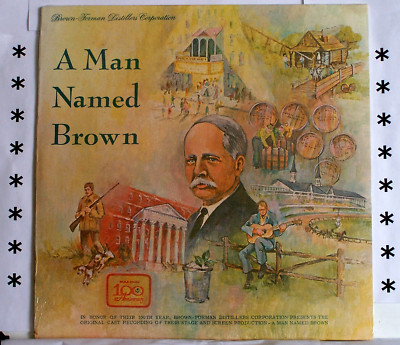
A Man Named Brown : Centennial 100th Birthday : Double-Golden Anniversary
New Sealed 12" Vinyl Album : 1970 Brown-Forman Corporation
Composer, bandleader, and inventor Raymond Scott was among the unheralded pioneers of contemporary experimental music, a figure whose genius and influence have seeped almost subliminally into the mass cultural consciousness. As a visionary whose name is largely unknown but whose music is immediately recognizable, Scott's was a career stuffed with contradictions: though his early work anticipated the breathless invention of bebop, his obsession with perfectionism and memorization was the very antithesis of jazz's improvisational ethos; though his best-known compositions remain at large thanks to their endless recycling as soundtracks for cartoons, he never once wrote a note expressly for animated use; and though his later experiments with electronic music pioneered the ambient aesthetic, the ambient concept itself was not introduced until a decade after the release of his original recordings. Born Harry Warnow in Brooklyn in 1908, he was a musical prodigy, playing piano by the age of two; following high school, he attended the Institute of Musical Art, later rechristened the Juilliard School. After graduating in 1931, Scott signed on as a staff pianist with the CBS radio network house band conducted by his brother; finding the repertoire dull and uninspired, he began presenting his own compositions to his bandmates, and soon bizarre Scott originals like "Confusion Among a Fleet of Taxicabs Upon Meeting with a Fare" began creeping into broadcasts. Scott remained a member of the CBS band until 1936, at which time he convinced producer Herb Rosenthal to allow him the chance to form his own group; assembling a lineup originally comprised of fellow network veterans Lou Shoobe on bass, Dave Harris on tenor saxophone, Pete Pumiglio on clarinet, Johnny Williams on drums, and the famed Bunny Berigan on trumpet, he dubbed the group the Raymond Scott Quintette, debuting on the Saturday Night Swing Session with the song "The Toy Trumpet." For all of Scott's eccentricities, his records flew off the shelves, their dadaist titles ("Dinner Music for a Pack of Hungry Cannibals," "Reckless Night on Board an Oceanliner," and "Boy Scout in Switzerland"), juxtaposed melodies, odd time signatures, and quirky arrangements somehow connecting with mainstream American audiences. Hollywood soon came calling, with the Quintette performing music for (and sometimes appearing in) features including Nothing Sacred, Ali Baba Goes to Town, and Rebecca of Sunnybrook Farm. In 1941, Warner Bros.' fledgling animation department bought the rights to Scott's back catalog, with music director Carl Stalling making liberal use of the melodies in his groundbreaking cut-and-paste cartoon soundtracks; Quintette favorites like the rollicking "Powerhouse" soon became immediately recognizable for their regular appearances in classic Bugs Bunny, Daffy Duck, and Porky Pig clips, the same music supporting the crazed antics of Ren & Stimpy and others half a century later. In 1945, Scott wrote incidental music for the Broadway production Beggars Are Coming to Town; the year following, he teamed with lyricist Bernard Hanighen on the musical Lute Song, which yielded another of his best known songs, "Mountain High, Valley Low." Also in 1946, Scott founded Manhattan Research, the world's first electronic music studio; housing equipment including a Martenot, an Ondioline, and a specially modified Hammond organ, it was advertised as "the world's most extensive facility for the creation of Electronic Music and Musique Concrete." After his brother Mark's 1949 death, Scott took over his duties as the bandleader on the syndicated radio favorite Your Hit Parade, with his second wife Dorothy Collins soon assuming the position as the program's featured vocalist; that same year, he also scored theatrical productions of Peep Show and Six Characters in Search of an Author. Of all of Scott's accomplishments of 1949, however, none was more important than the Electronium, one of the first synthesizers ever created. An "instantaneous composing machine," the Electronium generated original music via random sequences of tones, rhythms, and timbres; Scott himself denied it was a prototype synthesizer, it had no keyboard, but as one of the first machines to create music by means of artificial intelligence, its importance in pointing the way towards the electonic compositions of the future is undeniable. His other inventions included the "Karloff," an early sampler capable of re-creating sounds ranging from sizzling steaks to jungle drums; the Clavinox, a keyboard Theremin complete with an electronic sub-assembly designed by a then 23-year-old Robert Moog; and the Videola, which fused together a keyboard and a TV screen to aid in composing music for films and other moving images. In addition to hosting Your Hit Parade, Scott continued recording throughout the '50s, issuing LPs including This Time with Strings, At Home with Dorothy & Raymond, and Rock 'N' Roll Symphony. Additionally, he cranked out advertising jingles at an astonishing rate, scored countless film and television projects, and even founded a pair of record labels, Audiovox and Master, while serving as A&R director for Everest Records. During the mid-'50s, Scott assembled a new Quintette; the 1962 edition of the group was its last. The year following, he began work on the three-volume LP set Soothing Sounds for Baby, an "aural toy" designed to create a comforting yet stimulating environment for infants. As electronic music produced to inspire and relax, the records fit snugly into the definition of ambient suggested by Brian Eno a decade later, their minimalist dreamscapes also predating Philip Glass and Terry Riley. By the middle of the '60s, Scott began turning increasingly away from recording and performing to focus on writing and inventing; a 1969 musical celebrating the centennial of Brown-Forman Kentucky Bourbon was his last orchestral work, with his remaining years spent solely on electronic composition. Among his latter-day innovations was an early programmable polyphonic sequencer, which along with the Electronium later caught the attention of Motown chief Berry Gordy, Jr., who in 1971 tapped Scott to head the label's electronic music research and development team. After retiring six years later, he continued writing, his last known piece, 1986's "Beautiful Little Butterfly," was created on MIDI technology. By 1992, Scott's music was finally rediscovered by contemporary audiences, with the Reckless Nights & Turkish Twilights compilation appearing to great acclaim; he died in 1994 at the age of 85. (web bio)
The Brown-Forman Corporation is one of the largest American-owned companies in the spirits and wine business. Some well-known brands of the corporation include Jack Daniel's, Southern Comfort, Finlandia Vodka, Woodford Reserve Bourbon, Canadian Mist, Early Times, Old Forester, Korbel champagne, Fetzer wine. The company was founded in 1870 by George Garvin Brown, a young pharmaceuticals salesman in Louisville, who had the then-novel idea of selling top-grade whiskey in sealed glass bottles. Since then, it has grown into a company that in fiscal 2006 had sales of $2.4 billion. The Brown family controls more than 70% of the voting shares. (web bio)
This rare album, A Man Called Brown, is the 1970 Raymond Scott soundtrack to a film featuring a studio orchestra and vocals by students of the University of Louisville. The show was created on assignment by Raymond Scott to celebrate the 100th anniversary of the Louisville Kentucky distiller "Brown-Forman". Side one features Scott replicating the big cast-show style of the time, including 'Bourbon, Bourbon', 'Make Mine Kentucky', and more. Side two is where Scott falls into his beloved eccentricity, covering a range of styles, including a mod/psych/funk instrumental, 'Louisville Today', the cartoon-ish 'Speak Low, Speak Easy', the bluegrass flavor of 'Paddlin' Wheels', and the visionary, 'Tomorrow Is Now'. The LP was only available as a promotional premium in 1970 and is a very rare item for Raymond Scott completists. (web review)
Album description: This excellent 12-track album is new and sealed, very clean and flat, no cut-outs or punch holes. Released 41 years ago. Made in the USA. Check out our store listings for more sealed albums along with a wide variety of LP's, 45's, cassettes, CD's, magazines, books and more, everything reasonably priced. We ship worldwide in very secure packaging and shipping costs will be combined on multiple purchases. Any questions, please email us.
Tracklist:
1. Overture
2. Say It Again
3. Bourbon, Bourbon
4. Make Mine Kentucky
5. To My Louisville
6. Welcome Home
7. Great Men In Town
8. Speak Low, Speak Easy
9. Louisville Today
10. Paddlin' Wheels
11. Tomorrow Is Now
12. Finale
Shipping Costs:
USA: $3.00 Media Mail ($1.00 each additional)
Canada: $6.00 Airmail ($1.00 each additional)
Mexico: $9.00 Airmail ($5.00 each additional)
Europe/Asia/Australia/South America: $12.00 Airmail ($5.00 each additional)
Gatefold double albums count as two. Please email us with any questions for prompt reply.
All records packaged in stiff, padded cardboard packages for quick & secure shipment.
Check out our store listings for 1000's of vinyl records, CD's, cassettes, books & more. Save on shipping!
price rating
![Get Lifted [2LP Vinyl], 8718469532995, John Legend](https://www.popsike.mobi/php/thumbnail.php?url=https://www.popsike.pics/pix/20151022/391300861144.jpg)