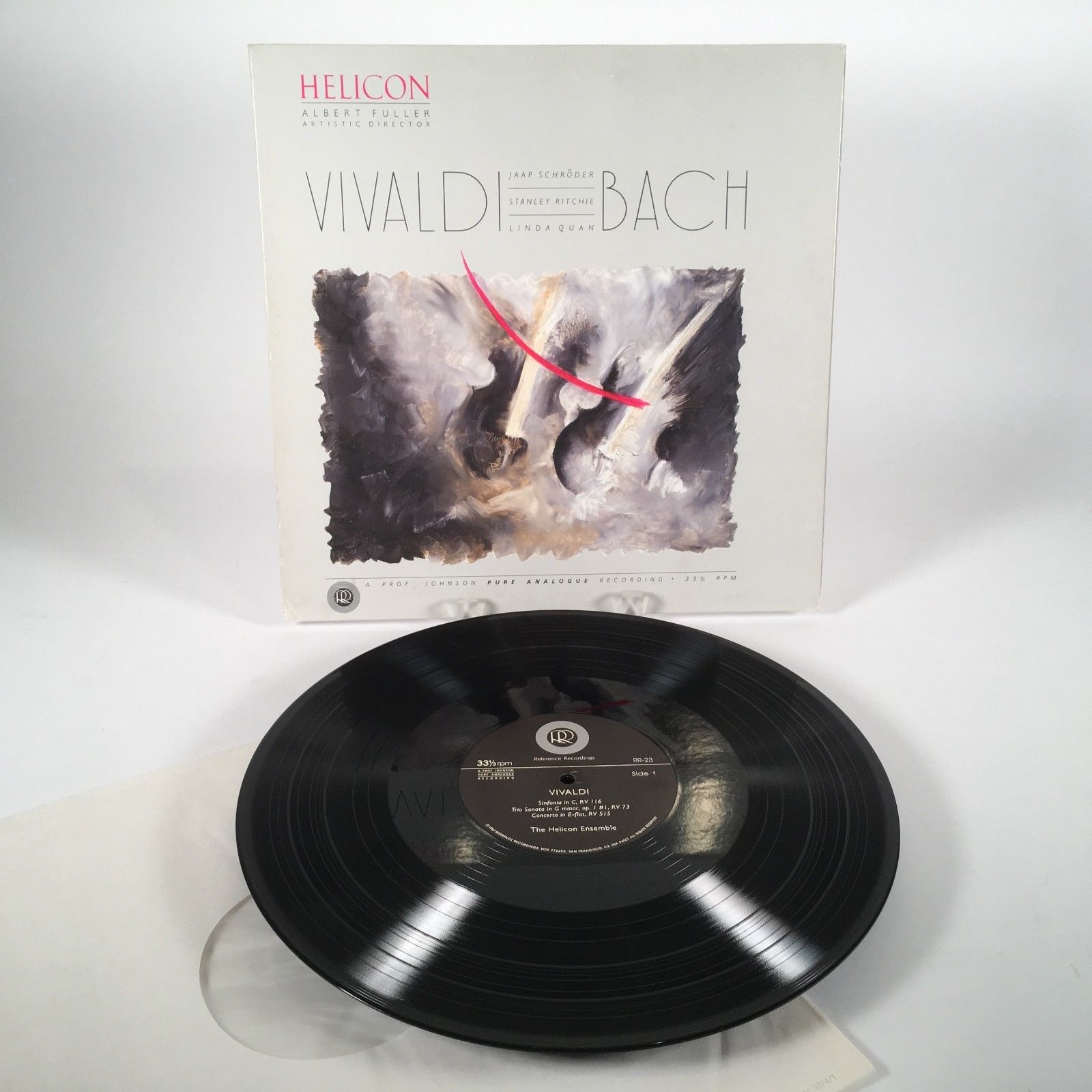
Reference Recordings (Half Speed) RR-23 VIVALDI BACH Helicon Ensemble NM (AP)
$
20


Favourite Auctions
To save auctions to your favourites, please login
If you don't have an account, please register
Description
Audiophile. Excellent quality Reference Recordings issue in gorgeous condition.
Vivaldi: Sinfonia, Trio Sonata, Concerto
Bach: Trio Sonata, Concerto
Jacobus Stainer, violin. Helicon Ensemble.
Genre/Sub Genre: Classical / sinfonia, sonata, concerto
Label: Reference Recording RR-23
Format: 1 x LP Stereo
Country: US Pressing
Year Released: 1986
Notes:
- Outstanding Reference Recording sonics
- Pure analogue recording
- Half-Speed Mastered
- 1st edition
- Out of print
- Cleaned by me using my 5-step manual cleaning method
- I visually graded and play graded this record
Visual and Play Grade:
SIDE 1 NM- Very clean, shiny and deep inky black. Little evidence of being played or handled. Three very light and hard to see sleeve hairlines. No spindle marks around the center label hole indicating very light play and careful handling. Plays very quiet.
SIDE 2 NM Very clean, shiny and deep inky black. Little evidence of being played or handled. No marks I can see. No spindle marks around the center label hole indicating very light play and careful handling. Plays very quiet.
Jacket Grade: NM- Gatefold jacket. No shelf wear. No splits. Bump in lower left corner. Smaller bump in upper right corner.
Sleeve Grade: NM- Original waxy paper and poly inner.
Shipping: Album will be placed inside new 3 ml. poly outer sleeve. Record and inner sleeve are placed between jacket and outer sleeve to prevent jacket splits during shipping. Shipped in pro-quality #200 LP mailer w/padding.
PLEASE READ THIS
For your protection as well as mine, all domestic record and audio sales over $100 will have to be sent with full auction value insurance.
All international record sales over $100 will have to be sent with insurance and shipped via registered mail.
Please ask or wait for a final invoice before paying for the auction. If you pay the stated Ebay postage (which does not include the insurance and registered mail fee) I will send an invoice for the addional cost and hold the shipment until it is paid.
~~~~~~~~~~ END OF LISTING ~~~~~~~~~~~~
Grading Terms I Use and What They Mean:
"SWINGERS" This is an off-center record, i.e., the center hole was not punched concentric with the record. All records are somewhat slightly off center if you measure them very accurately. A certain amount of this is expected and acceptable. Severely off center records can cause harm to the playback of the recording as the needle swings inward and outward to try and track the groove. It is really surprising how bad some records can be off center. Off center records cannot be detected visually, they must be played to uncover this defect.
Record and Jacket Grading Standards
I have been very unhappy with the variation in grading I see between record sellers. While all grading seems to reference the Goldmine grading standards, there are subtle variations in a condition that can make a big difference in the sonic enjoyment of a record, especially at the higher quality end of the grading spectrum. As such, I have created my own grading standards for records and jackets that points out these finer differences.
(SS) Still Sealed: "Still Sealed" is a grade I am reserving for factory-sealed records that have never been opened. This grade assumes the disc inside is undamaged and in "Mint" condition but this cannot be verified until the disc is opened and examined. The jacket will have its original shrink wrap.
(M) Mint: "Mint " is a grade I am reserving for a perfect record. There are no scratches, scuffs, hairlines, fingerprints, spindle marks or other indications that it has been handled or played. The jacket will have its original shrink which is opened. The are no corner bumps, scratches, marks, creases or other signs of jacket wear.
(M-) Mint Minus: A "Mint Minus" record may have one very light paper scuff but no hairlines or other surface scratches. It looks clean and unplayed. I may also use a "Mint Minus" to grade a sealed record that has corner bumps or tears in the shrink wrap.
(NM) Near Mint: "Near Mint" is a record that is virtually flawless, clean and glossy. A near perfect, rarely-played record. May play with some very light and occasional dust or static related light noise that is only heard in the quietest passages. The vinyl and label surfaces show no obvious sign of wear. It looks clean with the factory shine and there may be a very light, barely visible paper scuff or two and a few light hairlines but no scratches. An LP jacket has no seam splits or any other obvious signs of wear but one or two light creases are acceptable. Ring wear should be almost invisible. No punch holes or other discount marks. Very minimal corner bumps. Artist signatures are the only acceptable forms of handwriting for this grade. Basically, "Near Mint" looks as if you just got it home from a new record store and removed the shrink wrap.
(NM-) Near Mint Minus: Same as above, yet shows a few very light hairlines which have no effect on the sonic quality. The record will have its factory gloss and ?rainbow luster? and only light spindle marks. Ring wear is minimal but starting to show lightly at the top and bottom. The jacket may have discount cuts or sales stickers, which will be noted. Artist signatures and minimal owner marks are the only acceptable forms of handwriting for this grade.
(VG++) Very Good Plus Plus: Shows some signs that it was played and otherwise handled by a previous owner who took good care of it. Record surfaces may show signs of use and may have slight paper scuffs or very light surface scratches that only reveal themselves in the quietest of passages and don't detract from the overall sonic quality. Most factory shine is still present. Slight edge warps that do not affect the tracking or sound quality are OK and will be noted. An LP jacket may have some signs of ring wear and shelf wear and a small corner bump or two these are minimal and acceptable for this grade. A small seam split is also acceptable and will be noted. Light owner signatures, DJ marks and other forms of handwriting are acceptable for this grade. In general, if not for a couple of minor things wrong with it, this would be a showcase piece. All but the most discriminating collectors will find a ?Very Good Plus? record highly acceptable.
(VG+) Very Good Plus: Many of the defects found in a VG++ record are more pronounced in a VG+ disc but it is still a keeper. Surface noise is evident upon playing, but does not overwhelm the music. Groove wear will start to be audible and a random click, tic or soft pop may be evident but will not detract from the enjoyment of the recorded material. The jacket may have a seam split or ring wear and labels may be marred by writing, or have tape or stickers (or their residue) attached. A small light stain or some discoloring may be evident. The cover may exhibit a combination of these flaws but they will not overwhelm the piece.
(VG) Very Good: A VG disc will have more flaws but it is still a keeper. Surface noise is evident upon playing but does not overpower the music. Groove wear will be audible along with occasional pops and tics but there are no skips. The jacket may have a significant seam split and the spine may be seriously flaked. Labels and jackets may be marred by writing, or have tape or stickers (or their residue) attached. A small light stain or some discoloring may be evident. The cover may exhibit a combination of these flaws but they will not overwhelm the piece.
(G+) Good Plus, (G) Good: ?Good? means acceptable?not completely roached. The grade I usually reserve for listing the rarest of records. A record in ?Good? condition can be put onto a turntable and will play but it will it will have significant audible surface noise. A jacket or sleeve has larger seam splits and there may be significant water stains. Tape, writing, ring wear or other defects will start to overwhelm the object.
Special Note:
(+) Plus: An extra "plus? may be added occasionally to a grade to highlight the finer points of some better grades.
price rating


