Roland Kayn, simultan, Kybernetische Musik, Vinyl-Box, seltene Rarität von 1977
€
236
$
274


Favourite Auctions
To save auctions to your favourites, please login
If you don't have an account, please register
Description
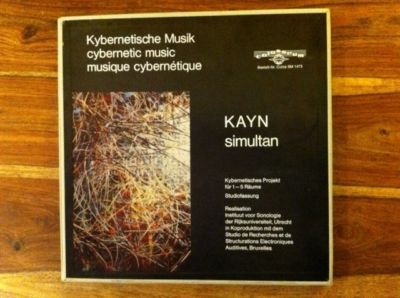
Verkaufe eine seltene Vinyl-Box mit 3 Schallplatten inklusive einem Booklet, dass handschriftlich signiert ist:
Kayn simultan
von Roland Kayn (1933-2011)
Kybernetische Musik - cybernetic music - musique cybernétique
Aufnahme von 1977
Realisation Institut voor Sonologie der Rijksuniversität, Utrecht
in Koproduktion mit dem Studio de Recherches et de Structurations Electroniques Auditives, Bruxxelles
Die Platten sind in einwandfreiem Zustand ohne Kratzer, die Box hat äußerlich normale Gebrauchsspuren
Inhaltsverzeichnis:
Kybernetisches Projekt Für 1 - 5 Räume, Studiofassung
LP1-A Monostabile 27:58 LP1-B Invarianten 20:40
LP2-A Sources Ergodiques Teil 1 20:18 LP2-B Matrix 22:45
LP3-A Sources Ergodiques Teil 2 15:12 LP3-B Logatome 29:07
Recorded By – Jaap Vink, Leo Küpper, Roland Kayn Technician – Jaap Vink, Leo Küpper, Roland Kayn Realized at Instituut voor Sonologie, Utrecht in collaboration with Studio de Recherches et de Structurations Electroniques Auditives, Bruxelles. 3LP Box including booklet with descriptive notes. Label: Colosseum Stereo Records, Bestell-Nr. Colos SM 1473
Vita des Komponisten Roland Kayn:
Roland Kayn was born in Germany in 1933 and started composing at an early age. He was just 20 years old when he won first prize at the festival of 20th century music in Karuizawa, Japan. Performances of his composition Aggregate (1959) resulted in him becoming persona non grata on the concert stage. Shortly after working in electronic studios in Poland, Germany and Italy, he joined the Gruppo Nuova Consonanza and this crucial detour into improvisation with Franco Evangelisti, Aldo Clementi and Ennio Morricone helped him find his definitive musical direction. Kayn decided to pursue his musical quest through composition with the intention, strange as it may seem, of excluding the composer as much as possible. He concentrated solely on electronic and electro-acoustic music from 1970 onwards. From an early age, Kayn was influenced by information theorists rather than other composers, and it was as a result of this that he started using the term "cybernetic" when describing his music. Basically, Kayn would design networks of electronic equipment and then develop a system of signals and commands that it could obey and execute. Words like "melody", "harmony" and "rhythm" do not apply to Kayn's music. Music, supposedly, should have every detail defined by the composer. Kayn insisted that his "cybernetic" music should regulate itself, thereby relinquishing the narrative elements and the psycho-emotional details usually associated with the ideas of "authorship" and "work of art". This meant that even he could not predict the eventual composition, which were sound processes without an epicentre, where every sound is equally important. For Kayn, "Music is sound, which is sufficient in itself". Roland Kayn feels that present day composers should avail themselves of the electronic techniques at their disposal and that electronic music is more than just the result of rapidly expanding technology. Frans van Rossum
price rating