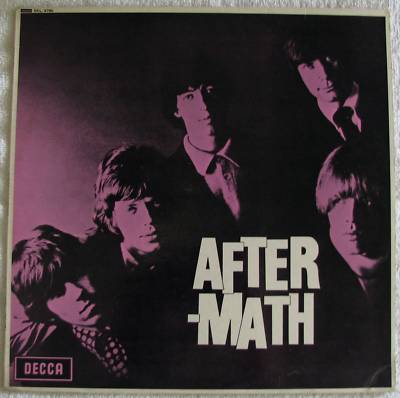
Rolling Stones AFTER-MATH UK STEREO SWEET NM-
$
37


Favourite Auctions
To save auctions to your favourites, please login
If you don't have an account, please register
Description
VINYL IS RATED VISUALLY
UNDER DIRECT SUNLIGHT & BRIGHT INCANDESCENT LIGHT
SORRY - NO RETURNS
all sales final --- All Sales Final --- ALL SALES FINAL
__________
PAYMENT MUST BE RECEIVED WITHIN: 7 DAYS AFTER AUCTION CLOSE!!
SEE GOLDMINE RECORD GRADING INFORMATION at VERY BOTTOM
UP FOR AUCTION IS:
On The
DECCA
Blue Stereophonic Label
A
BRITISH
IMPORT
PRESSING
OF
"THE ROLLING STONES*"
"AFTER-MATH"
___________________________
With a
BEAUTIFUL "LAMINATED" COVER
DECCA RECORDS - SKL 4786
--- MATRIX NUMBERS ---
SIDE ONE: XZAL - 7209 - 5W (STAMPED @ 6:00 o'clock with CU at the 3:00 o'clock position)
SIDE TWO: XZAL -7210 - 4W (STAMPED @ 6:00 o'clock with CK at the 3:00 o'clock position)
IN
WONDERFUL
STEREOPHONIC
SOUND
on
FANTASTIC
UK
IMPORT
VINYL
______________________________________
Vinyl: NM-
ABSOLUTELY STUNNING GLOSS AND SHEEN
PLEASE SEE PHOTOGRAPHS
____
Labels: NM-
ABSOLUTELY STUNNING LABELS
MINIMAL SPINDLE MARKINGS
PLEASE SEE PHOTOGRAPHS
____
Inner Sleeve: NM-
ABSOLUTELY GREAT CONDITION
MINIMAL MARKINGS
SLIGHT WRINKLING - NO RIPS - TEARS - SEPARATION
PLEASE SEE PHOTOGRAPHS
_____
Cover: NM-
BEAUTIFUL VIBRANT COLOURS
BEND on BOTTOM RIGHT of FRONT COVER
ONLY the SLIGHTEST RING WEAR
NO SPINE or SEAM SEPARATION
________________________
Here is a chance to own a copy of one of the BIGGEST hit albums of the 1960s, maybe ever!
_______________________________________________________
SOME HISTORY BEHIND THE MUSIC:
Aftermath
Aftermath Studio album by The Rolling Stones Released 15 April 1966 (UK)20 June 1966 (US) Recorded 3–8 December 1965 and 6–9 March 1966 Genre Rock, Folk Rock, Psychedelic Rock Length 53:20 (UK)
42:31 (US) Label Decca (UK)
London (US) Producer Andrew Loog Oldham Professional reviews
- Allmusic (UK)[1]
- Allmusic (US)[2]
- Blender [3]
(1965 UK)
Big Hits (High Tide and Green Grass)
(1966 US)
(1966) Between the Buttons
(1967 UK/US)
Got Live if You Want It!
(1966 US)
Alternate cover American cover
Aftermath, first released on 15 April 1966, by Decca Records is the fourth British studio album by The Rolling Stones. It was released in the United States on 20 June 1966 by London Records as their sixth American album. The album proved to be a major artistic breakthrough for The Rolling Stones, being the first full-length release by the band to consist exclusively of Mick Jagger/Keith Richards compositions. Aftermath was also the first Rolling Stones album to be recorded entirely in the United States, at the legendary RCA Studios in Hollywood, California at 6363 Sunset Boulevard, and the first album the band released in stereo.
The album is also notable for its musical experimentation, with Brian Jones playing a variety of instruments not usually associated with rock music—including sitar on "Paint It, Black", the Appalachian dulcimer on "Lady Jane" and "I Am Waiting", the marimbas (African xylophone) on "Under My Thumb" and "Out of Time," harmonica on "High and Dry" and "Goin' Home", as well as guitar and keyboards. Much of the music was still rooted in Chicago electric blues.
In 2002, the US edition of Aftermath was ranked number 108 on the List of Rolling Stone's 500 Greatest Albums of All Time.[4]
In August 2002 both editions of Aftermath were reissued in a new remastered CD and SACD digipak by ABKCO Records.
Release history
As with all the Stones pre-1967 LPs, different editions were released in the UK and the USA. This was a common feature of British pop albums at that time—the same practice was applied to all The Beatles albums prior to Sgt. Pepper's Lonely Heart's Club Band—because UK albums typically did not include tracks that had already been released as singles, and because British pop albums generally included 13 or 14 tracks, while American albums usually featured 11 or 12 tracks.
The original British version of Aftermath was issued in April 1966 as a fourteen-track LP. Issued between the non-LP single releases of "19th Nervous Breakdown" and "Paint It, Black", Aftermath was a major hit in the UK, spending eight weeks at #1 on the UK album chart.
The American version featured different cover art and an alternate, shorter running order that eliminated "Out of Time", "Take It or Leave It", "What to Do", and "Mother's Little Helper". All four tracks were later issued in the US on other compilations, and "Mother's Little Helper" was also issued as a single, in 1966, peaking at #8 on the Billboard charts.[5] In their place, the album substituted their current # 1 hit "Paint It, Black". The revamped Aftermath still reached #2 in the US, eventually going platinum.[6]
British track listing
All songs by Mick Jagger and Keith Richards.
Side one- "Mother's Little Helper" – 2:45
- "Stupid Girl" – 2:56
- "Lady Jane" – 3:08
- "Under My Thumb" – 3:41
- "Doncha Bother Me" – 2:41
- "Goin' Home" – 11:13
- "Flight 505" – 3:27
- "High and Dry" – 3:08
- "Out of Time" – 5:37
- "It's Not Easy" – 2:56
- "I Am Waiting" – 3:11
- "Take It or Leave It" – 2:47
- "Think" – 3:09
- "What to Do" – 2:32
American track listing
All songs by Mick Jagger and Keith Richards.
Side one- "Paint It, Black " – 3:45
- "Stupid Girl" – 2:56
- "Lady Jane" – 3:08
- "Under My Thumb" – 3:41
- "Doncha Bother Me" – 2:41
- "Think" – 3:09
- "Flight 505" – 3:27
- "High and Dry" – 3:08
- "It's Not Easy" – 2:56
- "I Am Waiting" – 3:11
- "Goin' Home" – 11:14
Personnel
The Rolling Stones- Mick Jagger – lead vocals, backing vocals, percussion, lighting, and harmonica
- Brian Jones – guitars (including slide guitar on "Doncha Bother Me"), marimba on "Under My Thumb" and "Out of Time", bells, Appalachian dulcimer on "Lady Jane" and "I Am Waiting", sitar on "Paint It, Black", harpsichord, harmonica on "High and Dry" and "Goin' Home", keyboards, backing vocals on "Out of Time"
- Keith Richards – guitar and backing vocals
- Charlie Watts – drums, percussion, marimba, and bells
- Bill Wyman – bass guitar, marimba, bells, piano, organ, and harpsichord
- Jack Nitzsche – percussion, piano, organ, and harpsichord
- Ian Stewart – piano and organ
______________________________
The GOLDMINE STANDARD
for
RECORD GRADING
THE TRUTH BEHIND THE GRADES
Most of the time, LPs are sold with two grades — one for the record and one for the cover. We list only one grade, however, because with some exceptions, albums without covers are worthless, and covers without the accompanying record are worthless. If an album is graded VG for the cover and VG+ for the record, add the two values together and divide by 2 to get a rough estimate of the value of a “mixed-grade” LP.
Most records are graded visually. This is because most record dealers have lot of records — hundreds of thousands in some cases — and they don’t have the time to play their entire stock. That said, some defects are easy to see, such as scratches and warps. Others are subtle, such as groove wear from using a cheap or poorly aligned tone arm. It has been our experience that older LPs (1950s to about 1971) tend to play better than they look, and newer LPs (at least until 1989) tend to play worse than they look.
When grading your records, do so under a strong light. Look at everything carefully, and then assign a grade based on your overall observations.
______________________________________________________
Here are the standard grades for record albums, from best to worst.
SEALED ALBUMS
Still-sealed albums can — and do — bring even higher prices than those in our listings. However, you must be careful when paying a premium for sealed LPs of any kind for several reasons:
1. They may have been re-sealed.
2. The records may not be in Near Mint condition.
3. The record inside may not be the original or most-desirable pressing.
4. Most bizarre of all, the wrong record my be inside. (I’ve had this happen to me; I opened a sealed album by on MCA artist only to find a record by a different MCA artist inside! Fortunately, I didn’t pay a lot of or that sealed LP. I would have been quite upset if I had!)
MINT (M)
These are absolutely perfect in every way. Often rumored but rarely seen, Mint should never be used as a grade unless more than one person agrees that the record or sleeve truly is in this condition.
There is no set percentage of the Near Mint value these can bring; it is best negotiated between buyer and seller.
NEAR MINT (NM OR M-)
A good description of a NM record is “it looks like it just came from a retail store and it was opened for the first time.” In other words, it’s nearly perfect.
Many dealers won’t use a grade higher than this, implying (perhaps correctly) that no record or sleeve is ever truly perfect.
Near mint records are shiny and free of visible defects. No writing, stickers, other markings or spindle marks appear on the label. No major factory defects are present; a record and label obviously pressed off center is not Near Mint.
If played, an NM record will do so without surface noise. Near Mint records don’t have to be “never played”; a record used on an excellent turntable can remain NM after many plays if the disc is properly cared for.
NM covers have no creases, ring wear or seam splits of any kind.
These are high standards, and they are not on a sliding scale. A record or sleeve from the 1950s must meet the same standards as one from the 1990s or 2000s to be Near Mint!
It is estimated that no more than 2 to 4 percent of all records remaining from the 1950s and 1960s are truly Near Mint. This is why they fetch such high prices, even for more common items. They must meet these standards to qualify.
VERY GOOD PLUS (VG+) OR EXCELLENT (E)
A good description of a VG+ Record is “except for a couple of minor things, this would be Near Mint.”
Most collectors, especially those who want to play their records, will be happy with a VG+ record, especially if it is toward the high end of the grade, (sometimes called VG++ or E+).
VG+ records may show some slight signs of wear, including light scuffs or very light scratches that do not affect the listening experience. Slight warps that don’t affect the sound are OK. Minor signs of handling are OK, too, such as telltale marks around the center hole, so long as repeated playing has not misshapen the hole. There may be some very light ring wear or discoloration, but it should be barely noticeable.
VG+ Covers should have only minor wear. A VG+ cover might have some very minor seam wear or a split (less than one inch long) at the bottom, the most vulnerable locataion. Also, a VG+ cover may have some defacing, such as a cut-out marking. Covers with cut-out markings can never be considered Near Mint.
VERY GOOD (VG)
Many of the imperfections found on a VG+ Record are more obvious on a VG record. That said, VG records — which usually sell for no more than 25 percent of a an NM record — are among the biggest bargains in record collecting, because moost of the “big money” goes for more perfect copies. For many listeners, a VG record or sleeve will be worth the money.
VG records have more obvious flaws than their counterparts in better shape. They lack most of the original gloss found on factory-fresh records. Groove wear is evident on sight, as are light scratches deep enough to feel with a fingernail.
When played, a VG record has surface noise, and some scratches may be audible, especially in soft passages and during a song’s intro and ending. But the noise won’t overpower the music otherwise. Minor writing, tape or a sticker can detract from the label. Many collectors who have jukeboxes will use VG records in them and not think twice. They remain a fine listening experience, just not the same as if it were in better shape.
VG covers will have many signs on human handling. Ring wear in the middle or along the edges of the cover, where the edge of a record would reside, is obvious; it may appear on all three sides, thought it won’t be obvious upon looking. Someone might have written on it or stamped a price tag on it, too.
GOOD (G), GOOD PLUS (G+) OR VERY GOOD MINUS (VG-)
Lower-grade records go for 10 to 15 percent of the Near Mint value, if you are lucky.
Good does not mean bad! The record still plays through without skipping, so it can serve as filler until something better comes along. But it has significant surface noicse and groove wear. The label is worn and exhibits significant ring wear, heavy writing or obvious damage caused by tring to remove tape or stickers and failing miserably.
A Good to VG- cover has ring wear to the point of distraction, has seam splits obvious on sight and may have even heavier writing, such as huge radio station letters written across the front to deter theft.
If the item is common, it’s probably better to pass it up. But if you’ve been seeking it for a long time, get it cheap and look to upgrade.
POOR (P) AND FAIR (F)
Poor and Fair records go for 0 to 5 percent of the Near Mint value, if they go at all.
More likely, they end up going in the trash. Records are cracked, impossibly warped or skip and/or repeat when an attempt is made to play them. Covers are so heavily damaged that you almost want to cry.
Only the most outrageously rare items ever sell for more than a few cents in this condition — again, if they sell at all
7" - standard 45 RPM co - cut-out pc - picture sleeve sl - slight UK- United Kingdom (British Pressing) 10" - 10-inch vinyl LP dj - Disc Jockey (promo) pi - picture Insert (CD Single) sm spl - Seam Split US - United States (domestic pressing) 12" - 12-inch single ep - Extended Play promo - promotional copy soc - sticker on cover va - various artists bb - bb hole in cover imp - import ps - picture sleeve (45) sol - slicker on label wlp - white label promo boot - bootleg lp - 12" vinyl album quad - quadraphonic ss - still sealed woc - writing on cover cc - cut corner m - mono Lp re - reissue s/t - self titled wol - writing on label cd - compact disc nap - not affecting play ri - reissue tc - title cover (12" and CD's) xol - "x" on label cd3 - 3" compact disc single non-lp- not on full-length LP or CD rpm - revolutions per minute ti - title insert (CD single) * check the context, as "m" can also mean "mint" cd5 - 5" compact disc single oc - original cast recording rw - ring wear toc - tape on cover coh - cut-out-hole ost - original soundtrack s - stereo Lp tol - tape on label
price rating